
Home » Sainik School Coaching » Sainik School Mainpuri
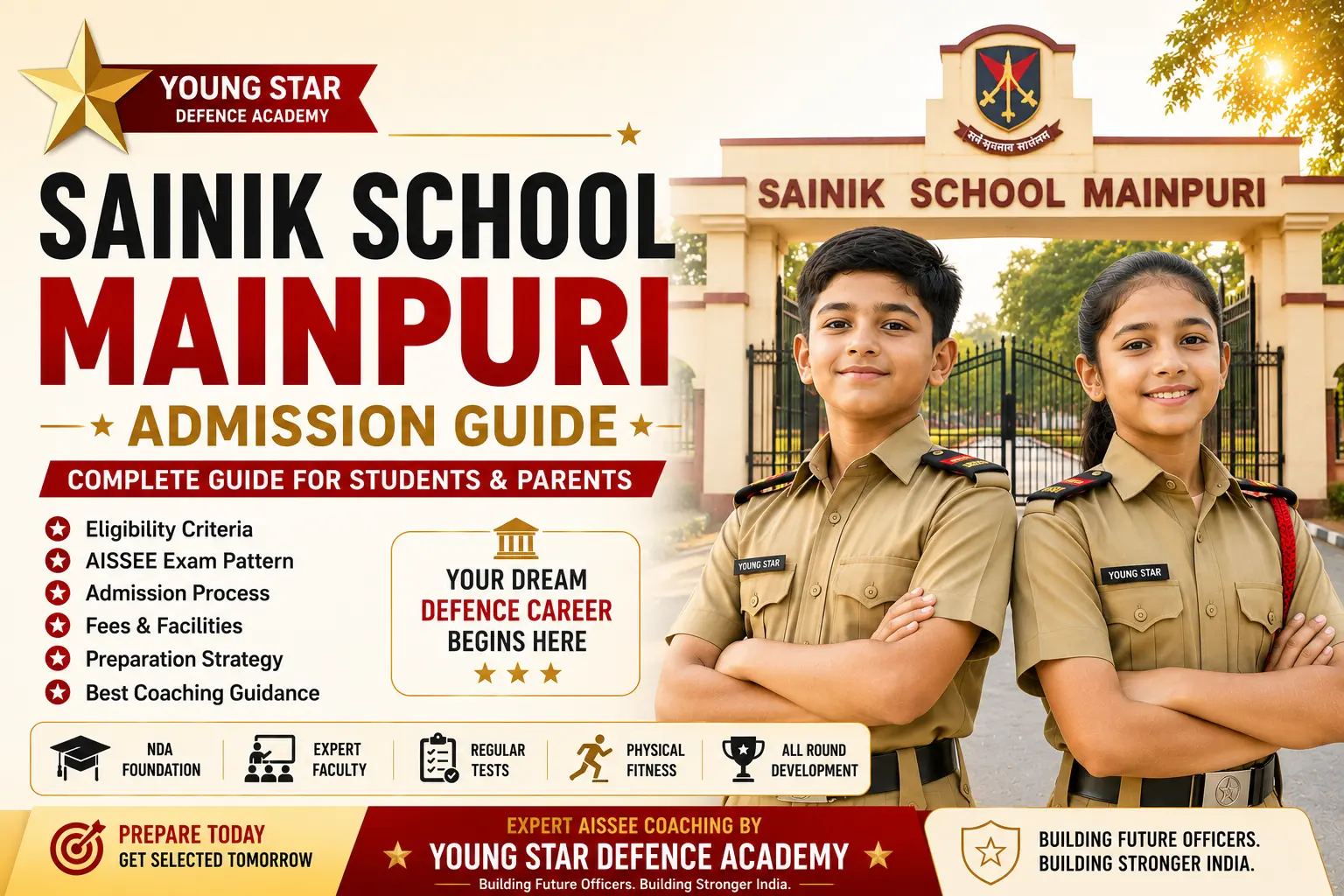
Sainik School Mainpuri Admission Guide for Students & Parents
Every year, thousands of families across Uttar Pradesh dream of securing a seat for their child in one of India’s most prestigious residential school networks — the Sainik Schools. For families in Mainpuri and the surrounding region, Sainik School represents far more than a quality education. It is a gateway to national service, a foundation for a military career, and a transformative residential experience that shapes character, discipline, and leadership from an early age.
Sainik Schools were established by the Government of India in 1961 with the primary aim of preparing students for entry into the National Defence Academy (NDA) and other prestigious military institutions. Today, there are 33 operational Sainik Schools across India, each offering a unique blend of academic rigour, physical training, and values-based education under the Sainik Schools Society, Ministry of Defence.
Admission to any Sainik School — including Sainik School Mainpuri — is granted through the All India Sainik Schools Entrance Examination (AISSEE), a national-level competitive examination conducted by the National Testing Agency (NTA). The exam is held once a year and is open to students seeking admission to Class 6 and Class 9. Since 2021, girls are also eligible — read our dedicated guide on Sainik School admission for girls for more details.
Because AISSEE is a competitive exam with limited seats and a large applicant pool, a child’s chances of selection depend significantly on how well and how early they prepare. This guide has been created to give parents and students in Mainpuri a complete understanding of the admission process, eligibility requirements, AISSEE exam pattern, syllabus, preparation strategy, and the role professional coaching plays in achieving a successful outcome.
By the end of this guide, you will know exactly what it takes to secure a seat at a Sainik School, what mistakes to avoid, and how Young Star Defence Academy has helped more than 25,000 students across India realise their Sainik School dream.
Section 1: Understanding Sainik School Admissions
What Are Sainik Schools?
Sainik Schools are fully residential co-educational schools functioning under the Sainik Schools Society, which operates under the administrative control of the Ministry of Defence, Government of India. These schools follow the CBSE curriculum and offer classes from Class 6 to Class 12.
The founding objective of Sainik Schools was to bridge the educational gap and produce well-rounded, physically fit, academically capable young individuals who would go on to join the National Defence Academy and serve as officers in the Indian Armed Forces. Over the decades, Sainik Schools have expanded their mandate: today their alumni include not just military officers but also civil servants, doctors, engineers, entrepreneurs, and national leaders.
Core Pillars of Sainik School Education
- Academic Excellence: CBSE curriculum taught by qualified faculty with a focus on conceptual understanding, competitive exam readiness, and board exam performance.
- Physical Fitness: Daily physical training, sports, and NCC activities that build stamina, coordination, and a healthy lifestyle.
- Leadership Development: Structured programs that develop public speaking, decision-making, teamwork, and responsibility from a young age.
- Character Building: A residential environment governed by discipline, routine, and values that shape integrity, honesty, and national pride.
- Career Readiness: Strong foundation for NDA, CDS, and other national competitive examinations.
Key Benefits for Students
| Benefit | What It Means for Your Child |
|---|---|
| CBSE Education | Nationally recognised board with strong academic standards |
| Residential Campus | Structured daily routine and 24-hour supervised environment |
| Sports & Physical Training | State and national-level sports participation opportunities |
| NDA Pipeline | Direct, structured preparation pathway for NDA entrance |
| Scholarship & Fee Support | Government fee concessions for SC/ST and defence wards |
| National Peer Network | Friendships and connections with peers from across India |
| Alumni Strength | A powerful alumni network in defence, government, and industry |
Also considering other defence schools? We offer dedicated coaching for Rashtriya Military School (RMS) and Rashtriya Indian Military College (RIMC) as well.
Section 2: Why Students from Mainpuri Aspire to Join Sainik Schools
Mainpuri is a district with a deep-rooted culture of service and national pride. Families here have historically respected the armed forces, and the aspiration to send a child to a Sainik School has grown steadily over the past decade. Here is why Sainik School admission matters so deeply for Mainpuri students and families.
A Direct Path to the NDA
Sainik School education is specifically designed to prepare students for the National Defence Academy entrance examination. The school curriculum, physical training regime, and character development activities align directly with what the NDA expects from its cadets. Students who study in Sainik Schools have a measurably higher success rate at the NDA examination compared to their peers from regular schools.
Military Discipline from an Early Age
The residential structure of Sainik Schools instils habits of discipline, punctuality, and personal responsibility from the moment a student joins in Class 6. This early conditioning creates adults who are organised, focussed, and capable under pressure — qualities that benefit them across every career path.
Confidence and Personality Development
Sainik Schools place exceptional emphasis on extracurricular activities, public speaking, cultural events, and leadership roles. Students emerge not just with academic knowledge but with the confidence, communication skills, and personal presence that set them apart in any setting — whether it is an NDA interview or a corporate boardroom.
Career Advantages That Last a Lifetime
A Sainik School certificate is a mark of distinction. It communicates to universities, employers, and selection committees that the candidate has survived and thrived in a demanding, competitive environment. Sainik School alumni consistently report that the experience gave them an edge in every major life challenge they encountered after school.
Community and National-Level Opportunities
Students from Sainik Schools participate in national-level sports championships, Republic Day parades, NCC camps, and cultural exchanges. These experiences broaden a student’s horizon far beyond what any local school can offer, and they create memories and friendships that last a lifetime.
Section 3: Sainik School Admission Process — Step by Step
The admission process for Sainik School Mainpuri follows the national AISSEE framework managed by the National Testing Agency (NTA). Parents must follow each step carefully to avoid missing deadlines or making errors that could disqualify an otherwise eligible student.
| Step | Activity | Important Notes |
|---|---|---|
| 1 | Official Notification Release | NTA releases the AISSEE notification (Oct–Nov). Check nta.ac.in and aissee.nta.nic.in regularly. |
| 2 | Online Registration & Application | Register at the NTA AISSEE portal. Fill in personal details, select the preferred Sainik School, upload documents and photograph. |
| 3 | Application Fee Payment | Pay the prescribed fee online. Different fee slabs apply for general and SC/ST categories. |
| 4 | Admit Card Download | Admit cards are released approximately 2–3 weeks before the exam. Download and print from the NTA portal. |
| 5 | AISSEE Written Examination | Typically held in January. Students must report to the exam centre with the admit card and a valid photo ID. |
| 6 | Result Declaration | Results are published on the NTA AISSEE portal. Check the official website for result dates. |
| 7 | School-wise Merit List | Separate merit lists are prepared for each Sainik School and category. Shortlisted candidates are notified. |
| 8 | Medical Examination | Shortlisted students undergo a medical fitness examination conducted at the respective Sainik School. |
| 9 | Final Admission & Reporting | Medically fit students complete document verification, fee payment, and report to the school on the joining date. |
Important: Application windows are typically short — often 3 to 4 weeks. Parents of aspiring students should set reminders and monitor official portals from September onwards each year.
Section 4: Eligibility Criteria for Sainik School Mainpuri
A full breakdown of eligibility requirements for Sainik School admission is available on our dedicated guide. The core criteria for Class 6 and Class 9 are summarised below.
Class 6 Admission — Eligibility
| Criterion | Requirement |
|---|---|
| Age (as on 31 March of admission year) | Minimum 10 years, Maximum 12 years |
| Educational Qualification | Must be studying in or have passed Class 5 from a recognised school |
| Gender | Boys and Girls both eligible (since 2021) |
| Nationality | Indian citizen |
Class 9 Admission — Eligibility
| Criterion | Requirement |
|---|---|
| Age (as on 31 March of admission year) | Minimum 13 years, Maximum 15 years |
| Educational Qualification | Must be studying in or have passed Class 8 from a recognised school |
| Gender | Boys and Girls both eligible |
| Nationality | Indian citizen |
Class 6 vs Class 9 — Quick Comparison
| Factor | Class 6 Admission | Class 9 Admission |
|---|---|---|
| Age Eligibility | 10–12 years | 13–15 years |
| Academic Stage | Class 5 pass/appearing | Class 8 pass/appearing |
| Competition Level | Higher (more applicants) | Lower (fewer seats, fewer applicants) |
| Years at Sainik School | 7 years (Class 6–12) | 4 years (Class 9–12) |
| Preferred for NDA preparation | Yes — more time for preparation | Possible but requires fast tracking |
Parent Tip: Class 6 admission is strongly preferred for students aspiring to join the NDA, as it gives seven full years of Sainik School training and preparation.
Section 5: AISSEE Exam Pattern
Class 6 Exam Pattern
| Subject | Number of Questions | Marks | Duration |
|---|---|---|---|
| Mathematics | 50 | 50 | 2 Hours 30 Minutes |
| General Knowledge | 25 | 25 | |
| Language (English/Hindi) | 25 | 25 | |
| Intelligence Test | 25 | 25 | |
| Total | 125 | 125 |
Class 9 Exam Pattern
| Subject | Number of Questions | Marks | Duration |
|---|---|---|---|
| Mathematics | 50 | 50 | 3 Hours |
| General Science | 25 | 25 | |
| Social Studies | 25 | 25 | |
| Intelligence Test | 25 | 25 | |
| English | 25 | 25 | |
| Total | 150 | 150 |
Key Exam Features
- Question Type: Multiple Choice Questions (MCQ) — four options, one correct answer.
- Medium: Bilingual — English and Hindi.
- Negative Marking: None. Attempt all questions.
- Mode: Pen and paper (OMR sheet).
- Difficulty Level: Based on NCERT syllabus. Mathematics and Intelligence Test are the most differentiating sections.
Section 6: AISSEE Syllabus Breakdown — Subject-wise Preparation Guide
For the complete official AISSEE syllabus for Sainik Schools with chapter-wise details, refer to our dedicated syllabus guide. The subject-wise breakdown below focuses on high-priority topics and preparation strategy.
Mathematics
Mathematics carries the highest marks in AISSEE and is the most critical differentiating subject. A strong performance in Mathematics can compensate for weaker scores in other sections, while a poor performance in Mathematics makes it very difficult to rank highly on the merit list.
| Topic | Importance | Preparation Strategy |
|---|---|---|
| Number System | High | Master LCM, HCF, factors, divisibility rules |
| Fractions & Decimals | High | Daily practice with word problems |
| Basic Algebra | Medium | Understand variables and simple equations |
| Geometry (Shapes, Area, Perimeter) | High | Learn all formulas; practise diagram-based questions |
| Mensuration | High | Focus on 2D and 3D shape calculations |
| Ratio & Proportion | High | Apply to real-world problems; practise shortcut methods |
| Percentage | Medium | Connect with profit/loss and discount questions |
| Time, Speed & Distance | Medium | Use unit conversion and simple formula approach |
| Data Interpretation | Medium | Practise bar graphs, tables, and pie charts |
Common Mistake: Students attempt to memorise formulas without understanding the underlying concept. In AISSEE, questions are application-based, so conceptual clarity is essential.
General Knowledge
The GK section tests a student’s awareness of current events, Indian history, geography, science, and civics. While it cannot be prepared in a few weeks, consistent daily reading and structured notes can produce significant gains.
| Topic Area | Key Subtopics |
|---|---|
| Indian History | Freedom struggle, major battles, important dates, key personalities |
| Indian Geography | Rivers, mountains, states and capitals, national parks, climate zones |
| General Science | Human body, plants, basic physics, basic chemistry, environment |
| Civics & Constitution | Fundamental rights, organs of government, national symbols |
| Defence & Military GK | Indian Army, Navy, Air Force, ranks, operations, awards |
| Current Affairs | Last 6–12 months of national and international events |
| Sports GK | National and international sporting events, Indian sports achievements |
Preparation Strategy: Maintain a handwritten GK notebook organised by topic. Review one topic every day and revise the notebook weekly. Read a children’s newspaper or age-appropriate current affairs magazine regularly.
English / Language
The Language section for Class 6 tests reading comprehension, grammar, and vocabulary at the Class 5 level. For Class 9, English includes more advanced grammar and comprehension.
| Topic | Marks Weightage | Preparation Tip |
|---|---|---|
| Reading Comprehension | High | Practise reading 2–3 passages daily; answer questions without re-reading |
| Grammar (Tenses, Parts of Speech) | High | Revise NCERT grammar rules; attempt 10 MCQs daily |
| Vocabulary (Synonyms, Antonyms) | Medium | Learn 10 new words daily with usage in sentences |
| Sentence Correction | Medium | Focus on subject-verb agreement and tense consistency |
| Fill in the Blanks | Medium | Contextual understanding; avoid guessing |
Common Mistake: Neglecting the language paper assuming it is easy. Many students lose marks here due to poor vocabulary and weak grammar fundamentals. Treat it with the same seriousness as Mathematics.
Intelligence and Reasoning
The Intelligence Test section is designed to measure a student’s logical thinking, pattern recognition, and problem-solving speed rather than academic knowledge. This section can be a strong differentiator for well-prepared students.
| Question Type | Examples |
|---|---|
| Analogy | Doctor : Hospital :: Teacher : ? |
| Series Completion (Number & Letter) | 2, 4, 8, 16, ? |
| Odd One Out | Identify the item that does not belong |
| Coding-Decoding | If A = 2, B = 3, what is CAB? |
| Mirror Image & Spatial Reasoning | Identify the correct mirror image of a figure |
| Blood Relations | If X is the father of Y, and Y is the brother of Z… |
| Direction & Distance | Walk North 5km, turn East 3km — final direction from start? |
| Venn Diagrams | Which diagram represents the relationship between Dogs, Animals, and Chairs? |
Preparation Strategy: Practise at least 20 reasoning questions daily under timed conditions. Speed and accuracy both matter in this section. Do not attempt to memorise approaches — train your brain to think logically by solving diverse question types regularly.
Section 7: Common Challenges Students Face in AISSEE Preparation
Understanding the challenges that trip up unprepared students is just as important as knowing what to study. Here are the most common obstacles and practical ways to overcome them.
| Challenge | Why It Happens | Solution |
|---|---|---|
| Weak Mathematical Foundations | Gaps in Class 3–4 concepts such as fractions, multiples, and basic geometry | Diagnose gaps with a baseline test; rebuild from NCERT fundamentals before attempting exam-level questions |
| No Structured Study Plan | Students study whatever they feel like on a given day | Follow a month-wise plan that covers the full syllabus at least twice before the exam |
| Ignoring GK and Language | Students focus entirely on Mathematics and neglect other subjects | Allocate specific time each day for GK and language — even 30 minutes per subject per day adds up significantly over months |
| No Mock Test Practice | Students study but never simulate exam conditions | Take one full-length mock test every week from 3 months before the exam; analyse every error |
| Poor Time Management in Exam | Spending too long on difficult questions | Practise time-bound solving; skip and return to difficult questions; attempt Mathematics first for most students |
| Examination Anxiety | Lack of practice under exam-like conditions | Regular mock tests in an exam-like setting desensitise students to exam pressure; practise deep breathing and positive self-talk |
| Starting Too Late | Parents begin preparations only 2–3 months before the exam | Begin at least 12 months in advance; the advantage is compounding — students who start early outperform last-minute preparers significantly |
Section 8: Facilities Available at Sainik Schools
Sainik Schools offer infrastructure that most regular schools cannot match. Understanding what a student gains from the residential environment helps parents appreciate the full value of securing admission.
Hostel and Residential Life
All Sainik School students live in the school hostel. Dormitories are supervised by housemasters and matrons. The residential setup creates a structured daily routine from wake-up at 5:30 AM to lights-out at 9:30 PM, covering academics, sports, meals, self-study, and rest in a balanced schedule.
Sports and Physical Training
Sainik Schools invest heavily in sports infrastructure. Students typically have access to football grounds, basketball courts, volleyball courts, athletics tracks, swimming pools, and indoor sports facilities. Physical training is mandatory every day, and students regularly compete at state and national levels in various sports.
Academic Infrastructure
- Science Laboratories: Physics, Chemistry, and Biology labs with modern equipment for practical learning.
- Computer Labs: Updated hardware and software for digital literacy and computer science education.
- Library: Extensive collections of academic texts, reference books, periodicals, and competitive exam preparation material.
Leadership and Character Development
- NCC Training: All Sainik School students participate in National Cadet Corps activities, building teamwork, discipline, and basic military orientation.
- Cultural Programs: Annual functions, debates, elocution competitions, music, and drama develop well-rounded personalities.
- Adventure Activities: Trekking, rock climbing, camping, and swimming as part of the physical development program.
Section 9: Benefits of Professional AISSEE Coaching
The question many parents in Mainpuri ask is whether professional coaching is truly necessary or whether a bright child can prepare independently. The honest answer: AISSEE is competitive. Tens of thousands of students apply each year for a limited number of seats. The students who secure admission are almost always those who received structured, expert-guided preparation.
Here is what professional AISSEE coaching provides that self-study cannot replicate effectively:
Structured Syllabus Coverage
A good coaching institute designs a curriculum that covers the entire AISSEE syllabus systematically, ensuring no topic is missed and adequate time is given to high-weightage areas. Without a plan, most students naturally gravitate toward topics they already know and neglect their weak areas.
Expert Mentorship
Faculty with years of AISSEE experience understand exactly which types of questions appear in the exam, what the common error patterns are, and how to explain concepts in a way that a Class 5 or Class 8 student can genuinely understand and apply.
Regular Mock Tests and Performance Tracking
Mock tests under real exam conditions are the most reliable predictor of final performance. Professional coaching programmes schedule regular chapter-wise tests and full-length mock examinations, followed by detailed performance reports that identify each student’s strengths and weaknesses. You can access free AISSEE mock tests on our website to benchmark your child’s current preparation level.
Doubt Solving and Individual Attention
Concepts that a student struggles to understand from a textbook can be resolved quickly in a structured coaching session. Dedicated doubt-solving periods ensure no student falls behind due to unresolved confusion.
Study Material
Purpose-built AISSEE study material covers the exam pattern, question types, and difficulty level more precisely than standard school textbooks. Quality coaching institutes develop proprietary material based on years of examination analysis.
Confidence and Exam Readiness
Perhaps the most underrated benefit of coaching is what it does for a student’s confidence. Consistent preparation, regular positive reinforcement from expert teachers, and the experience of performing well in mock tests creates an exam-ready mindset that is difficult to build through solo study.
Section 10: Why Choose Young Star Defence Academy for AISSEE Coaching
Young Star Defence Academy has spent years building India’s most comprehensive coaching programme for defence school entrance examinations. With a track record of over 25,000 Sainik School selections, the academy’s results speak for themselves. Here is what makes Young Star Defence Academy the trusted choice for AISSEE preparation across India, including for students from Mainpuri and Uttar Pradesh.
| Feature | What It Means for Your Child |
|---|---|
| Experienced Faculty | Teachers who have coached hundreds of successful AISSEE candidates and understand the exam deeply |
| AISSEE Specialisation | Dedicated curriculum designed exclusively for Sainik School entrance preparation, not a generic school coaching programme |
| Online Classes | Live and recorded online sessions allow students from Mainpuri to access the same quality of teaching without relocating |
| Offline Classes | Residential and classroom programmes at the Amritsar campus for students who benefit from a structured in-person environment |
| Weekly Testing | Subject-wise and full-length tests conducted every week to track progress and simulate real exam conditions |
| Detailed Performance Reports | Parents receive regular reports showing subject-wise scores, improvement trends, and areas requiring attention |
| Hostel Facility | Safe, supervised residential facility for students enrolling in the offline programme |
| Individual Attention | Batch sizes controlled to ensure every student receives the guidance they need — no student gets lost in a crowd |
| Parent Communication | Regular parent updates and dedicated counselling for families who have questions about the admission process |
| Proven Track Record | 25,000+ Sainik School | 1,325+ RIMC | 5,000+ NDA | 42,000+ RMS selections |
Ready to Begin Your Child’s Sainik School Journey?
Call or WhatsApp Young Star Defence Academy today at +91 81013 13136 to speak with a counsellor about the right programme for your child. Students from Mainpuri can enrol in our online programme from the comfort of their home, with the same curriculum and faculty that has produced thousands of successful selections. Learn more about our lead faculty and his teaching approach, and explore our dedicated guide for Sainik School preparation for Class 5 students.
Explore Our Sainik School Coaching Programme →
Section 11: 12-Month AISSEE Preparation Roadmap
A well-structured monthly plan is the foundation of a successful AISSEE campaign. Below are three separate roadmaps based on the student’s current level of preparation.
Roadmap for Beginners (Starting from Scratch)
| Month | Mathematics | GK | Language | Intelligence |
|---|---|---|---|---|
| Month 1–2 | Number system, fractions, decimals — basics | Introduction: India geography, basic history | Parts of speech, basic grammar rules | Analogy, series — introduction |
| Month 3–4 | Algebra basics, ratio, percentage | Indian history, freedom struggle | Reading comprehension, vocabulary building | Odd one out, coding-decoding |
| Month 5–6 | Geometry, mensuration, area-perimeter | General science, environment | Sentence correction, fill in the blanks | Direction, blood relations |
| Month 7–8 | Time-speed-distance, data interpretation | Civics, sports GK, defence GK | Comprehension advanced, vocabulary revision | Venn diagrams, mirror images |
| Month 9–10 | Full syllabus revision; topic-wise tests | Current affairs (last 6 months); full revision | Full grammar revision; full mock sections | Speed building — timed practice |
| Month 11 | Chapter-wise mock tests; error analysis | GK flashcard revision | Daily reading and vocabulary quizzes | Full reasoning papers — 25 questions in 20 min |
| Month 12 | Full-length mock tests — 4 per week | Consolidation — top 100 facts revision | Final revision — past year papers | Consolidation and confidence building |
Roadmap for Intermediate Students (Some Prior Preparation)
| Month | Focus Area |
|---|---|
| Month 1–3 | Identify weak topics through diagnostic test; targeted revision of problem areas |
| Month 4–6 | Complete syllabus coverage; 2 mock tests per month |
| Month 7–9 | Full syllabus revision; weekly mock tests; speed and accuracy training |
| Month 10–11 | Mock test series — analyse, correct, revise; focus on GK and current affairs |
| Month 12 | Full-length mock tests every alternate day; confidence consolidation |
Roadmap for Advanced Students (Strong Foundation)
| Month | Focus Area |
|---|---|
| Month 1–4 | Complete full syllabus revision; attempt previous year papers; begin weekly mock tests |
| Month 5–8 | High-difficulty question practice; timed section tests; GK and current affairs deepening |
| Month 9–10 | Full-length mock test analysis; error log maintenance; targeted weak area work |
| Month 11–12 | Mock test series under strict exam conditions; final revision; mental preparation |
Section 12: Success Tips from AISSEE Experts at Young Star Defence Academy
1. Build a Daily Routine and Follow It Without Exception
Discipline in study mirrors the discipline of a Sainik School student. Wake up at a fixed time, allocate specific time blocks for each subject, take short breaks, and end study sessions with a brief revision of the day’s work. Consistency over months beats intense but irregular studying every time.
2. Make Mathematics Your Strongest Subject
Mathematics carries 50 marks — by far the largest single section. A score of 45 or above in Mathematics virtually guarantees a competitive total, provided other sections are handled reasonably well. Practise 20–30 Mathematics problems every day without exception.
3. Use Mock Tests Strategically
Do not treat mock tests as assessments to be passed or failed. Treat them as diagnostic tools. After every mock test, spend at least as much time reviewing your errors as you spent taking the test. An error you understand and correct becomes a mark you earn in the actual exam.
4. Build a GK Bank Systematically
GK cannot be crammed in the last two weeks. Maintain a topic-wise GK notebook from the start of preparation. Add 5–10 facts every day. Review older entries weekly. Before the exam, this notebook becomes your most powerful revision tool.
5. Do Not Neglect Current Affairs
The GK section consistently includes questions on events from the preceding 6–12 months. Follow a reliable current affairs source appropriate for the student’s age, and review it weekly rather than scrambling in the final month.
6. Time Management Inside the Exam
Divide your time before entering the exam hall. For Class 6: allocate approximately 60 minutes to Mathematics, 20 minutes to GK, 20 minutes to Language, and 20 minutes to Intelligence — leaving 10 minutes for review. Practise this time allocation in every mock test so it becomes automatic on exam day.
7. Stay Physically Active During Preparation
Physical activity improves concentration, reduces anxiety, and keeps energy levels consistent. A 30-minute outdoor activity or exercise session every day is not time wasted — it is an investment in the quality of the remaining study hours.
8. Involve Parents in the Process
Research consistently shows that students whose parents are actively involved in their preparation — monitoring progress, communicating with teachers, providing encouragement — perform significantly better than students who prepare in isolation. Parents should stay engaged, not just supportive from a distance.
Section 13: Frequently Asked Questions — Sainik School Mainpuri Admission
Q1. What is AISSEE?
AISSEE stands for All India Sainik Schools Entrance Examination. It is a national-level entrance exam conducted by the National Testing Agency (NTA) on behalf of the Sainik Schools Society for admission to Class 6 and Class 9 in all Sainik Schools across India, including Sainik School Mainpuri.
Q2. How can I get admission to Sainik School Mainpuri through AISSEE?
To seek admission to Sainik School Mainpuri, you must register online on the NTA AISSEE portal during the application window (typically October–November), appear for the written examination (held in January), qualify on the merit list, pass the medical examination, and complete the admission formalities. Selecting Sainik School Mainpuri as a preference in your application is essential.
Q3. What is the age limit for Class 6 and Class 9 admission?
For Class 6, students must be between 10 and 12 years as on 31 March of the admission year. For Class 9, students must be between 13 and 15 years on the same date.
Q4. Is coaching necessary to clear AISSEE?
While self-study is possible, professional coaching significantly increases selection chances. AISSEE is competitive nationally, and structured coaching provides planned syllabus coverage, regular mock tests, expert guidance, and the exam-ready mindset that is very difficult to develop through solo preparation.
Q5. What are the fees at Sainik School Mainpuri?
Annual fees approximately range from Rs. 60,000 to Rs. 1,20,000 depending on the student’s category. Fee concessions are available for SC/ST students, defence wards, and economically weaker sections. Refer to our detailed Sainik School fee structure guide for a category-wise breakdown. Always verify against the official Sainik Schools Society notification for the current year.
Q6. Can girls apply for Sainik School Mainpuri admission?
Yes. Since 2021, girls are eligible to apply for admission to all Sainik Schools, including Sainik School Mainpuri, through AISSEE for both Class 6 and Class 9.
Q7. What documents are required for Sainik School Mainpuri admission?
Typically required documents include: birth certificate, school leaving or transfer certificate, previous class mark sheet, caste/category certificate (if applicable), domicile certificate, passport-size photographs, and a medical fitness certificate. See our complete documents required for Sainik School admission checklist for the full list with submission guidance.
Q8. How difficult is the AISSEE exam?
AISSEE is based on the NCERT syllabus up to the student’s current class level. The difficulty is moderate, but competition is intense due to the large number of applicants and limited seats. Mathematics and the Intelligence section are the most differentiating. Students with strong fundamentals and consistent preparation can score well.
Q9. Is hostel compulsory at Sainik School Mainpuri?
Yes. All Sainik Schools are fully residential. Day scholar admission is not available. All students must reside in the school hostel. The residential environment is central to the Sainik School experience and is not optional.
Q10. What medical standards must be met for Sainik School admission?
Selected students must pass a medical examination conducted by the school. Requirements include normal height and weight for age, vision correctable to 6/6, no colour blindness, no speech impairment, no flat feet, and overall physical fitness. Read our detailed guide on medical standards for Sainik Schools for a complete standard-wise breakdown.
Q11. Which coaching is best for AISSEE preparation in Mainpuri?
Young Star Defence Academy is among India’s most trusted AISSEE coaching institutes, with over 25,000 Sainik School selections. Students from Mainpuri can join the online programme for live classes, mock tests, study material, and expert guidance without leaving home. Call +91 81013 13136 to enquire.
Q12. How early should a student start preparing for AISSEE?
Ideally, students should begin preparing 12 months before the examination. Class 6 aspirants should start in Class 4 or 5; Class 9 aspirants in Class 7 or 8. Starting early allows thorough syllabus coverage, multiple revision cycles, and sustained mock test practice.
Q13. Is there negative marking in AISSEE?
No. There is no negative marking in AISSEE. Students should attempt every question. Leaving questions blank is a strategic error — always guess from the remaining options if time runs short.
Q14. How is the AISSEE merit list prepared?
Merit lists are prepared separately for each Sainik School and for each category (general, SC, ST, defence wards). Candidates are ranked by written exam marks within each category and school. Shortlisted candidates are then called for medical examination.
Q15. What is the exam date for AISSEE?
AISSEE is typically held in January each year. The official notification is released around October–November. Parents should monitor the NTA website (nta.ac.in) for the current year’s schedule.
Q16. How many seats are available at Sainik School Mainpuri?
Seat availability varies each year and is published in the official AISSEE notification. Seats are divided across categories including general, SC, ST, and defence wards. Our guide on seats and vacancies in Sainik Schools provides a school-wise and category-wise overview to help you plan your application strategy.
Q17. What are the career benefits of a Sainik School education?
Sainik School graduates are exceptionally well-positioned for the NDA, CDS, and other defence examinations. The combination of academic rigour, physical fitness, leadership training, and residential discipline produces individuals who excel in the military, civil services, and professional careers across sectors.
Q18. Does Young Star Defence Academy offer online coaching for Mainpuri students?
Yes. Young Star Defence Academy offers both online and offline coaching. Students from Mainpuri can enrol in the online programme featuring live classes, recorded sessions, weekly tests, study material, and performance reports — the same quality as the offline classroom experience.
Q19. What is the selection process after clearing AISSEE?
After the written exam, NTA declares results and school-wise merit lists are published. Shortlisted students undergo a medical examination at the respective Sainik School. Students who pass the medical round proceed to final admission, which involves document verification and fee payment within a specified deadline.
Q20. Is Sainik School Mainpuri a good choice for NDA preparation?
Absolutely. Sainik Schools are specifically designed as feeders for the NDA. The entire academic and physical training programme over seven years (Class 6 to Class 12) is oriented toward producing NDA-ready candidates. Students who join Sainik School Mainpuri in Class 6 graduate with a significant competitive advantage over peers from regular schools when it comes to the NDA entrance examination.
Conclusion: Begin Your Child’s Sainik School Journey Today
Sainik School education is one of the finest investments a parent can make in a child’s future. The combination of academic excellence, physical training, residential discipline, leadership development, and a powerful alumni network creates individuals who are ready to lead — whether in the military, civil services, or any other field they choose.
For students in Mainpuri, the path to Sainik School begins with a single competitive examination: AISSEE. The exam is fair, transparent, and based entirely on merit. Every child who is willing to prepare seriously and systematically has a genuine chance of securing admission.
The difference between students who get selected and those who do not is almost always preparation quality and preparation timeline. Students who begin early, follow a structured plan, take regular mock tests, and receive guidance from experienced mentors consistently outperform those who rely on last-minute effort.
Young Star Defence Academy exists to give every aspiring student that structured, expert-guided preparation. With over 25,000 Sainik School selections, 1,325+ RIMC selections, and 42,000+ RMS selections, the academy’s track record reflects years of dedicated, specialised coaching that places students from across India — including Uttar Pradesh — into the country’s finest defence schools.
Whether your child is just beginning to consider Sainik School or is already partway through their preparation, our team of experienced faculty is ready to guide them every step of the way — from the first day of study to the day they walk through the gates of their Sainik School.
Take the next step today. Call or WhatsApp us at +91 81013 13136 and let our counsellors help you create the right preparation plan for your child’s Sainik School admission.
Sainik School Coaching |
Sainik School for Girls |
RMS Coaching |
RIMC Coaching |
AISSEE Syllabus |
Eligibility for Sainik School Admission |
Sainik School Fee Structure |
Medical Standards for Sainik Schools |
Seats & Vacancies in Sainik Schools |
Documents Required for Sainik School |
Sainik School Preparation for Class 5 |
AISSEE Mock Tests |
About Our Lead Faculty