
Join the best NDA Coaching in Amritsar at Young Star Defence Academy. Expert faculty, Written Exam, SSB Interview, Physical Training, Hostel, Mock Tests & complete NDA preparation.
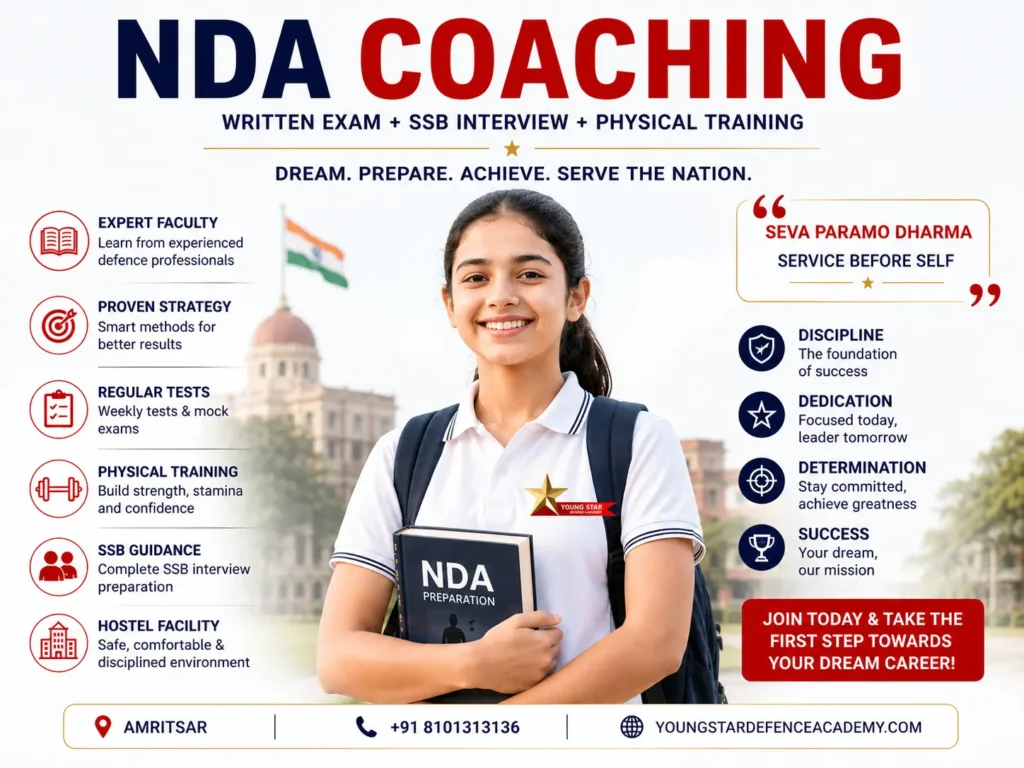
NDA Entrance Exam Preparation (For Class 11th & 12th / After 10th)
Download your Free NDA Syllabus start your NDA preparation the right way!
Regular Test + Weekly Mock Tests & Group Discussion + SSB Interview Training
Full NDA Study Material, Intensive Practice Sessions & Previous Year Papers
School Program + Hostel For NDA Coaching Aspirants
If you have ever dreamed of wearing an olive-green, navy-white, or sky-blue uniform and serving your country with honour, you have most likely heard the letters NDA. But what exactly is NDA, and why is it considered the crown jewel of India's defence education system?
The NDA full form is National Defence Academy — India's premier tri-service military academy where cadets from the Army, Navy, and Air Force train together before joining their respective service academies.
The National Defence Academy is a joint defence services training institution at Khadakwasla, near Pune, Maharashtra. Affiliated with Jawaharlal Nehru University (JNU), it awards a Bachelor's degree on completion of the 3-year program. NDA is unique — it trains future officers of all three military services under one roof.
Entry is through the NDA Entrance Exam, conducted twice a year by UPSC, testing Mathematics and General Ability. Clearing the written exam leads to an SSB Interview, a thorough medical examination, and a final merit list.
NDA alumni include generals, admirals, air marshals, and India's first Chief of Defence Staff.
Join after Class 12 — begin an officer career in your teens, years ahead of regular graduates.
Academics, adventure sports, flying, sailing, equestrian training — all under one program.
A permanent commission guarantees lifelong career security, excellent pay, and social prestige.
For many young Indians, serving the Tricolour is a calling — and NDA is the gateway to it.
Graduate with a JNU-recognised B.Sc. / B.A. while being commissioned as an officer.
| Parameter | Details |
|---|---|
| Full Name | National Defence Academy |
| Established | 7 December 1954 |
| Location | Khadakwasla, Pune, Maharashtra, India |
| Campus Size | Approx. 7,015 acres (28.38 sq km) |
| Motto | Seva Paramo Dharma (सेवा परमो धर्म) — Service is the Supreme Duty |
| Official Website | nda.nic.in | upsc.gov.in | joinindianarmy.nic.in |
| Training Duration | 3 Years — 6 Terms of 6 months each |
| Services | Indian Army · Indian Navy · Indian Air Force |
| Conducting Body | Union Public Service Commission (UPSC) |
| University Affiliation | Jawaharlal Nehru University (JNU), New Delhi |
| Degree Awarded | Bachelor of Science / Bachelor of Arts (B.Sc / B.A.) |
| Exams Per Year | 2 — NDA I (April) · NDA II (September) |
| Language | English and Hindi |
| Notable Alumni | Field Marshal Sam Manekshaw, Gen. Bipin Rawat, and thousands more |
| NDA for Girls | Yes — Women eligible since September 2021 (Supreme Court order) |
Derived from Sanskrit, the phrase captures the core philosophy every NDA cadet internalises — personal comfort, ambition, and gain must always come second to the welfare of the nation and the people one serves.
The motto echoes values from the Bhagavad Gita and India's warrior tradition. At NDA, it is woven into daily life — every 5:30 AM wake-up, every gruelling PT session, every sacrifice made reinforces the message: you serve before you rest.
These are not classroom lessons. They emerge from a daily routine that demands sacrifice — early mornings, physical hardship, academic pressure — all oriented around service. By graduation, the motto is not just memorised; it is lived.
Choosing the right NDA coaching institute is as important as choosing to prepare at all. The right environment, teachers, and system can be the difference between a selection letter and another year of waiting.
The NDA selection process is rigorous and multi-stage. Understanding each stage helps you prepare systematically and avoid surprises.
| Parameter | Requirement |
|---|---|
| Nationality | Indian citizen; also open to citizens of Bhutan/Nepal and Tibetan refugees settled in India |
| NDA Age Limit | 16.5 to 19.5 years as on the first day of the month in which the course commences |
| Qualification (Army) | Class 12 passed or appearing from any recognised board |
| Qualification (Navy & Air Force) | Class 12 with Physics and Mathematics as compulsory subjects |
| Marital Status | Unmarried — must remain unmarried until completion of training |
| Gender | Male and Female — women permitted since 2021 per Supreme Court order |
| Reservation | As per Government of India norms (SC, ST, OBC, EWS) |
| Number of Attempts | No official limit — attempt as long as you are within the age bracket |
Yes. Following a landmark Supreme Court judgment in August 2021, women are now eligible to apply for the NDA exam and join the National Defence Academy. Female candidates must meet the same academic, medical, and physical standards as male candidates. Young Star Defence Academy actively supports female NDA aspirants through dedicated coaching programs.
Physical and medical fitness is as important as academics for NDA selection. Many students who clear the written exam get rejected at the medical stage due to easily preventable conditions.
| Service | Minimum Height | Weight Range |
|---|---|---|
| Army | 157 cm (approx. 5'2") | 42.5–64 kg (varies by height) |
| Navy | 157 cm | As per standard military table |
| Air Force | 162.5 cm (for Pilot) | As per AFI standards |
| Service | Distant Vision | Near Vision | Colour Vision |
|---|---|---|---|
| Army | 6/6 (better) · 6/18 (worse) | N5 better · N10 worse | CP-3 |
| Navy | 6/6 in both eyes | N5 in both | CP-1 |
| Air Force (Pilot) | 6/6 in both (no specs) | N5 in both | CP-1 |
The NDA exam consists of two OMR-based objective papers with negative marking.
| Subject | Paper | Questions | Max Marks | Duration | Negative Marking |
|---|---|---|---|---|---|
| Mathematics | Paper I | 120 | 300 | 2.5 hrs | −0.83 per wrong |
| General Ability Test (GAT) | Paper II | 150 | 600 | 2.5 hrs | −1.33 per wrong |
| Total | 2 Papers | 270 | 900 | 5 hours | — |
| Section | Subject | Questions | Marks |
|---|---|---|---|
| Part A | English | 50 | 200 |
| Part B | Physics | ~25 | ~100 |
| Part B | Chemistry | ~15 | ~60 |
| Part B | Biology | ~10 | ~40 |
| Part B | History & Civics | ~15 | ~60 |
| Part B | Geography | ~15 | ~60 |
| Part B | Current Affairs | ~20 | ~80 |
| Total GAT | — | 150 | 600 |
| Chapter | Key Topics |
|---|---|
| Algebra | Sets, relations, functions; Complex numbers; Quadratic equations; Permutations & Combinations; Binomial theorem; Sequences & Series; Logarithms |
| Matrices & Determinants | Types; Operations; Determinants; Inverse; Applications to solve equations |
| Trigonometry | Angles; Identities; Properties of triangles; Inverse trig functions; Height & Distance |
| Analytical Geometry | 2D & 3D — Cartesian system; Lines; Circle; Conic sections; Direction cosines |
| Calculus | Limits; Continuity; Differentiation; Maxima & Minima; Integration; Definite integrals; Differential equations |
| Vector Algebra | Vectors; Dot product; Cross product; Applications in geometry |
| Statistics & Probability | Mean, Median, Mode; Dispersion; Random variable; Bayes' theorem; Binomial distribution |
| Topic | Sub-topics |
|---|---|
| Comprehension | Reading unseen passages; Inference; Vocabulary in context |
| Grammar | Tenses; Articles; Prepositions; Voice; Narration; Subject-verb agreement |
| Vocabulary | Synonyms; Antonyms; One-word substitutions; Idioms & Phrases; Spelling |
| Sentence Correction | Identifying errors; Choosing grammatically correct sentences |
| Fill in the Blanks | Appropriate word/phrase selection based on context |
| Subject | Key Topics |
|---|---|
| Physics | Motion; Laws of motion; Work & Energy; Heat; Sound; Light; Electricity; Magnetism; Nuclear physics basics |
| Chemistry | Elements, compounds, mixtures; Atomic structure; Acids, bases, salts; Metals & non-metals; Carbon compounds |
| Biology | Cell; Nutrition; Respiration; Human body systems; Diseases; Ecology; Environment |
| History | Ancient, Medieval, Modern Indian history; Freedom struggle; Post-independence India |
| Polity | Indian Constitution; Fundamental Rights & Duties; Parliament; Judiciary; Elections |
| Geography | Earth; Indian geography; Rivers; Climate; Soils; Natural vegetation; Resources; Population |
| Current Affairs | National & international events; Defence news; Science & technology; Sports; Awards |
The NDA Foundation Course is a long-term preparation program for students in Class 9 or 10. More time, more attempts, and a stronger academic base — the smartest approach to NDA preparation.
| Aspect | Details |
|---|---|
| Who Should Join | Students in Class 9, 10, or 11 who are serious about NDA |
| Course Duration | 1–2 years (depending on entry class) |
| Subjects Covered | Maths (NCERT + NDA level), English, Science, Social Studies, Current Affairs, Physical Training |
| Key Advantage | School board exams and NDA preparation go hand-in-hand — no last-minute rush |
| Physical Training | Daily PT, parade basics, and fitness drills from the beginning |
| Hostel Available | Yes — boys and girls hostel with boarding facilities |
| Expected Output | Ready to attempt NDA exam in Class 12 with 2–3 attempts within the age window |
Nothing replaces the discipline and immersive learning of a residential campus. Structured environment, peer motivation, physical training, and direct faculty access create conditions that mirror life at NDA itself.
Young Star Defence Academy is the preferred NDA coaching destination for aspirants across the northern region — Punjab, Jammu & Kashmir, and Himachal Pradesh. Here is why students and families from across these states consistently choose us over institutes in larger cities.
Amritsar is perfectly positioned for students from across Punjab, Jammu, and Himachal. With direct rail and road connectivity from Pathankot, Ludhiana, Jalandhar, Gurdaspur, Jammu, and Dharamshala, reaching Young Star is easier than travelling to Delhi or Chandigarh coaching centres.
Parents from Jammu, Pathankot, Una, Mandi, and rural Punjab trust Young Star because of our secure hostel facility with 24-hour supervision. Students live in a disciplined, structured environment — closer to home than metro coaching cities, yet fully residential.
Punjab, Jammu & Himachal have the highest per-capita defence recruitment in India. Families here deeply understand military service — and students come with a natural motivation that makes NDA coaching here exceptionally focused and results-driven.
Our faculty and staff understand the regional background of students from Punjab, Jammu, and Himachal — their language, their challenges, and their strengths. Students feel at home from Day 1, which directly improves focus and performance.
Quality NDA coaching in Delhi or Chandigarh comes with a premium cost of living. Amritsar offers the same — often better — coaching quality at significantly lower total costs for accommodation, food, and transport. Scholarships are also available for deserving students.
Being within 2–4 hours of most students' homes means parents can attend monthly meetings, collect report cards, and visit the campus regularly. This proximity builds family confidence and keeps students accountable — a big advantage over distant metro coaching centres.
Students from across the region have cleared NDA from Young Star.
Punjab · Jammu & Kashmir · Himachal Pradesh · Haryana
Many students and parents ask — why prepare for NDA in Amritsar instead of a bigger city? The answer is simple: Amritsar is not just a city — it is a mindset. Everything about this city shapes young people into exactly the kind of officer material the NDA looks for.
Amritsar and the surrounding region has one of the most storied military histories in India. The Sikh warrior tradition, the sacrifices of the Indian Army at the borders of Punjab, and the stories of Param Vir Chakra heroes from this region create an atmosphere that naturally inspires defence aspirants.
The Golden Temple's message of seva (service), the discipline of the Nishan Sahib, and the community spirit of langar — these values are part of daily life in Amritsar. For NDA aspirants, living in this environment naturally reinforces the values the SSB looks for: selflessness, discipline, and service before self.
Amritsar's climate — including the challenging summer heat and cold winters — is excellent for building physical resilience. Students who train outdoors through all seasons here are well-prepared for the physical demands of the NDA and SSB GTO tasks.
Amritsar is connected by air, rail, and road to all major cities. Students from across north India — Jammu, Pathankot, Ludhiana, Chandigarh, Shimla, and Delhi — can reach the city easily. The international airport and the well-connected railway junction make travel convenient for families visiting.
Compared to Delhi, Chandigarh, or Dehradun, Amritsar offers a significantly lower cost of living without any compromise on quality. Accommodation, food, and daily expenses are far more affordable — making long-term residential NDA coaching financially practical for families.
Punjab consistently produces among the highest number of NDA and armed forces selections in India. Preparing in this environment — surrounded by peers who share the same goal and a community that celebrates defence careers — creates a uniquely motivating preparation ecosystem.
Being a border state, Punjab students grow up with an innate awareness of national security, military operations, and patriotic values. This awareness gives them a natural edge in SSB interviews, Group Discussions, and Personal Interviews — areas where awareness of defence affairs is heavily tested.
Punjab is known for producing athletes, wrestlers, kabaddi players, and cricketers. The state's sports culture means students here are already physically active, competitive, and team-oriented — all qualities that directly align with NDA's physical training requirements and SSB GTO tasks.
Answers to the most commonly searched questions about NDA, the NDA exam, NDA eligibility, NDA coaching, and more — in simple, clear language.
NDA stands for National Defence Academy — India's premier joint service military training institution located at Khadakwasla, near Pune, Maharashtra. It is where future officers of the Indian Army, Navy, and Air Force are trained together under one roof. The NDA is affiliated with Jawaharlal Nehru University and awards a Bachelor's degree on completion of the 3-year program. Entry is through the NDA Entrance Exam conducted by UPSC twice a year.
NDA Full Form is National Defence Academy. It is sometimes confused with other uses of the acronym — in the political context NDA stands for "National Democratic Alliance," and in business it stands for "Non-Disclosure Agreement." In defence and military careers in India, NDA always means National Defence Academy.
The National Defence Academy is located at Khadakwasla, Pune, Maharashtra, India — approximately 25–30 km from Pune city centre. The campus covers over 7,015 acres alongside the scenic Khadakwasla Lake at the foothills of the Sahyadri mountain range, and includes academic blocks, parade grounds, sports facilities, a sailing lake, equestrian centre, and airstrip.
The NDA motto is "Seva Paramo Dharma" (Sanskrit: सेवा परमो धर्म), which translates as "Service is the Supreme Duty". It reflects the core philosophy that every cadet must internalise — personal comfort and ambition must always be subordinated to the service of the nation.
Any Indian citizen (male or female) aged between 16.5 and 19.5 years who is unmarried and has passed or is appearing for Class 12 from a recognised board can apply. For the Air Force and Navy wings, Physics and Mathematics are compulsory in Class 12. There is no minimum percentage required — you just need to have passed.
Yes — girls can now join NDA. Following a landmark Supreme Court judgment in August 2021, the Government of India was directed to allow women to apply for the NDA examination. The first batch of women cadets joined NDA thereafter. Female candidates must meet the same age, academic, and medical standards as male candidates.
The NDA age limit is 16.5 to 19.5 years as on the first day of the month in which the course is due to commence. For NDA I (April exam), the course commences in January of the following year; for NDA II (September exam), it commences in July. Always check the specific age window in the official UPSC NDA notification.
For the Army wing, Class 12 passed or appearing from any recognised board — any stream is acceptable. For the Navy and Air Force wings, Class 12 with Physics and Mathematics as compulsory subjects. There is no minimum percentage requirement — passing is sufficient.
Two MCQ papers: Paper I — Mathematics (120 questions, 300 marks, 2.5 hours) and Paper II — General Ability Test (GAT) (150 questions, 600 marks, 2.5 hours). The GAT covers English (200 marks) and General Knowledge — Physics, Chemistry, Biology, History, Polity, Geography, Economics, Current Affairs (400 marks). Negative marking of 1/3 per wrong answer. Total: 900 marks.
Three key official websites: (1) upsc.gov.in — NDA notifications, applications, admit cards, and results; (2) nda.nic.in — the National Defence Academy's official site; (3) joinindianarmy.nic.in — Indian Army's recruitment portal. Always use upsc.gov.in for exam-related processes.
Visit upsc.gov.in → "Online Application for Various Examinations of UPSC" → Select "NDA & NA Examination" → Register with email and mobile number → Fill personal, academic, and physical details → Upload photograph and signature → Pay application fee (₹100; free for SC/ST and female candidates) → Submit and save/print the confirmation page.
The UPSC releases the NDA notification twice a year: NDA I notification usually in January (exam in April), and NDA II notification in June (exam in September). Exact dates vary each year — always check upsc.gov.in for the official notification.
The NDA admit card (Hall Ticket) is released on upsc.gov.in approximately 3 weeks before the exam. Log in with your registration number and date of birth to download it. Print at least two copies and carry one on exam day. The NDA admit card is only issued online — it is not sent by post.
The NDA written exam cut-off typically falls between 300 and 380 marks out of 900, varying each year. The final merit cut-off (written + SSB, out of 1800) is typically between 680 and 730. A safe preparation target is to aim for 360–400+ in the written exam.
NDA cadets receive a monthly training stipend of approximately ₹56,100 during 3 years at NDA. After commissioning, a Lieutenant earns approximately ₹80,000–90,000/month (gross). Senior-rank officers (Lt General and above) earn ₹2,25,000–2,50,000/month, plus free housing, medical care, pension, and other lifelong benefits.
5 stages: (1) Written Exam — Maths + GAT, 900 marks; (2) NDA Result — shortlisted candidates called for SSB; (3) SSB Interview — 5-day assessment; (4) Medical Examination at a military hospital; (5) Final Merit List — combined written + SSB ranking. All five stages must be cleared.
SSB (Services Selection Board) is a 5-day personality and intelligence assessment: Day 1 — OIR Test and PPDT; Day 2 — Psychological Tests (TAT, WAT, SRT, SDT); Days 3–4 — GTO tasks; Days 4–5 — Personal Interview. A Conference on Day 5 where all three assessors jointly decide recommendations. SSB tests 15 Officer Like Qualities (OLQs).
NDA is competitive but very achievable with the right preparation. The written exam tests Class 11–12 level Mathematics and General Knowledge — nothing beyond the NCERT curriculum. With 12 months of systematic coaching, daily practice, and physical training, a determined student can clear NDA on their first or second attempt.
NDA training lasts 3 years (6 terms). After NDA, cadets proceed to service academies: Army → IMA Dehradun; Navy → INA Ezhimala; Air Force → AFA Dundigal. Total training period from NDA to commissioning as an officer is approximately 4.5 years.
After commissioning: Lieutenant (Army), Sub-Lieutenant (Navy), or Flying Officer (Air Force). Officers serve in operational, administrative, technical, and leadership roles, progressing up to General, Admiral, or Air Chief Marshal. Opportunities also exist in UN peacekeeping missions, diplomatic postings, and post-retirement careers.
There is no official limit on the number of NDA attempts. You can keep applying as long as you are within the 16.5–19.5 year age bracket. Since the exam is held twice a year, most candidates get approximately 4–6 attempts. Students who start preparing in Class 10 or 11 maximise their attempts.
Systematically study NCERT Class 11–12 Maths. Start with Algebra and Trigonometry (high-weightage), then Calculus, Matrices, Vectors, Probability, and Statistics. Use R.S. Aggarwal's NDA Mathematics. Practise 30–40 problems daily. Solve all PYQs chapter-wise. Take weekly timed mock tests.
Two tracks: (1) English — improve grammar, vocabulary, and reading comprehension daily. Read quality English newspapers. (2) General Knowledge — master NCERT Science (Class 9–12), Social Studies, Polity, and Economy. Build a daily current affairs habit. Practise GAT PYQs regularly.
The best NDA coaching institute offers experienced faculty (ideally ex-service officers + subject specialists), small batch sizes, UPSC-aligned curriculum, daily physical training, regular mock tests with analysis, SSB preparation, and hostel facilities. Young Star Defence Academy provides all of these with a strong track record of NDA selections.
Yes. Young Star Defence Academy provides separate hostel facilities for boys and girls with 24-hour security, warden supervision, and nutritious mess facilities. The environment mirrors the disciplined residential life at NDA — structured timetables, supervised study hours, daily PT, and sports. Highly recommended for out-of-city aspirants.
Minimum height: 157 cm (~5 ft 2 in) for the Army and Navy wings. For the Air Force wing (Pilot entry), typically 162.5 cm with specific sitting height criteria. Weight standards are proportionate to height as per standard Indian military medical tables.
A comprehensive examination at a military hospital assessing: height, weight, BMI; vision (distant, near, colour); hearing; dental health; cardiovascular fitness; orthopaedic assessment; ENT; skin; and absence of conditions barring military service such as hernias or varicose veins.
Months 1–2: NCERT Maths, English grammar, NCERT Science, History. Months 3–4: Calculus, Matrices, Geography, Polity. Months 5–6: Complete Maths, Biology, Economics, first full mock test. Months 7–8: Intensive revision, PYQ analysis. Months 9–10: Full mocks twice weekly, time management. Months 11–12: Final revision, current affairs, speed drills. Daily PT throughout all 12 months.
A long-term coaching program for students in Class 9, 10, or 11. Runs for 1–2 years covering the complete NDA syllabus alongside the school board curriculum. Includes daily PT, current affairs, SSB orientation, and regular mock tests. Students who join the Foundation Course typically have 2–4 NDA exam attempts within their age window.
Take the test under real exam conditions — timed, no interruptions. After each test, analyse every wrong answer. Track score trends across tests. Identify weak subjects and allocate extra study time to those areas. Young Star conducts full monthly mock tests for all enrolled students.
The written exam result is typically declared 2–3 months after the exam as a PDF with shortlisted roll numbers on upsc.gov.in. Detailed marks are disclosed only after the entire selection process is complete and the final merit list is published.
Days start at 5 AM with PT, parade, or sports. Academic classes cover university-level Physics, Chemistry, Maths, Computer Science, and Humanities. Evenings include compulsory sports, sailing, flying, horse-riding, and adventure training. The routine builds mental toughness, physical stamina, academic ability, and leadership simultaneously over 3 years.
NDA PYQs are available on upsc.gov.in, in Arihant and Upkar PYQ compilation books, and through reputable defence coaching websites. They reveal actual question patterns, difficulty level, and frequently tested topics — the single most important study resource for NDA preparation.
NDA I is typically held in April (2nd or 3rd Sunday). NDA II is held in September (1st or 2nd Sunday). Exact dates are confirmed in the official NDA notification on upsc.gov.in. Always verify from the official notification rather than third-party sources.
Use NCERT books for Maths (Class 11–12), Science, and Social Studies (Class 9–12). Use R.S. Aggarwal's NDA Maths book and Arihant NDA guide. Read The Hindu daily for current affairs. Solve all PYQs. Take online mock tests. SSB preparation without guidance from ex-service faculty is significantly harder.
Negative marking of 1/3 of marks for each wrong answer. In Paper I (Maths): wrong answer costs 0.83 marks. In Paper II (GAT): wrong answer costs 1.33 marks. Unattempted questions carry zero penalty. Only attempt a question if you are reasonably confident.
Students at the National Defence Academy are officially called Cadets, regardless of which service wing they belong to. After graduating and completing service academy training, they are commissioned as officers — Lieutenant (Army), Sub-Lieutenant (Navy), or Flying Officer (Air Force).
NDA has three wings: the Army Wing trains cadets for the Indian Army; the Naval Wing trains future Naval officers who proceed to INA Ezhimala; the Air Force Wing trains future Air Force officers who proceed to AFA Dundigal. All three wings train together for 3 years.
The NDA Passing-Out Parade (POP) is the ceremonial graduation parade held after 3 years of training. Cadets march in immaculate formations, receive graduation diplomas, and are reviewed by a senior dignitary — often the President, Prime Minister, or a senior military commander.
Coaching is not mandatory — some self-motivated students do clear NDA through self-study. However, the right coaching significantly increases your probability of success through structured preparation, expert guidance, SSB coaching, daily physical training, peer competition, and mock tests with analysis.
NDA Pune refers to the National Defence Academy located at Khadakwasla, approximately 25 km from Pune city, Maharashtra. Pune is home to multiple defence institutions and is often called India's "Oxford of the East."
NDA is an entry route for Class 12 students (16.5–19.5 years) who join the Armed Forces before graduation. CDS (Combined Defence Services) is for graduates (minimum Bachelor's degree). NDA gives longer, more intensive training and wider career advancement.
Yes. Class 10 students can join the NDA Foundation Course to build their base, discipline, and physical fitness before becoming exam-eligible.
Algebra, Matrices, Determinants, Trigonometry, Analytical Geometry (2D and 3D), Differential Calculus, Integral Calculus, Differential Equations, Vector Algebra, Statistics, and Probability — all at Class 11–12 (NCERT) level.
Reading Comprehension, Grammar (Tenses, Articles, Prepositions, Voice, Narration), Vocabulary (Synonyms, Antonyms, Idioms, One-word substitution), Sentence Correction, Fill in the Blanks, and Para Jumbles.
Approximately 395–420 seats per cycle: about 208 for Army, 42 for Navy, and 120 for Air Force (including NCC special entry). Vacancies vary year to year.
For NDA I (April exam), joining is typically in January of the following year. For NDA II (September exam), joining is in July of the following year.
NCERT Science (Class 9–12), NCERT Social Studies (Class 9–10), India's Struggle for Independence by Bipin Chandra, Indian Polity by M. Laxmikanth (abridged), and Pratiyogita Darpan for current affairs.
Compulsory in Class 12 only for Navy and Air Force wings. Not required for Army wing. However, all candidates must prepare for Paper I (Mathematics, 300 marks) regardless of stream.
Fees vary by program (Foundation, Regular, or Crash Course) and hostel inclusion. Merit-based scholarships are available at Young Star Defence Academy. Contact the admissions team for current details.
Yes, for the Army Wing. Navy and Air Force wings require Physics and Maths in Class 12. All candidates must prepare for the 300-mark Mathematics paper regardless of stream.
Check upsc.gov.in directly for the most current notification, dates, age criteria, and vacancy details. Young Star Defence Academy also shares timely notification updates with all students.
Sainik Schools are residential schools (Class 6–12) that prepare students for NDA. Sainik School is schooling — NDA is where you actually train to become an officer. Entry into Sainik Schools is via the AISSEE exam.
Visit upsc.gov.in → Online Application → NDA & NA Examination. Complete Part I (Registration) and Part II (Application). Upload photo and signature as specified. Pay the fee. Save/print the confirmation. Double-check every detail before submitting.
15 traits assessed at SSB: Effective Intelligence, Reasoning Ability, Organising Ability, Power of Expression, Social Adaptability, Cooperation, Sense of Responsibility, Initiative, Self Confidence, Speed of Decision, Ability to Influence the Group, Courage, Stamina, Determination, and Integrity/Liveliness.
PPDT — Picture Perception and Description Test. Day 1 of SSB: candidates view a hazy picture for 30 seconds, write a story, narrate it in a group, and arrive at a consensus story. Tests perception, imagination, communication, and group interaction.
TAT — Thematic Apperception Test. Day 2 of SSB: candidates write stories for 12 vivid pictures (+ 1 blank) shown for 30 seconds each. Stories must have a beginning, middle, and positive end in 4 minutes. Reveals underlying personality and dominant thinking patterns.
WAT — Word Association Test. 60 words shown for 15 seconds each — candidates write the first sentence/phrase that comes to mind. Tests subconscious personality traits. Positive, constructive, action-oriented responses indicate good OLQs.
SRT — Situation Reaction Test. 60 practical situations, 30 minutes total (~30 seconds per situation). Reveals how a candidate reacts under pressure. Responses should be quick, practical, responsible, and proactive.
GTO — Group Testing Officer conducts outdoor group tasks on Days 3–4: Group Discussion, Group Planning Exercise, Progressive Group Task, Half Group Task, Individual Obstacles (10), Command Task, Final Group Task, and Lecturette (3-minute talk).
A 30–60 minute one-on-one with an Interviewing Officer covering background, personality, motivation, current affairs awareness, strengths/weaknesses, and future plans. Prepare by knowing your Bio-Data thoroughly and practising articulate, honest responses.
8 centres: Allahabad (1 SSB), Bhopal (2 SSB), Bengaluru (4 SSB & 12 AFSB), Mysuru (14 AFSB), Dehradun (18 SSB), Kapurthala (22 SSB), and Visakhapatnam (Naval SSB).
Written result → Shortlisted candidates attend SSB → Recommended candidates undergo medical → Final Merit List published after all stages. Detailed marks disclosed separately after the final list.
₹100 for general category. SC/ST and female candidates are exempted. Payable online via net banking, credit/debit card, or SBI e-challan.
SSB recommendation letter, admit card, NDA notification letter (specifying medical centre), Class 10/12 mark sheets, completed medical questionnaire, and any previous medical records if applicable.
Yes. CBSE, ICSE, or any State Board — all equally eligible. Your Class 12 board marks do not affect the NDA application — only written exam, SSB, and medical marks matter.
For Navy and Air Force wings, yes. For Army wing, no. But all candidates must prepare for Paper I (Mathematics, 300 marks) regardless of Class 12 subjects.
Approximately ₹56,100/month (7th Pay Commission). Accommodation, food, uniform, training, and medical care are all provided by the government free of cost.
No. NDA is for candidates within the 16.5–19.5 year age window (Class 12 level). Graduates can apply for CDS, TES, UES, or Short Service Commission entries instead.
Cadets who will be commissioned into the Indian Army and subsequently trained at IMA, Dehradun. They comprise the largest wing at NDA in terms of intake numbers.
Cadets preparing for the Indian Navy who proceed to INA Ezhimala, Kerala, after NDA. Naval wing cadets also get exposure to sailing on Khadakwasla Lake.
Cadets preparing for the Indian Air Force who proceed to AFA Dundigal, Hyderabad. They get early exposure to aeronautics and are eventually commissioned as Flying Officers.
3 years (6 terms) at NDA. Service-specific training adds 1–1.5 years: IMA for Army (12 months), INA for Navy (12 months), AFA for Air Force (18 months). Total: approximately 4–4.5 years to commissioning.
No separate physical test in the written exam process. Physical fitness is assessed at SSB (GTO tasks) and formally during the medical examination. Life at NDA is extremely physically demanding — daily 5 AM PT, obstacle courses, and sports are mandatory.
Call us at +91 81013 13136 or WhatsApp us at wa.me/918101313136. You can also fill the online enquiry form on our website. We respond within 24 hours on working days.
The NDA exam is conducted in both English and Hindi — the question paper is bilingual. English proficiency is critical for the SSB interview and for life as an officer.
Yes. Young Star Defence Academy offers live online classes, recorded lectures, online mock tests, digital study material, and 1-on-1 doubt sessions. Online coaching ensures students anywhere in India get access to quality guidance.
NDA Foundation Day is celebrated every year on 7 December — the date on which NDA was officially inaugurated in 1954 by Prime Minister Jawaharlal Nehru.
The Union Public Service Commission (UPSC) — India's premier central government recruitment body. All NDA notifications, applications, admit cards, and results are published on upsc.gov.in.
After commissioning, NDA officers serve in vast roles across Infantry, Armoured, Artillery in the Army; surface, submarine, and aviation branches in the Navy; flying and technical branches in the Air Force. They can rise to General, Admiral, or Air Chief Marshal. Excellent post-retirement opportunities exist in public sector, private industry, and academia.