
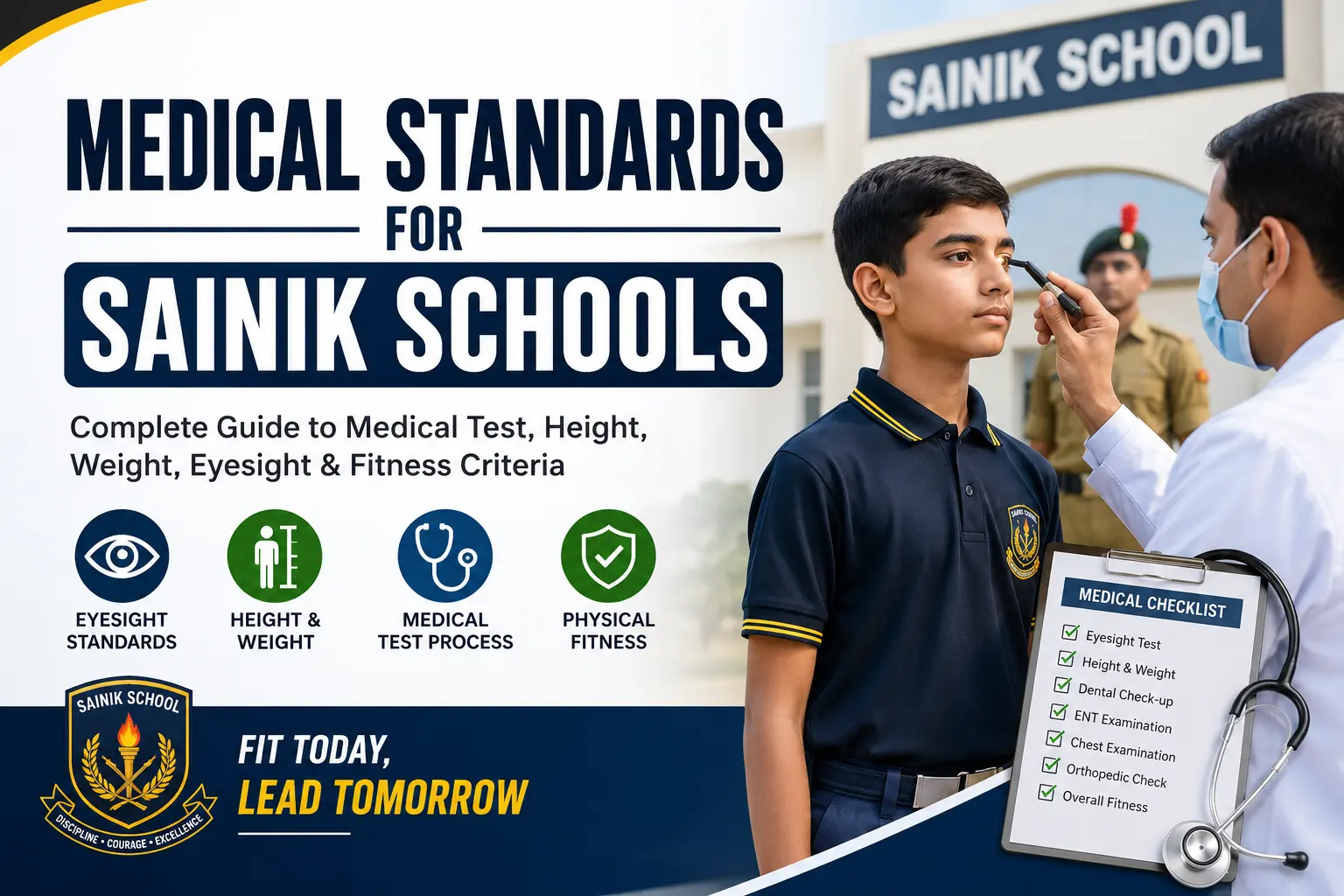
Medical Standards for Sainik School Admission
Every parent who dreams of sending their child to a Sainik School knows one thing — the written exam is only half the battle. Once your child clears the AISSEE written exam, the next critical step is the Sainik School medical examination. And this is where many students lose their chance — not because of poor academics, but because of avoidable medical issues that were never addressed in time.
At Young Star Defence Academy, we have guided thousands of students through the Sainik School admission process. Over the years, we’ve seen how a lack of clear information about medical standards leads to last-minute panic, preventable rejections, and heartbroken families. This article is our effort to change that.
Here, you’ll find everything — from the detailed Sainik School medical test process to eyesight standards, height and weight charts, common rejection reasons, and practical preparation tips. Read it carefully. Share it with your child. And start preparing well before exam day.
Why Medical Fitness Is Important in Sainik School
Sainik Schools are not ordinary boarding schools. They are pre-military institutions run under the Ministry of Defence, designed to prepare young boys and girls for a life in the armed forces. The physical and mental demands at these schools are significantly higher than at regular schools.
Students at Sainik Schools participate daily in activities like:
- Early morning physical training and drill
- Swimming, horse riding, and trekking
- Obstacle courses and outdoor camping
- Regular marching and parade practice
- Sports and team competitions throughout the year
For a child to thrive in this environment, a strong and healthy body is absolutely essential. That’s why the Sainik School medical examination is not a formality — it’s a genuine fitness evaluation. Students who are declared medically unfit are not placed on the final merit list, regardless of how well they performed in the written exam.
Complete Sainik School Medical Examination Process
The medical test takes place after AISSEE written exam results are announced. Students who clear the written exam and secure a rank are called for a medical examination at the respective Sainik School they’ve been allotted to. The examination is conducted by a Medical Board appointed by the school.
Here is what happens during the Sainik School medical examination:
Eye Examination
Vision is one of the most important parameters checked. The examining doctor tests each eye separately using a Snellen chart. The acceptable standard for Sainik School admission is:
- 6/6 in one eye and 6/9 in the other eye
- Vision that is correctable to this standard through spectacles is generally accepted
- Colour blindness is not permitted
- Night blindness is also a disqualifying condition
If your child wears glasses, don’t panic. Spectacles are allowed in Sainik School. The key is that the corrected vision must meet the required standard. However, if the corrected vision still doesn’t reach 6/6 and 6/9, the student may face rejection.
Height and Weight Check
General physical development is assessed through height and weight measurements. These are evaluated in proportion to the child’s age using standard BMI (Body Mass Index) norms. Candidates who are severely underweight, overweight, or have abnormal growth patterns may be flagged for further review.
Broadly, the minimum height requirements are:
- Class 6 admission: Minimum height of 128 cm
- Class 9 admission: Minimum height of 140 cm
Weight must be proportionate to height and age. See the detailed table in the next section.
Dental Examination
The dental check is often underestimated by parents, but it matters. The doctor examines:
- Presence of severe tooth decay or cavities that affect chewing
- Missing teeth that impair normal function
- Alignment of teeth and jaw
Minor dental issues usually don’t lead to rejection. But if a child has severe dental problems that affect eating or speech, it could be flagged.
ENT Examination (Ear, Nose, Throat)
The ENT examination checks for:
- Hearing ability — the child must have no chronic hearing problems
- Wax accumulation or ear infections (can be cleaned and resolved before the exam)
- Speech clarity — stammering or significant speech defects may lead to rejection
- Nasal blockages or chronic sinusitis
Chest and Physical Fitness Check
For boys, chest expansion is a specific measurement. The minimum chest expansion required is 2 to 5 cm. The doctor will also check for:
- Respiratory issues such as asthma or TB
- Heart conditions or abnormal blood pressure
- Overall cardiovascular health
Orthopedic Examination
The orthopedic check looks for physical deformities that may affect day-to-day military training activities:
- Flat foot (Pes Planus) — a very common reason for medical rejection
- Knock knees (Genu Valgum)
- Bow legs or other limb deformities
- Any injury or physical condition that restricts movement
Sainik School Eyesight Requirements — Explained Simply
This is probably the most searched topic among parents preparing for Sainik School admission. Let’s break it down clearly.
Acceptable vision standard: The required eyesight is 6/6 in one eye and 6/9 in the other eye. This is a relatively lenient standard compared to NDA requirements later in life.
Are spectacles allowed? Yes, spectacles are allowed in Sainik School. If your child’s corrected vision (with glasses) meets the 6/6 and 6/9 standard, they will generally pass the eye test.
What about colour blindness? Colour blindness is a disqualifying condition for Sainik School admission. If your child has been diagnosed with colour blindness, verify this medically before the admission process begins.
Night blindness: Night blindness is also not permitted and is checked during the eye examination.
Common reasons for rejection in the eye test:
- Uncorrected vision below 6/6 and 6/9
- Colour blindness
- Night blindness
- Squint (Strabismus) in some cases
- Corneal abnormalities
Tip for parents: Get your child’s eyes checked by an ophthalmologist at least 6 months before the AISSEE exam. If there is a correctable issue, you’ll have time to address it.
Height and Weight Standards for Sainik School
The following table gives a practical reference for height and weight requirements for Sainik School admission for both boys and girls across Class 6 and Class 9.
| Class | Gender | Minimum Height | Recommended Weight Range |
|---|---|---|---|
| Class 6 | Boys | 128 cm | 22 – 35 kg (approx., age 10–11) |
| Class 6 | Girls | 128 cm | 22 – 35 kg (approx., age 10–11) |
| Class 9 | Boys | 140 cm | 35 – 50 kg (approx., age 13–14) |
| Class 9 | Girls | 140 cm | 35 – 50 kg (approx., age 13–14) |
Weight standards are always evaluated against height and age. A child who is tall but underweight, or short but overweight for their age, may be flagged. Consult your family doctor regarding BMI well before the exam.
Common Reasons for Medical Rejection in Sainik School
These are the most frequent reasons why students fail the Sainik School medical test — and most of them are preventable with timely action.
1. Weak Eyesight
The most common reason. Students whose uncorrected or corrected vision doesn’t meet 6/6 and 6/9 are rejected. Get an updated refraction test done if your child wears glasses.
2. Colour Blindness
This is an automatic disqualification. There is currently no corrective treatment for colour blindness, so get this tested early.
3. Flat Foot (Pes Planus)
A surprisingly large number of children have flat feet, and many parents don’t know about it until the medical exam. Flat foot can be identified early and in some cases improved with physiotherapy.
4. Knock Knees (Genu Valgum)
This refers to the condition where the knees touch when standing straight and there’s a gap between the ankles. Mild cases may be acceptable; severe cases are rejected.
5. Obesity / Overweight
If your child’s BMI is significantly above the normal range for their age and height, they may be declared unfit. Start working on diet and physical activity well in advance.
6. Underweight
Being significantly underweight is also a concern. A malnourished child may not be considered physically fit for the rigours of Sainik School life.
7. Dental Problems
Severe cavities, missing permanent teeth, or jaw misalignment that affects chewing can lead to rejection. Get dental issues treated before the medical exam.
8. Hearing Impairment
Chronic ear infections, wax build-up, or actual hearing loss are flagged during the ENT examination. Many cases of wax accumulation can be treated easily before the exam.
9. Stammering or Speech Defects
Students with significant speech defects may be considered unfit. Mild stammering that doesn’t affect communication is usually not a problem.
10. Skin Diseases
Chronic fungal infections, persistent skin conditions, or psoriasis can be flagging points during the medical check.
11. Respiratory Conditions
Asthma, tuberculosis, or chronic respiratory disorders are disqualifying conditions.
12. Heart Conditions or High Blood Pressure
Any congenital or acquired heart condition or abnormal blood pressure reading will likely lead to rejection.
Can Students Apply Again After Medical Rejection?
Yes, absolutely. A medical rejection in one year does not permanently disqualify a student from Sainik School admission — provided they are still within the eligible age group and class.
- If your child fails the medical exam, you have the right to request a re-medical examination at a higher-level military hospital or Government hospital, depending on the school’s procedure.
- Students who address a correctable medical condition (such as getting dental treatment, managing weight, or improving nutrition) can reapply in the next academic cycle.
- Conditions like colour blindness, severe flat foot, or serious heart conditions are generally permanent disqualifiers.
- Always take the re-medical option if you feel the initial assessment was not accurate. It’s your right as a parent.
For detailed admission process information, read our complete guide on Sainik School Admission Process.
Documents Required During the Medical Examination
When you attend the Sainik School medical exam, make sure you carry the following documents. Missing documents can cause unnecessary delays.
- AISSEE admit card (original)
- AISSEE rank/merit letter issued by NTA
- Birth certificate (original + photocopy)
- Caste certificate (if applicable — SC/ST/OBC)
- Recent passport-size photographs (minimum 4–6 copies)
- Medical fitness certificate from a registered doctor (if asked in advance)
- Prescription glasses or documents from an eye specialist (if applicable)
- Any existing medical reports relevant to your child’s health
For a complete checklist, visit our detailed page on Documents Required in Sainik School.
Preparation Tips to Pass the Sainik School Medical Test
Start Early — Don’t Wait for Results
Don’t wait for AISSEE results before thinking about the medical exam. Start physical preparation and medical check-ups from the day you submit the application form.
Get a Complete Health Check-Up
About 3–4 months before the medical exam, take your child to a doctor for a full health evaluation. Check eyes, teeth, ears, heart, and weight — everything on the list.
Eye Test is Critical
Visit an ophthalmologist, not just an optician. Get a dilated eye exam to check vision accurately. If your child needs glasses, ensure the corrected vision meets 6/6 and 6/9.
Work on Physical Fitness
Encourage daily physical activity — running, swimming, sports, yoga. A child who is regularly active will naturally maintain healthy weight and physical proportions.
Address Dental Issues
If your child has cavities or tooth problems, get them treated 2–3 months before the exam to allow healing time.
Flat Foot Check
Ask a physiotherapist to check whether your child has flat feet. If yes, start corrective exercises immediately. Some cases improve significantly with consistent physiotherapy.
Diet and Nutrition
For underweight or overweight children, work with a nutritionist or paediatrician. A healthy BMI can be achieved with the right guidance in 3–6 months.
For structured academic preparation, explore our Sainik School Coaching programme — we cover written exam preparation alongside physical and overall student development.
Difference Between the Written Exam and Medical Test
Many parents confuse the sequence of events. Here’s exactly how the process flows:
- Written Exam (AISSEE) — Conducted by NTA. Tests Mathematics, General Knowledge, Language, and Intelligence. Visit exams.nta.ac.in/AISSEE for official exam details.
- Merit List Based on Written Exam — Students are ranked. Only those who qualify in the merit list are called for the next stage.
- Medical Examination — Called on the basis of written exam rank. Conducted at the respective Sainik School. Students declared medically fit move forward.
- Final Merit List — Only students who clear both stages appear here. Verify official school-wise lists at sainikschool.ncog.gov.in.
- Document Verification and Admission — Final stage. Read our Sainik School Syllabus guide to understand what your child will study once admitted.
FAQs About Sainik School Medical Standards
1. Is wearing spectacles allowed in Sainik School?
Yes, spectacles are allowed in Sainik School. As long as your child’s corrected vision (with glasses) meets the standard of 6/6 in one eye and 6/9 in the other, they will be considered medically fit for the eye test. There is no restriction on wearing glasses during daily school life either.
2. What eyesight is required for Sainik School admission?
The required vision standard is 6/6 in one eye and 6/9 in the other eye, which can be with or without spectacle correction. Colour blindness and night blindness are not permitted under any circumstances.
3. Is there a re-medical process if a student fails?
Yes. If a student is declared medically unfit, the parents can request a review or re-medical examination at a designated government or military hospital. The procedure varies slightly between schools, so check with the specific Sainik School directly.
4. Can an overweight child get admission to Sainik School?
A child who is significantly overweight (high BMI for their age and height) may be declared medically unfit. However, the assessment is based on overall BMI norms — not weight alone. If your child is slightly over the normal range, work with a doctor and nutritionist to bring the weight into a healthy range before the medical exam.
5. What medical problems can lead to rejection in Sainik School?
Common rejection reasons include colour blindness, severe flat foot, knock knees, uncorrected weak eyesight, chronic hearing problems, stammering, asthma or TB, heart conditions, severe dental problems, obesity, and significant underweight. Most of these can be identified and addressed before the exam with timely planning.
6. Is the medical test difficult to pass?
The Sainik School medical test is thorough but not designed to fail average healthy students. If your child is reasonably active, has no chronic illness, and has good basic vision, they should be able to clear the medical exam without difficulty. The key is to identify and address any hidden issues early.
7. Are the medical standards different for girls?
Most physical fitness standards are the same for boys and girls. Chest expansion measurement is applicable to boys only. Height and weight standards are evaluated based on the same BMI-for-age norms for both genders.
8. Is colour blindness allowed in Sainik School?
No. Colour blindness is a disqualifying condition for Sainik School admission. Since Sainik Schools are pre-military institutions preparing students for armed forces careers, colour vision is considered essential.
9. Can a student with flat feet get admission?
Flat foot (Pes Planus) is a common reason for medical rejection. However, severity matters. Mild flat foot that doesn’t affect physical activity may sometimes be overlooked. Severe flat foot is usually a disqualifying condition. Get your child assessed by a physiotherapist early — corrective exercises can help in mild to moderate cases.
10. When exactly does the medical examination happen?
The medical examination takes place after AISSEE written exam results are announced and a provisional merit list is published. Students who clear the written exam are then called to the respective Sainik School for their medical examination. Only after clearing the medical exam are students placed on the final selection merit list.
Final Words — From Us to Every Parent Reading This
We’ve seen students score brilliantly in the AISSEE written exam, only to lose their seat due to a medical condition that could have been fixed months earlier. As a coaching institute that has helped more than 25,000+ students reach Sainik Schools over the years, our message to every parent is simple: prepare for the medical exam the same way you prepare for the written exam — seriously and in advance.
Get the health check-ups done. Speak to specialists. Work on physical fitness from Day 1. And if there’s a medical concern, address it while there’s still time.
Your child’s dream of wearing the Sainik School uniform is completely within reach. With the right preparation — both academic and physical — nothing should stand in the way.
For expert coaching, structured preparation, and admission guidance, call us at +91 81013 13136 or explore our Sainik School Coaching programme today.