
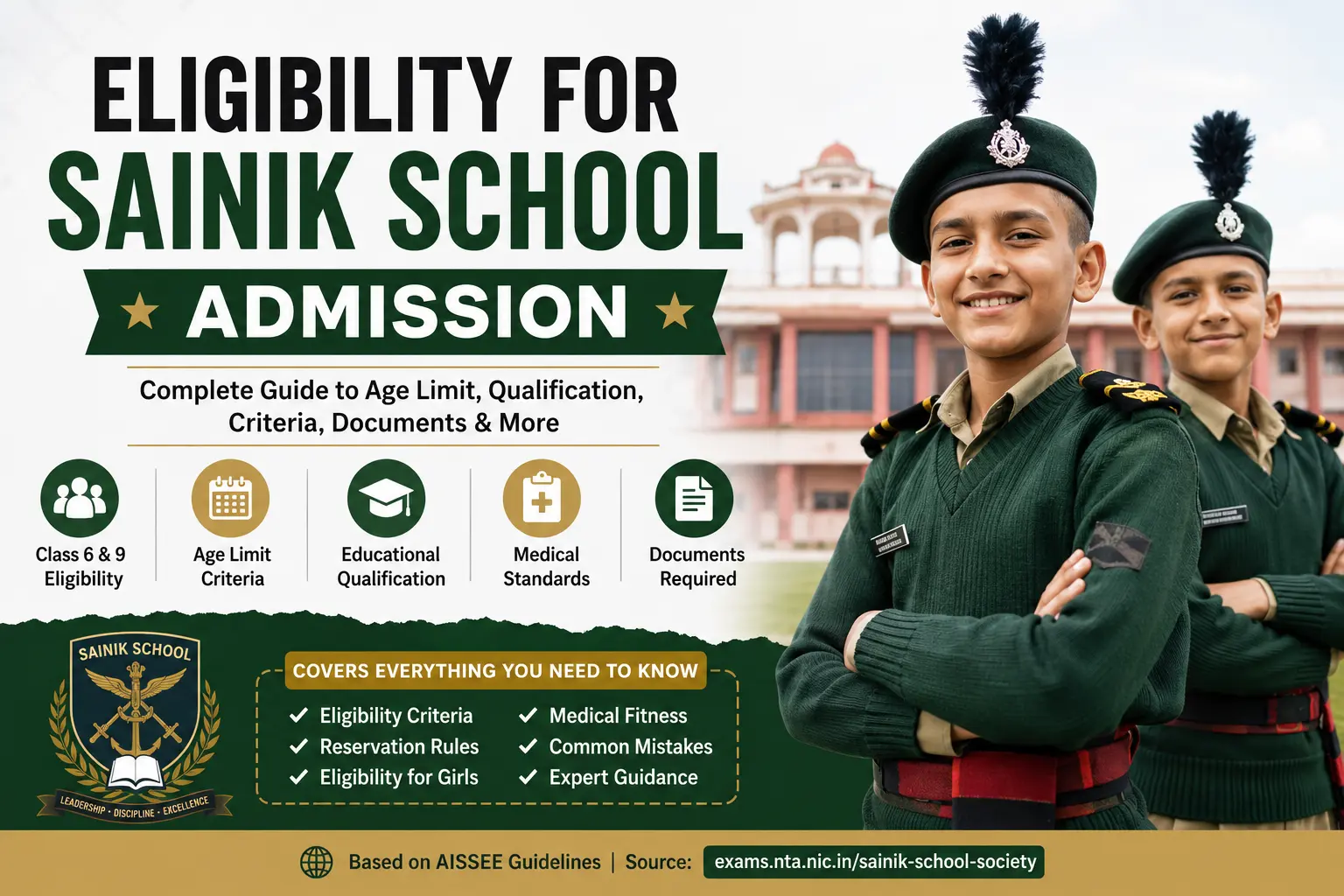
Eligibility for Sainik School Admission
Every parent who dreams of seeing their child in an olive-green uniform, standing tall on the parade ground of a Sainik School, starts with one very practical question — is my child even eligible?
Understanding the eligibility for Sainik School admission is not just a formality. It is the single most important step before you begin preparing for the All India Sainik Schools Entrance Examination (AISSEE). Thousands of applications are rejected every cycle not because the students lacked ability, but because parents missed a detail in the eligibility criteria — a wrong date of birth entry, an expired category certificate, or a document uploaded in the wrong format.
Sainik Schools are among India’s most prestigious residential institutions. Established under the Sainik Schools Society and administered by the Ministry of Defence, these schools prepare students for entry into the National Defence Academy (NDA) and other armed forces training academies. The standard is high, the competition is fierce, and the process is unforgiving of errors.
This guide covers every aspect of Sainik School eligibility criteria — age limits, educational qualifications, medical standards, reservation norms, documentation, and the most common mistakes that cost families their application. If you are a parent or student planning to appear in AISSEE, read this carefully before you fill a single field in the application form.
What is Sainik School Admission Eligibility?
Sainik School admission eligibility refers to the minimum conditions a student must satisfy before they can apply for the AISSEE. These conditions are set by the Sainik Schools Society and published in the official AISSEE notification on NTA’s official AISSEE portal.
The eligibility criteria cover five core areas:
- Age: The student must fall within a defined age bracket as on a specific cut-off date
- Educational Qualification: The student must be studying in or have passed a specific class from a recognised school
- Gender: Both boys and girls can apply, subject to seat availability at individual schools
- Nationality: Indian nationals only
- Medical Fitness: The student must be free from specified physical and medical conditions
The reason eligibility verification matters so much is that AISSEE operates at national scale. The Sainik Schools Society has no bandwidth to manually review borderline cases or accept late corrections. If your child does not meet even one of these conditions, the application is simply invalidated — regardless of how well they score in the exam.
Before enrolling your child in any Sainik School coaching programme, make sure they are fully eligible. Coaching without eligibility is wasted effort and expense.
Sainik School Eligibility for Class 6 Admission
Class 6 is the primary entry point into Sainik Schools. The vast majority of students join at this level, and the competition here is the most intense. If your child is currently in Class 4 or Class 5, this section is what you need to focus on.
Age Criteria for Class 6
The student must be between 10 and 12 years of age as on the 31st March of the academic year in which admission is being sought. This means both the minimum and maximum age are calculated on that fixed date — not on the date of the exam, not on the date of the result, and not on the date of joining.
This is the single most misunderstood criterion. Many parents calculate their child’s age on the exam date and assume they are eligible, only to find out later that the child has either crossed 12 years or is below 10 years as on the 31st March cut-off. Double-check this before applying.
Educational Qualification
The student must be studying in Class 5 at the time of application and must pass Class 5 before joining Class 6 of the Sainik School. Students who have already passed Class 5 and are currently in Class 6 are not eligible for Class 6 admission.
The school must be a recognised institution — recognised by the relevant state government or a central board like CBSE, ICSE, or any other board with proper affiliation.
Gender and Nationality
Both boys and girls are eligible. Indian nationality is mandatory. Children of Indian origin holding foreign nationality are not eligible.
| Eligibility Factor | Requirement for Class 6 |
|---|---|
| Age (as on 31st March) | 10 years (minimum) to 12 years (maximum) |
| Current Class | Studying in Class 5 |
| School Recognition | Government recognised school |
| Gender | Boys and Girls both eligible |
| Nationality | Indian nationals only |
| Board | Any recognised board (CBSE, ICSE, State Board) |
Note: Age is always calculated as on 31st March of the year of admission. Please verify the exact cut-off date from the official notification each time.
Sainik School Eligibility for Class 9 Admission
Class 9 admission exists for students who could not enter at Class 6 or who join from outside the Sainik School system. The seats at this level are significantly fewer, and competition — while smaller in absolute numbers — is no less serious.
Age Limit for Class 9
The student must be between 13 and 15 years of age as on the 31st March of the admission year. The same date-of-birth rule applies here as it does for Class 6.
Educational Qualification for Class 9
The student must be currently studying in Class 8 from a recognised school. They must pass Class 8 before joining Class 9. Students already in Class 9 are not eligible.
For Class 9, the student is expected to have reasonable command over subjects like Mathematics, Science, English, and Social Science, as the AISSEE paper at this level tests a broader and more advanced syllabus. You can review the complete AISSEE syllabus here to understand what preparation is needed.
Seat Availability
Not all Sainik Schools offer Class 9 admission. The number of seats depends on vacancies within that school’s existing Class 9 batch. Parents must check the specific school’s seat availability in the official notification before applying for this entry level.
| Eligibility Factor | Class 6 | Class 9 |
|---|---|---|
| Age (as on 31st March) | 10 to 12 years | 13 to 15 years |
| Qualifying Class | Studying in Class 5 | Studying in Class 8 |
| Gender | Boys and Girls | Boys and Girls |
| Seats | Fixed intake per school | Based on vacancies only |
| Medical Fitness | Mandatory | Mandatory |
Sainik School Age Limit Criteria
Of all the eligibility conditions, the age limit creates the most confusion — and the most rejections. Let’s break it down clearly.
The age is always calculated as on 31st March of the year of admission, not on the exam date. So if your child appears for the exam in January, you still count their age as it will be on 31st March of that same year.
Minimum and Maximum Age
- Class 6: The child must be at least 10 years old and must not have completed 12 years as on 31st March
- Class 9: The child must be at least 13 years old and must not have completed 15 years as on 31st March
Why Date of Birth Accuracy is Critical
The date of birth you enter in the application must exactly match your child’s Birth Certificate (issued by the Municipal Corporation or Panchayat), and this must in turn match their school records and Aadhaar card. Even a one-day discrepancy — for example, 1st April versus 31st March — can push a child outside the eligible age window.
We have seen cases where a child’s school records show a different date than the birth certificate because parents got the school admission date slightly adjusted at the time of Class 1 enrollment. This creates a document mismatch that can disqualify the application during verification, even if the child performed well in the exam.
Is There Any Age Relaxation?
There is no age relaxation for general category students. SC and ST candidates may receive a small relaxation as per the reservation guidelines, but this applies to the upper age limit only and is explicitly mentioned in the official notification. Do not assume any relaxation unless it is specifically stated for that year’s cycle.
Educational Qualification Required for Sainik School
The educational qualification for Sainik School admission is straightforward, but there are a few nuances parents often miss.
For Class 6 Admission
The student must be enrolled in Class 5 at a government-recognised school at the time of application. “Recognised” means the school has official affiliation — it could be a CBSE school, an ICSE school, or a state board school. Home schooling, unrecognised private institutions, and madrasas without board affiliation are not acceptable.
For Class 9 Admission
The student must be enrolled in Class 8 from a recognised school. There is no minimum percentage required at the Class 5 or Class 8 level for the application itself — however, for students to be offered admission after clearing AISSEE, they must have passed their qualifying class examination.
What About CBSE, ICSE, and State Board Students?
All three are equally valid. The AISSEE does not favour any particular board. The exam is designed to test a student’s fundamentals — and a well-prepared student from any recognised board can compete effectively.
Can Students from Rural or Government Schools Apply?
Absolutely. Sainik Schools, in fact, have a significant number of students from rural backgrounds and government schools. The admission process is designed to be accessible to all sections of society, which is also why the fee structure at Sainik Schools is subsidised by the government.
Can Girls Apply for Sainik School Admission?
Yes — and this is a relatively recent and very welcome development. Girls are now officially eligible to apply for Sainik School admission. This change came through a government directive to make Sainik Schools more inclusive, and several schools have already admitted girl students in their batches.
Which Schools Admit Girls?
Not every Sainik School has girls’ hostel facilities or dedicated infrastructure yet. The availability of seats for girls depends on individual school capacity. Each year’s official AISSEE notification clearly specifies which schools are accepting girls and how many seats are available. Parents of girl students must check this carefully before applying.
Is the Eligibility Criteria Different for Girls?
No. The age criteria, educational qualification, and medical standards are the same for girls as they are for boys. There is no gender-based relaxation in age or qualification. However, some schools may have specific guidelines about hostel facilities, and these are communicated during the counselling process.
Medical and Physical Standards for Girls
Medical fitness standards are applied uniformly. Girls are also required to meet vision, hearing, and general health requirements during the medical examination. The physical standards for height and weight follow standard developmental benchmarks appropriate for the age group.
If you are a parent of a girl child who is eligible and interested, do not hesitate. Sainik Schools offer one of the finest combinations of academic rigour and character development available anywhere in India. Speak to an expert at Young Star Defence Academy to understand how girl students should approach their AISSEE preparation.
Medical Eligibility for Sainik School Admission
Medical fitness is non-negotiable. A student may score among the top candidates in AISSEE, clear document verification, and still be denied admission if they do not pass the medical examination. Many parents only discover medical disqualifications during the final stages of admission, which is both heartbreaking and entirely avoidable if they had checked earlier.
For a detailed breakdown, refer to our dedicated page on medical standards for Sainik Schools. Here is a comprehensive overview:
Vision Requirements
Good eyesight is one of the most important medical parameters. The student must have:
- Distant vision: 6/6 in each eye (with or without glasses, depending on individual school policy)
- No significant colour blindness
- No squint (strabismus)
Students with glasses are not automatically disqualified, but the degree of refractive error matters. High myopia or other significant visual conditions can lead to rejection. If your child wears glasses, have their eyes tested by an ophthalmologist — not just an optician — well before the medical exam.
Hearing
Normal hearing in both ears is required. Chronic ear infections or any hearing impairment that requires assistive devices will lead to disqualification.
Height and Weight
Students are expected to fall within standard height-weight ranges for their age group. There is no specific fixed minimum height for admission, but the child must be in good general health and proportionate physical condition. Severely underweight or overweight children may be flagged during the medical exam.
Common Medical Rejection Reasons
- High refractive error (power in glasses) — one of the most frequent causes of medical rejection
- Colour blindness — even mild colour vision deficiency can be a problem
- Flat feet (Pes Planus) — moderate to severe cases are often rejected
- Stammering or speech defects — can be a disqualifying factor
- Skin conditions — chronic conditions like psoriasis or fungal infections may be flagged
- Dental issues — untreated decayed teeth or orthodontic problems that impair function
- Any chronic illness — epilepsy, asthma (severe), diabetes, or cardiac conditions
Practical Advice for Parents
Do not wait for the medical examination to discover a problem. Get a comprehensive health check for your child before the application season. Address treatable conditions early. If there is a concern about vision, consult an eye specialist and understand whether your child’s condition is within acceptable limits. Being proactive here can save months of preparation from going to waste.
Reservation Criteria in Sainik School Admission
Sainik Schools follow a structured reservation policy designed to ensure representation across social categories, regions, and defence families. Understanding this is important because reservation affects merit lists, cut-off scores, and ultimately the probability of admission.
For the full details on how reservations work, including documentation and state-wise quotas, read our detailed guide on reservation in Sainik Schools.
| Category | Reservation Percentage (Approximate) | Certificate Required |
|---|---|---|
| Scheduled Caste (SC) | 15% | Caste Certificate from competent authority |
| Scheduled Tribe (ST) | 7.5% | Tribe Certificate from competent authority |
| Other Backward Class (OBC) | 27% (Non-Creamy Layer) | OBC-NCL Certificate |
| Defence / Ex-Servicemen Ward | Varies by school | Service Certificate / Discharge Certificate |
| Home State Quota | 67% of seats | Domicile / Residence Certificate |
| General Category | Remaining seats | No category certificate needed |
Home State Quota — A Critical Point
This is often misunderstood. Approximately 67% of seats in each Sainik School are reserved for students who are residents (“home state” candidates) of the state in which that school is located. The remaining seats are open to candidates from across India (All India category).
This means that if you live in Punjab and are applying to Sainik School Kapurthala, your child competes against other Punjab students for 67% of the seats — which is actually an advantage. But if you live in Haryana and are applying to the same school, your child competes in the All India pool for the remaining seats, where competition is much stiffer.
OBC Certificate Must Be Non-Creamy Layer
Many families apply under OBC category with an older certificate. The OBC certificate must specifically state “Non-Creamy Layer” (NCL), and it must be current and valid at the time of application. An outdated certificate, or one that does not mention NCL status, will not be accepted.
Documents Required for Eligibility Verification
Getting your documents right is just as important as preparing for the exam. A well-prepared student with incorrect or incomplete documents can face rejection during verification. Here is what you need to have ready. You can also refer to our detailed page on documents required for Sainik School admission.
Core Documents
- Birth Certificate: Issued by Municipal Corporation, Gram Panchayat, or hospital. Must exactly match school records and Aadhaar.
- Aadhaar Card: Student’s own Aadhaar. Must match name and date of birth in other documents.
- Domicile / Residence Certificate: Issued by the Tehsildar or competent authority. Required to claim home state quota.
- School Bonafide / Enrolment Certificate: Confirming the student is currently enrolled in Class 5 (for Class 6 admission) or Class 8 (for Class 9 admission).
- Previous Class Marksheet: Last exam results. For Class 9 admission, Class 7 marksheet is typically needed.
- Category Certificate: SC/ST/OBC-NCL certificate as applicable. Must be recent and from a competent authority.
- Passport-size Photographs: Recent, white background, as specified in the notification. Inconsistent or old photographs are a common upload error.
- Defence Service Certificate (if applicable): For students applying under defence ward quota.
Common Document Upload Mistakes
- Uploading blurry or low-resolution scans of certificates
- Uploading an older photograph that doesn’t match the student’s current appearance
- File size exceeding the portal’s limits — causing truncated uploads that appear complete on screen but are invalid
- Uploading documents in wrong file format (e.g., TIFF instead of JPEG)
- Uploading a parent’s documents instead of the student’s own documents
- Forgetting to upload the domicile certificate when claiming home state quota
Scan all documents in good lighting at 200–300 DPI. Check each file after upload to confirm it is fully visible and readable. Do not rush through this stage.
Common Reasons Students Become Ineligible
After years of guiding families through the AISSEE process, we have identified the mistakes that come up again and again. Many of these are completely avoidable with early awareness.
1. Incorrect Date of Birth Entry
This is the number one reason for eligibility rejection. A typo in the DOB field, or a mismatch between the DOB entered and the birth certificate, triggers automatic invalidation during document verification. Always triple-check the date of birth before submitting the application.
2. Wrong Category Selection
Selecting OBC when the student is actually SC, or claiming defence ward status without the right certificate — these create mismatch during verification. Apply under the category you have valid documents for, not the category you think might give you an advantage.
3. Applying When Child is Already Overage
Some parents realise mid-preparation that their child crossed the maximum age limit. This happens when parents delay applying by one year, assuming they can try “next time.” Eligibility windows are narrow. If your child is eligible, apply in that cycle.
4. Invalid or Expired Category Certificates
OBC-NCL certificates in particular have validity periods. An expired certificate submitted during document verification will disqualify the application even if the student scored well. Check expiry dates and renew certificates before the application season opens.
5. Medical Conditions Discovered Late
A student who has undiagnosed colour blindness, flat feet, or high refractive error will be rejected at the medical stage after the family has invested months of preparation. Pre-screen your child medically — ideally a full year before the planned AISSEE attempt.
6. Applying for Class 9 at a School with No Vacancies
Parents sometimes apply to a school that has not declared any Class 9 seats that year. The application is processed but the student has no chance of admission. Always check the school-wise seat matrix in the official notification.
7. Incomplete Application Form
Leaving mandatory fields blank, or filling optional fields incorrectly, can cause the application to be rejected outright by the portal. Review the entire form section by section before the final submission.
How Eligibility is Verified During Admission
Eligibility is not just checked at the application stage. It is verified multiple times throughout the admission process:
Stage 1 — Online Application Portal
The NTA system performs basic checks when you submit the form. Age calculation is automated based on the DOB you enter. If your child falls outside the age window, the portal may reject the submission immediately.
Stage 2 — Document Verification After Result
Once results are declared and merit lists are released, selected students are called for document verification. At this stage, all original certificates are physically checked against what was submitted online. Any mismatch results in cancellation of the provisional selection.
Stage 3 — Medical Examination
Shortlisted students must appear for a medical examination conducted by a designated medical board at the respective Sainik School. This is thorough and covers all the parameters described earlier in this guide.
Stage 4 — School-Level Counselling
Finally, the selected student and their parents are called for counselling at the school. Any remaining eligibility questions — particularly around domicile, category claims, or special quota — are resolved here. Fee payment and formal enrollment happen at this stage.
Important Tips Before Applying for AISSEE
These tips come from our experience guiding hundreds of families through the Sainik School admission process:
- Read the official notification cover to cover. It is the only authoritative source. Everything else — including this guide — is supplementary. The official notification is available on NTA’s AISSEE portal.
- Verify DOB across all documents before you start filling the form. Birth certificate, Aadhaar, and school records should all show the same date. If they don’t, resolve the discrepancy first.
- Get a medical pre-screening at least one year before the exam. Especially check vision, hearing, and flat feet. Early diagnosis gives time to treat or address issues.
- Prepare category certificates well in advance. OBC-NCL certificates take time to obtain from government offices. Don’t wait until the last week of the application window.
- Choose the school-state combination carefully. Applying to a school in your home state gives you access to the larger home state quota. Applying out-of-state puts your child in the All India merit list.
- Start coaching early. The AISSEE syllabus is well-defined, and consistent preparation from Class 3 or 4 onwards gives children a meaningful edge by the time they appear for the exam.
- Do not rely on unofficial sources for eligibility information. School friends, social media posts, and coaching centres that are not updated regularly can give you outdated or incorrect data. Always cross-check with the official notification.
Frequently Asked Questions (FAQs)
Who can apply for Sainik School admission?
Any Indian national who meets the age criteria and is currently studying in Class 5 (for Class 6 admission) or Class 8 (for Class 9 admission) from a recognised school is eligible to apply for AISSEE.
What is the age limit for AISSEE Class 6?
The student must be between 10 and 12 years of age as on 31st March of the year of admission. Age is not calculated on the exam date.
What is the age limit for AISSEE Class 9?
The student must be between 13 and 15 years of age as on 31st March of the year of admission.
Can girls apply for Sainik School admission?
Yes. Girls are eligible to apply for both Class 6 and Class 9 admission. However, seat availability for girls varies by school and is declared in the official notification each year.
Is a domicile certificate compulsory?
If you are claiming the home state quota (which accounts for approximately 67% of seats), a domicile or residence certificate is mandatory. Students applying under the All India quota technically do not need it, but it is always advisable to have one ready.
Is medical fitness mandatory for AISSEE?
Yes. Medical fitness is a hard requirement. Students who do not pass the medical examination conducted by the school’s medical board cannot take admission, regardless of their AISSEE score.
Can students from CBSE, ICSE, and State Board schools all apply?
Yes. AISSEE does not discriminate based on board affiliation. Students from any recognised board — CBSE, ICSE, state boards — are equally eligible.
Is there any reservation for defence ward children?
Yes. Children of serving defence personnel, ex-servicemen, and war widows are eligible for the defence category reservation. A valid service or discharge certificate is required to claim this benefit.
What happens if incorrect eligibility details are submitted?
If the discrepancy is caught during document verification, the student’s provisional selection will be cancelled. There is no appeal or correction window after submission in most cases. This is why accuracy during form-filling is critical.
Is there any relaxation in the age limit for SC and ST students?
Yes, typically there is a relaxation of one to two years in the upper age limit for SC and ST candidates. The exact amount is specified in each year’s official notification. There is no age relaxation for OBC or general category students.
Can a student apply to more than one Sainik School?
Yes. A single AISSEE application allows you to list multiple school preferences. The allocation is done based on merit and seat availability as per your stated preferences.
What if a student fails Class 5 or Class 8 after appearing for AISSEE?
Admission is conditional on passing the qualifying class. If a selected student fails their Class 5 or Class 8 exam, their Sainik School admission will be cancelled.
Conclusion
Sainik School admission is one of the most rewarding opportunities in Indian education — but it comes with a process that demands precision. The eligibility for Sainik School admission is not complicated, but it is exacting. A small oversight — a wrong date, an expired certificate, a missed medical condition — can undo months of effort and investment.
The good news is that all of this is entirely within your control. If you understand the criteria, verify your documents early, pre-screen your child medically, and begin preparation in time, the path to AISSEE success becomes a great deal clearer.
At Young Star Defence Academy, Amritsar, we have guided families through this process repeatedly. We help students not just with academics, but with the entire admission journey — from eligibility assessment to final enrollment. If you have questions about your child’s specific situation, do not rely on guesswork. Reach out, verify, and then move forward with confidence.
Your child’s Sainik School dream is worth the effort. Start right — start with eligibility.