
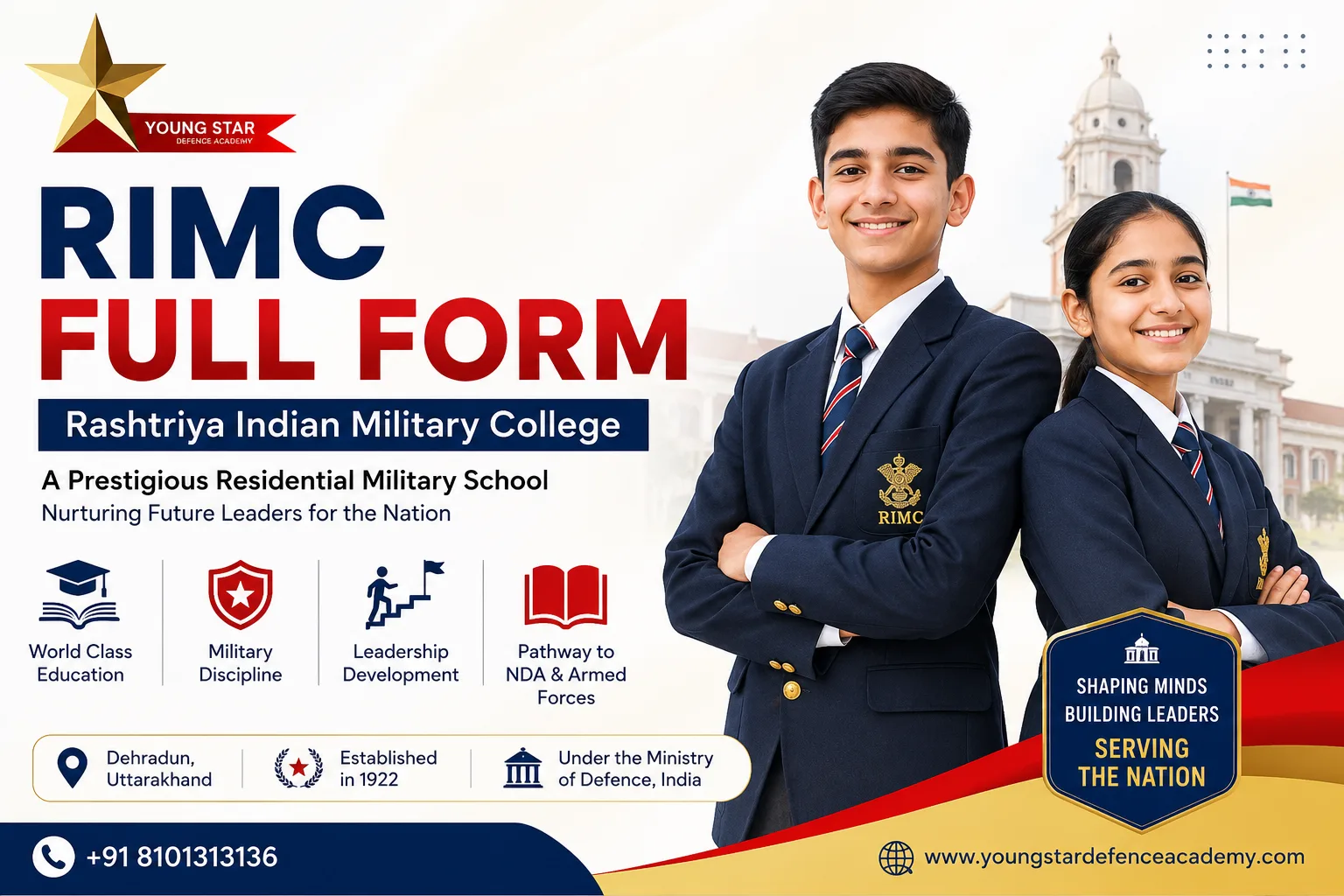
RIMC Full Form is Rashtriya Indian Military College. It is a prestigious residential military institution located in Dehradun, Uttarakhand, under the Ministry of Defence. Boys and girls in Class 8 are selected through a national entrance examination, a Services Selection Board style interview, and a medical examination.
Most parents first hear the term RIMC and wonder what it actually stands for and why it matters so much to defence aspirants. That single question usually opens the door to a much bigger one: how does a twelve-year-old actually get admitted to one of the oldest military schools in the country? This guide answers both, along with everything else you need to know about eligibility, exam pattern, syllabus, fees, and preparation strategy.
By the end of this article, you will understand exactly what RIMC is, how the admission process works, what the entrance exam looks like, and how a structured coaching plan can improve your child’s chances of selection.
Preparing for the RIMC entrance exam? Get expert guidance from Young Star Defence Academy.
Table of Contents
- RIMC Full Form
- What is RIMC?
- History of RIMC
- Why is RIMC Famous?
- Where is RIMC Located?
- Eligibility Criteria
- RIMC Admission Process
- RIMC Entrance Exam Pattern
- RIMC Syllabus
- RIMC Age Limit
- Fee Structure
- Documents Required
- RIMC vs Sainik School
- RIMC vs Rashtriya Military School
- Benefits of Studying at RIMC
- Career Opportunities After RIMC
- How to Prepare for the RIMC Entrance Exam
- Why Choose Young Star Defence Academy for RIMC Preparation?
- Frequently Asked Questions
RIMC Full Form
The RIMC Full Form is Rashtriya Indian Military College. In Hindi, it is called Rashtriya Bhartiya Sainya Mahavidyalaya, though the English name is used almost everywhere, including on official documents and the admit card.
The pronunciation is straightforward: Rash-tree-ya In-dian Military College. Each word carries meaning on its own. “Rashtriya” means national, showing that the institution belongs to the entire country rather than a single state. “Indian” ties it to the nation’s armed forces. “Military College” describes its core purpose: preparing young cadets for a future in uniform.
Knowing the RIMC full form is only the starting point. What really matters to parents and students is what this name represents: a 100% residential school that grooms boys and girls academically, physically, and mentally for a career in the Indian Armed Forces, mainly through direct entry into the National Defence Academy.
What is RIMC?
RIMC is a residential defence school that operates directly under the Ministry of Defence, Government of India. Unlike a typical boarding school, its entire academic and co-curricular structure is built around military discipline, leadership, and character development.
The main objective of RIMC is to identify boys and girls with leadership potential at a young age and shape them into future officers of the Indian Army, Navy, and Air Force. Cadets who clear their studies at RIMC get direct entry into the National Defence Academy, skipping the standard NDA written exam.
A few things define the RIMC experience:
- Residential military education: Cadets live on campus throughout the academic year under a structured routine.
- Leadership development: Activities like drill, horse riding, and adventure training build confidence and command ability from a young age.
- Academic excellence: RIMC follows a rigorous curriculum affiliated with the CBSE, ensuring cadets are equally strong in academics and physical training.
- Character building: Discipline, punctuality, and teamwork are treated as seriously as marks in an exam.
You can read more directly from the institution on the official RIMC website, which covers admission notifications and prospectus updates.
History of RIMC
RIMC was established during the colonial period with the goal of preparing Indian boys for entry into the Royal Military College, Sandhurst, in England. It was the first institution of its kind in India built specifically to train future army officers from a young age.
The idea behind founding RIMC was simple but far-reaching: identify talent early, in the early teenage years, and mould it over several years of structured education rather than trying to build leadership qualities in adulthood.
After independence, the college was renamed and repositioned to serve the newly formed nation, feeding directly into the National Defence Academy instead of a foreign military college. Over the decades, RIMC has expanded its facilities, updated its curriculum, and eventually opened its doors to girls, marking one of its most significant milestones.
Today, RIMC is recognised as one of the oldest and most respected military schools in Asia, with a long list of alumni who have gone on to hold senior positions in the Armed Forces. For a deeper look at its structure and legacy, read our detailed page on Rashtriya Indian Military College.
Why is RIMC Famous?
RIMC’s reputation is built on a few consistent pillars that have not changed in decades.
- Military discipline: Life at RIMC runs on a strict daily schedule, similar to what cadets will later experience at the NDA and in active service.
- Direct NDA preparation: Because cadets get direct entry to the NDA, RIMC functions as a feeder institution for future Army, Navy, and Air Force officers.
- Leadership training: Cadets are given responsibilities early, from managing squads to leading drills, which builds command experience most schools cannot offer.
- Distinguished alumni: RIMC has produced numerous senior officers, including several who have gone on to hold top ranks in the Armed Forces.
- High academic standards: The CBSE-based curriculum is delivered with additional rigor, ensuring cadets are well prepared for both military and civilian higher education if their career path changes later.
Where is RIMC Located?
RIMC is located in Dehradun, Uttarakhand, a city already known for hosting several premier defence institutions, including the Indian Military Academy. The campus sits amid the Doon Valley, surrounded by the Himalayan foothills.
The campus itself is spread across a large, green estate with parade grounds, academic blocks, a riding school, sports fields, and dedicated hostel accommodation known as “companies,” where cadets live under the supervision of company commanders.
Facilities on campus typically include:
- Modern classrooms and science laboratories
- A library with academic and general reading material
- Horse riding school, since equestrian training is a signature RIMC activity
- Sports grounds for athletics, football, hockey, and other games
- Medical facilities for routine and emergency care
- Hostel accommodation organised by cadet “companies”
The environment is intentionally structured to mirror military life, helping cadets adapt gradually to the discipline they will encounter later at the NDA.
Eligibility Criteria
RIMC eligibility criteria cover age, class, nationality, medical fitness, and gender. Use our RIMC eligibility calculator to quickly check whether your child qualifies for the upcoming entrance exam.
| Criteria | Requirement |
|---|---|
| Age | Between 12.5 and 14 years as on the specified cut-off date (varies slightly per intake) |
| Class | Studying in Class 7, moving into Class 8, in a school recognised by the state or central education board |
| Nationality | Must be a citizen of India |
| Medical Standards | Must meet the medical fitness standards prescribed for RIMC cadets, verified through a medical board examination |
| Gender Eligibility | Open to both boys and girls, following the opening of admissions to girl candidates |
RIMC Admission Process
The RIMC admission process involves several stages, each designed to test a different aspect of a candidate’s readiness. Here is a step-by-step breakdown; you can also read our detailed RIMC admission process guide for state-wise application notes.
- Application: Eligible candidates apply through their respective state government, since RIMC allocates seats state-wise and union territory-wise rather than through direct individual applications in most cases.
- Written Exam: Shortlisted candidates appear for the RIMC entrance exam, covering Mathematics, English, and General Knowledge.
- Interview: Candidates who clear the written exam are called for a Services Selection Board style interview, assessing personality, confidence, and leadership potential.
- Medical Examination: A detailed medical board examination checks physical fitness against the standards prescribed for RIMC cadets.
- Merit List: A final merit list is prepared based on combined performance in the written exam, interview, and medical fitness.
- Final Admission: Selected candidates complete document verification and formally join RIMC as cadets.
For a complete overview of the process along with required documents, see our RIMC admission page.
RIMC Entrance Exam Pattern
The RIMC entrance exam pattern tests four core areas. Understanding the marking and duration for each subject helps in building an accurate study plan; you can also check our dedicated RIMC exam pattern page for the latest breakdown.
| Subject | Marks | Duration | Qualifying Criteria |
|---|---|---|---|
| Mathematics | 200 | 2 hours | Minimum qualifying marks in each subject, as prescribed by the board |
| English | 125 | 1 hour | Minimum qualifying marks required |
| General Knowledge | 75 | 1 hour | Minimum qualifying marks required |
Here is what each paper tests:
- Mathematics: Concepts up to the Class 7 level, with emphasis on arithmetic, basic algebra, and geometry.
- English: Grammar, comprehension, vocabulary, and basic composition skills.
- General Knowledge: Current affairs, general science, history, geography, and defence-related awareness.
Candidates who qualify the written exam move on to the interview and medical stages described earlier.
RIMC Syllabus
The RIMC syllabus is based on the Class 6 and Class 7 curriculum, with a slight emphasis on application-based questions rather than rote learning. For a full topic-wise breakdown, visit our RIMC syllabus guide.
Mathematics
- Number system, fractions, and decimals
- HCF and LCM
- Percentage, ratio, and proportion
- Simple and compound interest
- Profit and loss
- Basic algebra and linear equations
- Lines, angles, and basic geometry
- Mensuration: area and perimeter of simple shapes
- Data handling and basic statistics
English
- Reading comprehension passages
- Grammar: tenses, articles, prepositions, and conjunctions
- Synonyms and antonyms
- One-word substitutions
- Sentence correction and rearrangement
- Basic letter and paragraph writing
General Knowledge
- Current affairs, national and international
- Indian history and freedom movement
- Geography of India and the world
- General science: physics, chemistry, and biology basics
- Indian polity and constitution basics
- Defence-related general knowledge, including ranks and important dates
RIMC Age Limit
The RIMC age limit typically falls between 12.5 and 14 years as on the notified cut-off date, which usually aligns with a specific date around the middle of the academic year. Because this age band is narrow, even a difference of a few weeks can affect eligibility for a particular intake.
Here is a practical example: if the cut-off date for an intake is set in a given year, a child born within the 18-month window ending on that date is eligible. A child born just outside that window, even by a matter of days, will need to wait for the next eligible intake instead.
Because of how narrow and specific this window is, we strongly recommend verifying your child’s exact eligibility using our eligibility calculator or reading our detailed RIMC age limit guide before starting preparation.
Fee Structure
RIMC fees cover tuition, hostel, uniform, and other miscellaneous charges. The figures below are indicative and meant only to give parents a general sense of the cost structure.
| Component | Approximate Range |
|---|---|
| Tuition Fee | Charged on a termly or annual basis, as per official notification |
| Hostel Charges | Covers boarding and lodging for the full academic year |
| Uniform and Kit | One-time and recurring charges for uniforms, sports kit, and riding gear |
| Other Charges | Includes items like books, stationery, medical, and activity charges |
Documents Required
Keep the following documents ready well before the application window opens:
- Birth certificate for age proof
- School-issued mark sheet or bonafide certificate
- Domicile or residence certificate, if applicable
- Caste certificate, where relevant, issued by a competent authority
- Passport-size photographs as per specification
- Identity proof of parents or guardian
- Medical fitness documents, if requested at any stage
RIMC vs Sainik School
Parents often compare RIMC with Sainik Schools since both are residential defence-oriented institutions. Here is how they differ.
| Aspect | RIMC | Sainik School |
|---|---|---|
| Admission Entry Point | Class 8 only | Class 6 and Class 9 |
| Competition Level | Extremely high, with very limited seats nationwide | High, but with more seats available across multiple schools |
| Fees | Generally higher, given specialised facilities | Comparatively moderate |
| Curriculum | CBSE-based with intensive military training | CBSE-based with structured military-style discipline |
| Boarding | 100% residential, single campus in Dehradun | 100% residential, multiple campuses across India |
| Career Opportunities | Direct entry into NDA after RIMC | Strong NDA preparation, but entry is through the standard NDA exam |
| Selection Process | Written exam, interview, and medical examination | Written exam and medical examination, interview weight varies |
If you are also exploring options for girls, our Sainik School for Girls guide and RIMC admission for girls guide cover eligibility and preparation specifically for girl candidates. We also offer dedicated Sainik School coaching for families weighing both options.
RIMC vs Rashtriya Military School
Rashtriya Military Schools (RMS) are another category of defence-oriented residential schools, and they are often confused with RIMC because of the similar name.
| Aspect | RIMC | Rashtriya Military School (RMS) |
|---|---|---|
| Governing Authority | Directly under the Ministry of Defence, single institution | Under the Ministry of Defence, multiple schools across India |
| Entry Classes | Class 8 only | Class 6 and Class 9 |
| Direct NDA Entry | Yes, cadets get direct entry into NDA | No direct entry; strong NDA preparation but standard exam required |
| Number of Campuses | One, in Dehradun | Multiple, across cities including Ajmer, Bangalore, Belgaum, Chail, and Dholpur |
If RMS is also on your shortlist, our RMS coaching program covers preparation for all RMS campuses in detail.
Benefits of Studying at RIMC
- Direct entry into the National Defence Academy without appearing for the standard NDA written exam
- Early exposure to military discipline, structure, and leadership responsibilities
- Strong academic foundation through a CBSE-based curriculum delivered with additional rigor
- Access to specialised training like horse riding, which is rarely available at other schools
- A network of alumni and peers who often go on to serve in the Armed Forces together
- Personality development through structured extracurricular and adventure activities
- A disciplined lifestyle that builds time management and self-reliance from a young age
Career Opportunities After RIMC
RIMC is primarily a feeder institution into the National Defence Academy, but the career paths it opens up go beyond a single option.
- NDA: Most cadets move directly into the NDA after completing their time at RIMC, joining the Army, Navy, or Air Force wings.
- Armed Forces: After the NDA, cadets go on to specialised training academies before being commissioned as officers.
- Higher Education: Some cadets who choose not to pursue a defence career use their strong academic foundation for higher studies in civilian universities.
- Civil Services: The discipline, general awareness, and leadership training gained at RIMC often help cadets who later choose competitive civil service exams.
- Other Career Paths: A well-rounded education and leadership grounding at RIMC also supports careers in management, public administration, and related fields.
How to Prepare for the RIMC Entrance Exam
Cracking the RIMC entrance exam takes more than last-minute revision. Here is a practical approach.
- Study Plan: Start preparation at least 8 to 12 months in advance, dividing time across Mathematics, English, and General Knowledge.
- Recommended Books: Focus on NCERT textbooks for Class 6 and Class 7, along with dedicated RIMC and Sainik School entrance exam guides.
- Time Management: Practice solving each subject within its allotted time to build speed alongside accuracy.
- Mock Tests: Regular full-length mock tests help students get comfortable with the actual exam pressure. Our RIMC mock test series is designed around the real exam pattern.
- Previous Year Papers: Solving previous year papers gives a clear idea of question difficulty and recurring topics. Explore our collection of RIMC previous year question papers.
- Interview Preparation: Practice speaking confidently on general topics, current affairs, and personal background, since the interview evaluates personality as much as knowledge.
- Common Mistakes to Avoid: Don’t ignore General Knowledge while focusing only on Mathematics and English; all three subjects matter for the final score.
Why Choose Young Star Defence Academy for RIMC Preparation?
Preparing for RIMC on your own is possible, but a structured environment makes a real difference at this age. At Young Star Defence Academy, our RIMC coaching program is built around what the entrance exam actually demands.
- Experienced Faculty: Our teachers understand the RIMC exam pattern and know where students typically lose marks.
- Structured Classroom Coaching: Lessons are organised subject-wise and paced to match the syllabus timeline.
- Regular Mock Tests: Frequent mock exams help students track progress and build exam-day confidence.
- Interview Guidance: We prepare students for the SSB-style interview through mock interviews and personality development sessions.
- Hostel Facilities: Outstation students can access hostel accommodation for focused, distraction-free preparation.
- Personalised Mentoring: Each student’s progress is tracked individually, with extra attention given to weaker areas.
Young Star Defence Academy is founded by Prashant Singh, with campuses in Amritsar, Chandigarh, and Kapurthala, dedicated entirely to preparing students for RIMC, RMS, Sainik School, and NDA Foundation entrance exams.
Want expert guidance for RIMC entrance exam preparation?
Frequently Asked Questions
What is the full form of RIMC?
RIMC Full Form is Rashtriya Indian Military College, a residential military school in Dehradun under the Ministry of Defence.
What does RIMC stand for?
RIMC stands for Rashtriya Indian Military College, one of the oldest military schools in Asia.
Is RIMC under the Army?
RIMC operates directly under the Ministry of Defence rather than under the Army alone, and it prepares cadets for all three services: Army, Navy, and Air Force.
Can girls apply to RIMC?
Yes, girls are eligible to apply for admission to RIMC. Read our detailed RIMC admission for girls guide for specific preparation tips.
What is the RIMC age limit?
Candidates are typically required to be between 12.5 and 14 years old as on the notified cut-off date. Check our RIMC age limit page for exact criteria.
Is RIMC better than Sainik School?
RIMC and Sainik School serve different purposes. RIMC offers direct entry into the NDA, while Sainik School prepares students well for the standard NDA entrance exam. The better choice depends on your child’s goals and readiness.
How difficult is the RIMC entrance exam?
The RIMC entrance exam is considered highly competitive because of very limited seats and a rigorous selection process covering written exams, interview, and medical fitness.
What is the RIMC fee structure?
Fees cover tuition, hostel, uniform, and other charges, and may change from time to time. Always verify current fees from the official prospectus or our RIMC fees page.
How many seats are available at RIMC?
Seats are allocated state-wise and union territory-wise, and the total number is limited, which is one reason RIMC admission is so competitive.
What books should I study for RIMC preparation?
NCERT books for Class 6 and Class 7, along with dedicated RIMC and Sainik School entrance exam guides, are a good starting point.
Is coaching necessary for RIMC preparation?
Coaching is not mandatory, but structured guidance helps students cover the syllabus systematically and prepare confidently for the interview stage.
What is the RIMC admission process?
The process includes application through the state government, a written entrance exam, an interview, a medical examination, and a final merit list. See our full RIMC admission process guide.
Where is RIMC located?
RIMC is located in Dehradun, Uttarakhand, in the Doon Valley region.
What is the RIMC syllabus?
The syllabus is based on Class 6 and Class 7 level Mathematics, English, and General Knowledge. Read our detailed RIMC syllabus guide for topic-wise coverage.
What is the RIMC exam pattern?
The exam includes three papers: Mathematics (200 marks), English (125 marks), and General Knowledge (75 marks) — 400 total, plus a 50-mark Viva Voce for a grand total of 450. Full details are on our RIMC exam pattern page.
Can CBSE students apply for RIMC?
Yes, students from CBSE as well as other recognised state and central boards can apply, as long as they meet the age and class eligibility criteria.
What happens after RIMC?
Cadets typically move on to the National Defence Academy through direct entry, followed by service-specific training academies and commissioning as officers.
Is RIMC a boarding school?
Yes, RIMC is a fully residential institution where cadets live on campus throughout the academic year.
Is there an interview in the RIMC selection process?
Yes, candidates who clear the written exam appear for a Services Selection Board style interview that assesses personality and leadership potential.
How can I improve my chances of RIMC selection?
Consistent preparation across all four subjects, regular mock tests, previous year paper practice, and dedicated interview preparation all improve selection chances significantly.
Is the RIMC full form the same as RMS?
No, RIMC (Rashtriya Indian Military College) and RMS (Rashtriya Military School) are different institutions with separate entry classes, campuses, and admission processes, though both fall under the Ministry of Defence.
Conclusion
Understanding the RIMC full form is just the first step toward a much bigger journey. Rashtriya Indian Military College offers one of the most respected paths into the Indian Armed Forces, combining strong academics with early leadership training in a fully residential setup.
Getting selected takes focused preparation across Mathematics, English, and General Knowledge, along with confident interview performance. If you are serious about giving your child the best possible start toward RIMC, Young Star Defence Academy’s structured coaching program, experienced faculty, and regular mock tests can make that preparation far more effective.
Ready to start your RIMC preparation journey?