
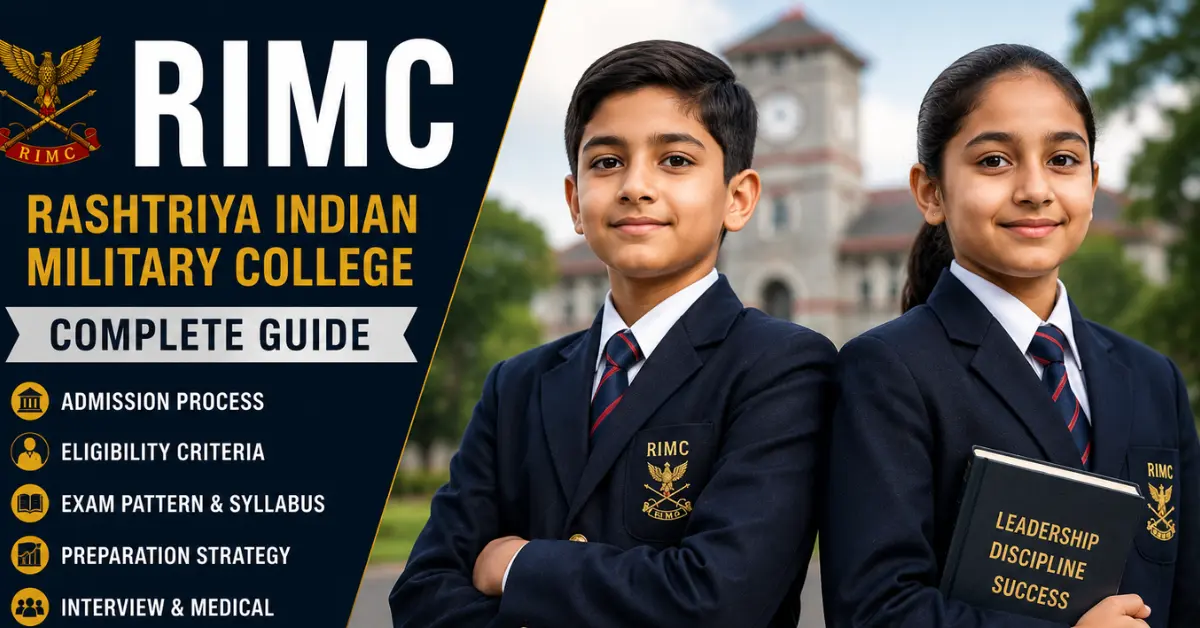
Every year, thousands of families across India ask the same question: which school will truly prepare my son or daughter for a career in the armed forces? For many, the answer leads to one institution — RIMC Dehradun. Formally known as the Rashtriya Indian Military College, it stands in a league of its own among military schools in India. Many parents also search for it as “RIMC school” or “Rashtriya Military College” — all pointing to the same historic institution in Dehradun.
Getting in, however, is a different story. The seats are few, the competition is fierce, and the preparation demands far more than just good marks. This guide covers everything — eligibility, exam pattern, syllabus, preparation strategy, and how to avoid the mistakes that cost students their seat year after year.
1,325+ RIMC selections. Structured syllabus, mock interviews, and mentor-led preparation from Amritsar, Chandigarh & Kapurthala campuses.
| 📞 Call +91 81013 13136 | 💬 WhatsApp Us |
What Is RIMC Dehradun?
The Rashtriya Indian Military College is a residential military school located in Dehradun, Uttarakhand — a city that has become India’s unofficial capital of military and residential education; read more about Dehradun’s military school ecosystem. It was established in 1922 — originally as the Prince of Wales Royal Indian Military College — with the purpose of preparing young boys for the National Defence Academy and ultimately for a commissioned career in the Indian Armed Forces. The RIMC full form, Rashtriya Indian Military College, reflects its standing as one of the country’s oldest and most respected feeder institutions for the defence services.
Over the decades, it has evolved into one of the most respected feeder institutions for the defence services. Its alumni include some of the most decorated officers in the history of the Indian Army, Navy, and Air Force.
Why RIMC Holds a Unique Position
- It is one of only a handful of schools in India with a direct pipeline to the NDA
- Students receive military training alongside academics from Class 8 itself
- The environment builds officers, not just exam-passers
- Boarding life instils discipline, leadership, and physical toughness from a young age
- Girls have been eligible to apply since January 2023 — a landmark change that opened this opportunity to a wider pool of motivated students
If your child has a genuine desire to serve in the armed forces, few starting points are better than the gates of RIMC Dehradun.
Career Path After RIMC
Parents often ask: what happens after RIMC Dehradun? The answer is straightforward and compelling.
After completing Class 12 at RIMC, students are well-positioned to appear for the NDA entrance examination. The rigorous academic and physical training they receive during their years at RIMC gives them a measurable advantage in both the written exam and the SSB interview. Many RIMC graduates go on to receive the President’s Commission and reach the highest ranks in the Indian Army, Navy, and Air Force.
Beyond the military, the discipline and leadership skills developed at RIMC open doors in civil services, corporate leadership, and public life as well. The school does not just produce officers — it produces exceptional individuals.
Why Students Choose RIMC Over Other Military Schools
There are several military boarding schools in India, but RIMC Dehradun has a distinct character. Here is what makes it the first choice for families serious about a defence career:
- Early immersion in military life — students join at the Class 8 level, giving them nearly five years of military environment before they appear for NDA
- Academic rigour — the curriculum is CBSE-based but supplemented with defence-oriented training that keeps students competitive
- Physical fitness culture — sports, drill, and physical training are compulsory and taken seriously
- Leadership by practice — cadets hold positions of responsibility within the school system, developing command instincts early
- Personality development — public speaking, debates, cultural events, and inter-house competitions build confidence and communication
- National exposure — students from across India study together, building a diverse peer network
Simply put, RIMC Dehradun does not wait for students to grow up. It accelerates their growth from day one.
RIMC Dehradun Admission Process — Step by Step
RIMC admission runs twice a year — for the January and July terms. For a complete breakdown of every stage, documents required, and important dates, see our dedicated RIMC Admission Process guide. Here is the overview:
- Official Notification — The Ministry of Defence or Indian Army releases the notification. Keep an eye on the official RIMC website and national newspapers.
- Online Application — Fill the application form through the official RIMC portal. Ensure all details are accurate. Documents required include birth certificate, school certificates, and photographs.
- Written Entrance Examination — This is the first filter. The exam is conducted across designated centres in India. It tests English, Mathematics, and General Knowledge.
- Viva Voce (Interview) — Students who qualify the written exam are called for an interview at RIMC Dehradun. This tests personality, awareness, and communication.
- Medical Examination — Candidates who clear the interview undergo a thorough medical examination as per Indian Army standards.
- Final Merit List — Selection is based on combined performance in the written exam, viva voce, and medical fitness. The final merit list is released by the Indian Army.
Important: Seats are limited — approximately 25 seats per term. With applicants numbering in the thousands, every mark in the written exam matters.
RIMC Eligibility Criteria
| Criteria | Details |
|---|---|
| Age | 11½ to 13 years as on the date of commencement of the term |
| Educational Qualification | Must be studying in Class 7 or have passed Class 7 from a recognised school |
| Gender | Both boys and girls are eligible (girls eligible since January 2023) |
| Nationality | Indian citizens only |
| Medical | Must meet Indian Army medical standards for fitness |
Double-check the age criteria against the specific term you are applying for. Age eligibility is calculated precisely, and even a few weeks can make a difference. Read the full RIMC eligibility and admission process for term-wise age calculation guidance, or check the exact RIMC age limit for the upcoming term against your child’s date of birth.
For an instant, error-free check, use our eligibility calculator — enter your child’s date of birth and current class to see immediately whether they qualify for the next RIMC term.
RIMC Entrance Exam Pattern
For a full marks-wise, subject-wise breakdown of the written exam and viva voce, see our detailed RIMC exam pattern guide.
Written Examination
| Subject | Maximum Marks | Duration |
|---|---|---|
| Mathematics | 200 | 2 hours |
| English | 125 | 1 hour 15 minutes |
| General Knowledge | 75 | 45 minutes |
| Total Written | 400 | — |
Viva Voce
| Component | Marks |
|---|---|
| Viva Voce (Interview) | 50 |
| Grand Total | 450 |
Medical Standards
Candidates must pass a medical examination conducted by Army Medical Officers. Key standards include:
- Good general health and physical fitness
- Corrected vision within acceptable limits
- No history of serious illness or physical deformity
- Height and weight within age-appropriate norms
The RIMC Dehradun viva voce carries 50 marks — over 11% of the total score. Many students underestimate this and pay the price. Interview preparation is non-negotiable.
RIMC Syllabus in Detail
Below is a subject-wise overview. For the complete topic-by-topic breakdown with preparation strategy and recommended books, refer to our full RIMC syllabus guide.
Mathematics (200 Marks)
Mathematics is the highest-scoring subject and the one where most selections are decided. Key topics include:
- Number systems — integers, fractions, decimals, LCM, HCF
- Arithmetic — percentages, profit & loss, simple interest, ratio and proportion, time & work, speed, distance & time
- Algebra — basic equations, linear expressions, algebraic identities
- Geometry — lines, angles, triangles, quadrilaterals, circles
- Mensuration — area and perimeter of 2D shapes, volume and surface area of 3D solids
- Statistics — mean, median, mode, basic data interpretation
Strategy: Build strong conceptual clarity in arithmetic first. RIMC mathematics questions are not trick questions — they reward students who understand the fundamentals deeply and can apply them under time pressure.
English (125 Marks)
- Reading comprehension passages
- Grammar — tenses, parts of speech, active/passive voice, direct/indirect speech
- Vocabulary — synonyms, antonyms, fill in the blanks
- Essay and letter writing
- Sentence correction and rearrangement
Strategy: Daily reading of a newspaper or good magazine builds vocabulary and comprehension speed simultaneously. Essay writing practice should start at least six months before the exam.
General Knowledge (75 Marks)
- History — Indian freedom struggle, major battles, national heroes
- Geography — physical geography of India, rivers, mountains, states and capitals
- Science — basic physics, chemistry, biology concepts up to Class 7
- Current affairs — national and defence-related news
- Indian Armed Forces — ranks, formations, important operations
- Sports, awards, and general awareness
Strategy: GK cannot be prepared in a week. Build it steadily over months. Focus on defence-related GK specifically — questions on the armed forces appear frequently and are easy marks if you prepare them systematically. See the complete topic list in our RIMC syllabus guide.
How to Prepare for the RIMC Entrance Exam
Preparation for this exam is not about working harder — it is about working smarter. Here is a framework that works:
Daily Study Routine
- Mathematics: 1.5 to 2 hours daily, focused on concept practice and timed problem solving
- English: 45–60 minutes, split between grammar exercises and reading comprehension
- General Knowledge: 30–45 minutes, combining revision of static topics and daily current affairs
- Physical fitness: 30–45 minutes of running, exercises, and sports — yes, this matters for the interview stage
Monthly Milestones
- Months 1–2: Foundation building — complete the core syllabus, identify weak areas
- Months 3–4: Practice and speed — solve previous year papers, take timed mock tests
- Month 5: Revision and gap-filling, intensive interview preparation
- Final weeks: Light revision, confidence building, physical and mental readiness
Interview Preparation
The viva voce at RIMC is not a general knowledge quiz. The interview panel is assessing your child’s personality, confidence, awareness, and aptitude for military life. Preparation should include:
- Regular mock interviews with experienced mentors
- Knowledge of current affairs, especially defence-related news
- Basic knowledge about RIMC’s history and traditions
- Clarity on why they want to join RIMC — a genuine, articulate answer matters
- Confident body language, eye contact, and clear speech
Physical Fitness
Do not neglect fitness. The medical board checks physical fitness standards carefully. Beyond the medical, a physically active child tends to present better in interviews — the energy and confidence shows. Build a routine of morning runs, push-ups, sit-ups, and outdoor sports.
Best Age to Start RIMC Preparation
This is a question almost every parent asks — and the honest answer is: the earlier, the better.
The ideal candidate for RIMC coaching is a student in Class 5 or Class 6. Here is why:
- Mathematics concepts for RIMC go up to Class 7 level — a student who builds strong foundations in Class 5–6 has time to master and practise rather than just cover the syllabus
- English reading habits take months to develop. A student who starts in Class 6 will have a vocabulary and comprehension advantage over one who starts three months before the exam
- General knowledge, especially defence GK, needs sustained effort over many months
- Interview skills — confidence, communication, posture — simply cannot be built overnight
If your child is in Class 5 right now and interested in defence school admissions, our guide on Sainik School preparation for Class 5 covers the early foundation strategy in detail — much of it applies directly to RIMC preparation as well.
If your child is already in Class 7, don’t panic. Focused, intensive preparation over 6–8 months with the right guidance can still produce excellent results. But starting earlier always gives a meaningful advantage in a competition this tight.
Why Coaching Makes a Real Difference in RIMC Preparation
Some parents wonder whether their child really needs coaching for a Class 8 entrance exam. Here is the honest picture:
RIMC selects approximately 25 students per term from thousands of applicants across India. The students who get selected are not necessarily the most intelligent — they are the best prepared. The difference between a rank of 20 and a rank of 30 (just outside the cutoff) is almost always about preparation quality, not raw ability.
Good coaching provides:
- Structured syllabus coverage — nothing important is missed, nothing is covered randomly
- Previous year paper analysis — students learn the exam’s patterns, favourite question types, and common traps
- Regular mock tests — timed practice under exam conditions builds both speed and composure
- Expert faculty — experienced teachers who know where students make mistakes and how to correct them
- Mock interview sessions — this is where self-preparation simply cannot substitute for trained mentors
- Peer competition — preparing alongside other motivated students raises every student’s game
- Parent feedback loops — regular progress updates keep families aligned and involved
Want Coaching? Young Star Defence Academy Can Help
At Young Star Defence Academy (YSDA), RIMC coaching is not an add-on — it is one of our core programmes, alongside dedicated batches for students preparing from Amritsar, Chandigarh, and Kapurthala. Founded by Prashant Singh, whose career has been built entirely around defence entrance preparation, YSDA has guided students from across India to RIMC seats and beyond. Our 1,325+ RIMC selections speak to a preparation system that has been tested and refined over many years.
Here is what makes YSDA different from a general coaching centre:
- Defence-focused faculty — our teachers understand the specific demands of military entrance exams, not just school academics
- Small batch sizes — each student gets real attention, not just a seat in a lecture hall
- Hostel facility — residential option available for outstation students, with a disciplined daily routine that mirrors boarding school life
- Structured interview preparation — mock viva voce sessions conducted by mentors with experience in defence selection environments
- Personal mentorship — each student has a mentor who tracks their progress, identifies weaknesses, and provides individual guidance
- Regular parent communication — monthly progress reports and open communication so families stay informed and confident
- Discipline-oriented culture — our environment prepares students not just for the exam, but for the institution they are aspiring to join
- Integrated preparation — students preparing for RIMC at YSDA also benefit from our Sainik School coaching and RMS coaching resources and expertise
We do not promise results. We promise preparation of the highest standard — and results follow.
📞 Speak with a defence mentor today: +91 81013 13136
📋 Book a free counselling session and get a personalised preparation plan for your child.
💬 Message us on WhatsApp for a free counselling session.
RIMC vs Sainik School vs RMS — A Comparison
| Feature | RIMC | Sainik School | RMS (Rashtriya Military Schools) |
|---|---|---|---|
| Entry Class | Class 8 | Class 6 and Class 9 | Class 6 |
| Seats Available | ~25 per term | Varies by school (25–45) | Varies by school |
| Difficulty Level | Very High | High | High |
| Primary Goal | NDA & Officer cadres | NDA & Commissioned service | NDA & Defence services |
| Military Training | Intensive from Class 8 | Moderate | Moderate to High |
| Boarding | Compulsory | Compulsory | Compulsory |
| Interview Component | Yes — 75 marks viva voce | Yes — interview stage | Yes — interview stage |
| Gender | Boys and Girls | Boys and Girls (20% seats for girls) | Boys and Girls |
| Prestige Level | Highest among feeder schools | Very High | High |
All three schools lead to excellent defence careers. The right choice depends on your child’s age, readiness, and the intensity of preparation you can commit to. Our Sainik School coaching page covers the AISSEE in detail, and our RMS coaching page covers all five Rashtriya Military Schools — if you are exploring either of those routes alongside RIMC. Whichever exam you’re targeting, run the numbers first on our eligibility calculator to confirm your child qualifies for the relevant class and term.
If your daughter is specifically looking at options, our guide on Sainik School for girls covers seat reservations, eligibility, and admission strategy in full.
Common Mistakes Students Make During RIMC Preparation
Understanding what goes wrong is as important as understanding what to do right. These are the mistakes that cost students their RIMC Dehradun seat most often:
1. Underestimating Mathematics
With 200 marks, Mathematics decides more RIMC selections than any other factor. Students who treat it as “just Class 7 maths” and do not practise under timed conditions often lose 20–30 marks they could have saved. Conceptual clarity combined with daily timed practice is non-negotiable.
2. Ignoring the Interview
The viva voce is 75 marks. Students who score well in the written exam and enter the interview underprepared often lose their seat to a student who scored fewer written marks but performed brilliantly in the interview. Start interview preparation at least 3 months before the exam.
3. Skipping Mock Tests
Reading notes is not the same as appearing for an exam. Without regular timed mock tests, students do not develop the composure and speed the actual exam demands. Practising from RIMC previous year question papers is one of the fastest ways to learn the exam’s recurring topics and question style. While our free AISSEE mock tests are built for Sainik School, the practice discipline is identical — write at least one full timed test per week in the final two months.
4. Rote Learning in GK
General Knowledge cannot be memorised as a list. Students who understand why facts are important — their context and connections — retain them far better under exam pressure than students who simply recite them.
5. Poor Physical Preparation
Physical fitness is evaluated during the medical examination. More subtly, a student who is physically active and fit presents with a natural confidence and energy that stands out during the interview. Do not skip the morning PT routine.
6. Starting Too Late
Six weeks of preparation for RIMC is not preparation — it is damage control. The students who score in the top 25 have almost always been preparing for 6–12 months. Start early.
Frequently Asked Questions About RIMC Dehradun Admission
What is the age limit for RIMC Dehradun admission?
Candidates must be between 11½ and 13 years of age on the date of commencement of the term they are applying for. Age is calculated precisely — check your child’s date of birth against the specific term dates carefully using our RIMC age limit guide or the eligibility calculator. The RIMC admission process page has a detailed age calculation guide as well.
Is RIMC only for boys?
No. Since January 2023, girls are also eligible to apply for RIMC Dehradun admission. This is a significant change that has opened one of India’s most prestigious military schools to a much wider group of motivated students.
How difficult is the RIMC entrance exam?
It is highly competitive. Only around 25 students are selected per term from thousands of applicants across India. The written exam is set at Class 7 level, but the competition means that top scores are required. The viva voce adds another dimension of difficulty that many students underestimate. See the full RIMC exam pattern for a marks-wise breakdown.
Is coaching necessary for RIMC?
Technically, self-preparation is possible. Practically, the students who clear RIMC almost always have structured RIMC coaching behind them. The combination of expert guidance, mock tests, and interview preparation is very difficult to replicate independently, especially for the viva voce component.
How many students are selected in RIMC each year?
Approximately 25 students per term, and there are two terms (January and July). This means roughly 50 students are selected across India per year — an extremely limited intake given the national competition.
What is the fee structure at RIMC?
Fees at RIMC are structured and reasonable by residential school standards, with concessions for wards of defence personnel. For a full breakdown of the RIMC Dehradun fees across all cost heads, see our dedicated fee structure guide, or contact us and we will help you navigate the fee and scholarship information.
Can girls apply for RIMC?
Yes. Girls have been eligible for RIMC admission since January 2023, and this eligibility continues. The same age criteria, entrance exam, and selection process apply to all candidates regardless of gender. Girls interested in defence school admissions can also explore Sainik School for girls as a parallel option.
What is the syllabus for RIMC entrance exam?
The written exam covers Mathematics (200 marks), English (125 marks), and General Knowledge (75 marks) — totalling 400 marks. The viva voce carries an additional 50 marks, bringing the grand total to 450 marks. See the full topic-by-topic breakdown in our RIMC syllabus guide.
Is RIMC better than Sainik School?
Both are excellent institutions for a defence career. RIMC has a higher prestige level and a more intensive military training environment, but also far fewer seats and harder competition. Sainik Schools offer more seats and are available across multiple states, making them a more accessible starting point for many families. Read more on our Sainik School coaching page to compare both paths.
What happens after completing RIMC?
After Class 12 at RIMC, students are strongly placed to appear for the NDA entrance examination. Their years of military training, physical fitness, and academic preparation give them a genuine edge in both the written exam and the SSB interview. RIMC alumni consistently feature among the most decorated officers in the Indian Armed Forces.
How do I apply for RIMC admission?
Applications for RIMC admission are made through the official RIMC website when the notification for a new term is released. You will need your child’s birth certificate, school records, and passport-size photographs. Our RIMC admission process guide walks through every step in detail. You can also contact us directly for personalised guidance on the application.
Take the First Step
RIMC Dehradun is not an exam you stumble into. The students who make it are the ones whose families made a deliberate decision — early — to give them the preparation they deserve.
If your child has the ambition to serve India in uniform, the best thing you can do right now is start serious preparation. The seat is achievable. The preparation is learnable. But the time to begin is always now, not later.
Young Star Defence Academy has helped students from across India build the preparation needed to compete for RIMC, Sainik School, NDA, and RMS seats.
📞 Call us: +91 81013 13136
📋 Book a free counselling session — we will assess your child’s current level and build a personalised preparation roadmap.
💬 WhatsApp a defence mentor — no obligation, no pressure, just honest guidance.