
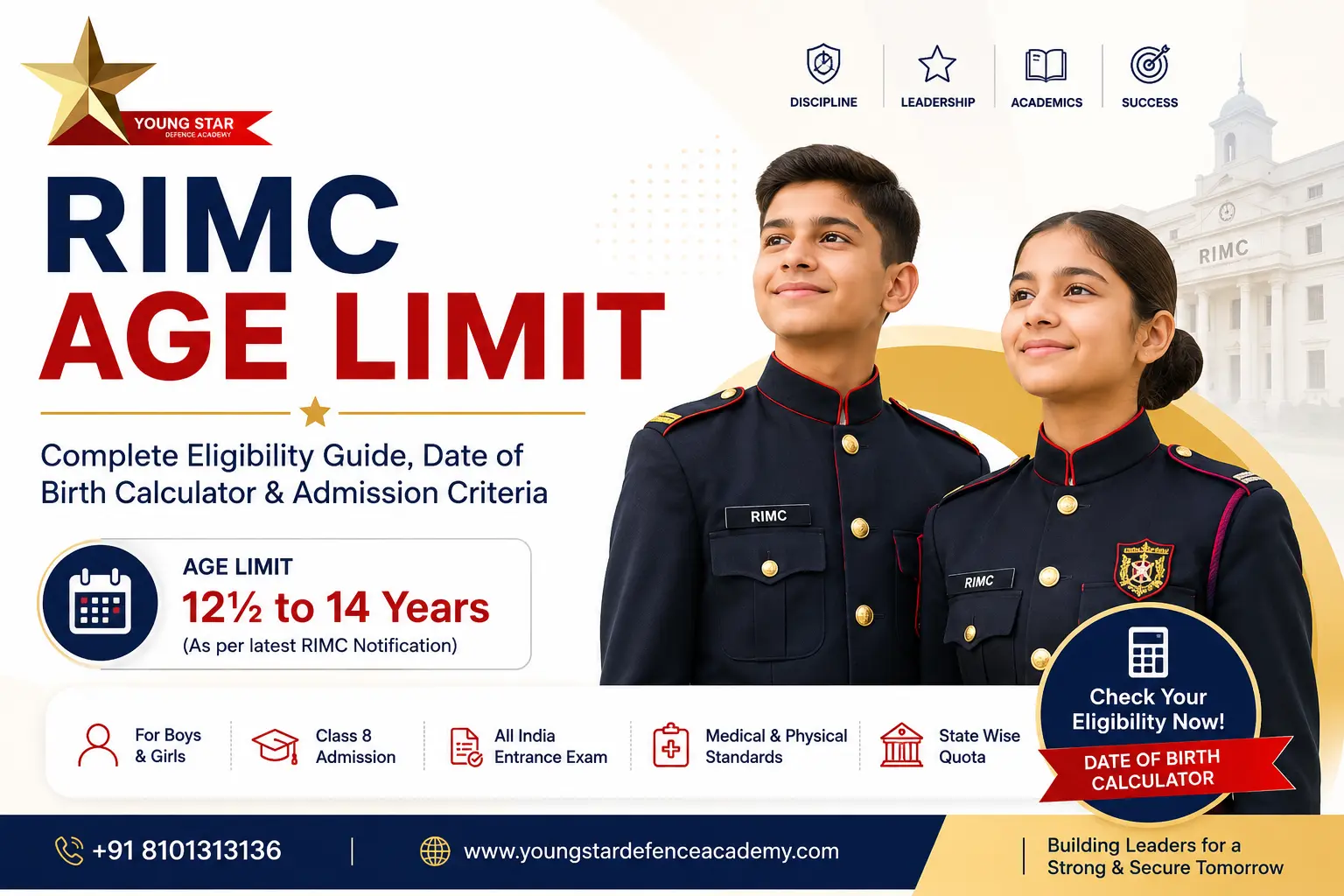
RIMC Age Limit: Complete Eligibility Guide, Date of Birth Calculator & Admission Criteria
Confused about whether your child qualifies for RIMC? Get your child’s eligibility checked by our defence admission counsellors — free, on WhatsApp.
Every year, thousands of parents across India begin the same search: “What is the RIMC age limit for my child?” It sounds like a simple question. In practice, it is the single most common reason talented children get rejected before the entrance exam even begins. Not because they failed a test. Often, their date of birth fell one day outside the eligible window — or a parent worked from an old, outdated age chart.
Rashtriya Indian Military College, Dehradun, is one of the most selective residential institutions in the country. Only around 250 cadets study there at any given time, and only a handful of seats open up per state in every admission cycle. When competition is this tight, eligibility is not a formality. It is the first filter, applied strictly — with no exceptions and no room for correction once you submit an application.
This guide exists because most parents get three things wrong when they check RIMC eligibility. They use today’s date instead of the term-commencement date. They mix up the January term and the July term DOB brackets. And they assume the age limit is a fixed number of years, rather than a moving date range that resets with every notification. This guide clears up all three — in plain language, with real dates and real examples.
By the end of this article, you will know exactly how the RIMC age limit works. You will know how to calculate your child’s eligibility manually, which educational and medical standards apply, and what documents you need. You will also see how RIMC eligibility compares with Sainik School and RMS age rules. One reminder: treat the dates here as a working reference, and always cross-check the exact bracket against the current official notification before you fill any form. RIMC updates its DOB windows with every admission cycle — getting this one detail wrong can end an application before it starts.
Quick Answer: RIMC Eligibility at a Glance
| Age Limit | 12½ to 14 years, calculated as on the date the term commences (1 January or 1 July) |
| Educational Qualification | Studying in Class VII, or has passed Class VII, from a recognised school |
| Nationality | Indian citizen, domiciled in the state through which the application is routed |
| Gender Eligibility | Both boys and girls are eligible, with separate merit lists |
| Medical Requirement | Fitness standards prescribed for defence training institutions, checked at a military hospital |
| Admission Frequency | Twice a year — a January term and a July term, each with its own DOB bracket |
| Class of Admission | Class VIII only — RIMC does not admit students directly into any other class |
| Official Entrance Examination | Written test (Mathematics, English, General Knowledge), followed by Viva-Voce and Medical Examination |
These figures are a working summary. RIMC issues a fresh notification for every term with its own exact DOB bracket, so always confirm the current cut-off dates on the official RIMC website before applying.
Table of Contents
- What is RIMC?
- Latest RIMC Age Limit
- Date of Birth Eligibility
- RIMC Age Calculator
- Educational Qualification
- Nationality Requirements
- Gender Eligibility
- Medical Eligibility
- State Quota
- Admission Process
- Documents Required
- Common Mistakes Parents Make
- RIMC vs RMS vs Sainik School Age Limit
- Frequently Asked Questions
- Expert Tips
- Final Conclusion
1. What is RIMC?
Rashtriya Indian Military College, Dehradun, began its life in 1922 as the Prince of Wales Royal Indian Military College, built with a single purpose: to prepare Indian boys for entry into premier military training academies. Today it functions as a Category ‘A’ training establishment under the Ministry of Defence, standing alongside the National Defence Academy, the Indian Military Academy, and the Officers Training Academy in India’s defence education ecosystem.
What makes RIMC different from an ordinary boarding school is its singular focus. A cadet who joins in Class VIII spends the next five years — through to Class XII — in a structured environment. It blends CBSE-pattern academics with military discipline, horse riding, swimming, drill, adventure training, and leadership grooming. Class sizes are small, the teacher-to-student ratio is unusually favourable, and every part of the daily routine is designed to build the temperament of a future officer, not just the marksheet of a good student.
Parents choose RIMC for the same reason officers’ families have chosen it for a century: it is widely regarded as the single strongest feeder institution into the National Defence Academy. A large share of RIMC cadets go on to clear the NDA entrance process with far greater ease than students preparing from a conventional school background, simply because the five years at RIMC are built around exactly that outcome. Beyond the NDA pathway, RIMC’s academic standards, sports infrastructure, and character-building programme give cadets a strong foundation even if a student later chooses a civilian career.
To understand the full picture of what RIMC is, its history, and its place among India’s defence schools, read our detailed guide on Rashtriya Indian Military College, and see what the three letters actually stand for in our RIMC full form guide.
2. Latest RIMC Age Limit
The RIMC age limit is not a fixed number that stays the same every year. It is a rule that says a candidate must be at least 12½ years old, and not older than 14 years, on the exact day the term begins. Because RIMC runs two intakes a year — one term starting 1 January and the other starting 1 July — there are two separate DOB brackets in circulation at any given time, and they are recalculated fresh for every notification.
This is the part that trips up most parents. It is not “14 years old when the child sits the exam” and it is not “14 years old on 1 April of the admission year.” The reference date is always the date the term actually commences at RIMC — 1 January for the January term, and 1 July for the July term. The written examination itself is usually held five to seven months before that reference date, so a child can look “too young” or “too old” on exam day and still be perfectly eligible once the correct reference date is applied.
Why does RIMC insist on this narrow 18-month window? Because admission is only into Class VIII, and the college has designed its five-year academic and physical training curriculum around cadets who are neither too young to cope with the discipline nor too old to complete the full Class VIII to Class XII cycle at the expected pace before moving on to the NDA entrance process at 16½ to 19 years. The age bracket exists to protect that pipeline, not to arbitrarily exclude children.
Because the exact DOB bracket shifts with every notification, we strongly recommend checking our live RIMC eligibility calculator before you assume your child qualifies for a particular term, and cross-verifying against the notification published on the official RIMC website.
3. Date of Birth Eligibility
Because the age limit is really a date-of-birth window, the cleanest way to check eligibility is to work directly with DOB ranges rather than ages in years and months. Below is a structural example of how RIMC brackets are typically framed. Treat the exact dates as illustrative — always match your child’s DOB against the live bracket published in the current notification.
| Term | Reference Date | Eligible DOB Window (illustrative pattern) |
|---|---|---|
| January Term | 1 January of the admission year | 2 January (14 years before) to 1 July (12½ years before) |
| July Term | 1 July of the admission year | 2 July (14 years before) to 1 January (12½ years before) |
To make this concrete: a candidate applying for a January-term admission must have been born on or after the date that falls exactly 14 years before that 1 January, and on or before the date that falls exactly 12½ years before that same 1 January. A candidate born even one day before the earlier cut-off, or one day after the later cut-off, does not qualify — RIMC’s Guidelines to Admission are explicit that no request for correcting or reconsidering a date of birth is entertained once the form has been submitted.
Example 1: Suppose a term begins on 1 January of a given year. A child eligible for that term must be born somewhere between the first two days of January fourteen years earlier and the first day of July twelve-and-a-half years earlier. A child born even a week after that upper cut-off misses this January term. But they may still qualify for the July term in between, depending on exactly where their birthday falls. This is why it pays to work out both brackets in advance.
Example 2: A child born in early monsoon months, say June, will typically find themselves right at the edge of eligibility for either the January or July term of a particular year, and safely in the middle of the bracket for the adjacent term. This is common, and it is exactly the kind of case parents should map out two admission cycles in advance using our eligibility calculator rather than guessing.
4. RIMC Age Calculator
You do not need any special tool to work out RIMC eligibility manually — you only need to be precise about the reference date. Here is the method we walk parents through at our counselling sessions:
- Identify the term you are targeting — January or July — and note its exact commencement date from the current notification.
- Calculate the date exactly 14 years before the term-commencement date. Your child must be born on or after this date.
- Calculate the date exactly 12½ years before the term-commencement date (that is, 6 months short of 13 years before). Your child must be born on or before this date.
- Check your child’s DOB, as recorded on their birth certificate, against this window. Use the birth certificate date, not the school-record date, if the two ever differ — RIMC gives primacy to the municipal/panchayat-issued birth certificate.
- Cross-check with the school-leaving or bonafide certificate to make sure the same DOB is reflected there too, since both documents are required at submission.
Doing this by hand for two terms across two years takes about ten minutes with a calendar in front of you, and it removes any doubt caused by online age-calculator tools that sometimes use the wrong reference date. If you would rather not do the maths yourself, our RIMC eligibility calculator is built specifically around the term-commencement logic described above, and gives you a straight eligible/not-eligible answer along with the recommended attempt for your child.
5. Educational Qualification
The educational bar for RIMC is deliberately simple, but it is applied strictly: a candidate must, at the time the term begins, either be currently studying in Class VII, or have already passed Class VII, from a school recognised by the relevant education authority.
A few clarifications parents frequently ask about:
- Recognised boards: CBSE, ICSE, and state board schools are all accepted, provided the school itself carries formal recognition from its state education department or the relevant board.
- Students who have skipped ahead: A child already in Class VIII or higher at the time of the exam is not automatically disqualified purely on educational grounds, but they must still fall within the DOB bracket — the two conditions (age and class) are both checked independently.
- Students who have repeated a year: A child who is currently in Class VI, and has not yet passed or is not yet studying in Class VII, does not meet the educational bar for that particular attempt, even if their date of birth otherwise qualifies. They should wait for a later term once they are in Class VII.
- Transfer or migration cases: Children who have recently transferred schools, including from abroad, need a bonafide or transfer certificate from their current recognised school confirming the class they are studying in, in addition to their previous school records.
Because Class VII (or having passed it) is the threshold, most serious aspirants begin structured RIMC preparation while still in Class VI, so that both the academic foundation and the age bracket line up comfortably by the time they sit the entrance exam. Our detailed RIMC syllabus guide breaks down exactly what is tested at this stage.
6. Nationality Requirements
RIMC admission is open to Indian citizens. Applications are routed through the candidate’s home state’s Directorate of Education or Directorate of Public Instruction, based on the child’s state of domicile — not through RIMC directly. This is an important structural point: even after clearing the written exam, viva-voce, and medical examination, a candidate’s seat is tied to the state quota of the state through which their application was submitted.
Children of central government employees, including defence personnel, who are posted outside their home state can usually appear for the exam at their place of posting for convenience, but their candidature and eventual seat allocation is still considered against their original domicile state’s quota, not the state they happen to be living in at the time.
7. Gender Eligibility
RIMC now admits both boys and girls, with separate all-India and state-wise merit lists prepared for each. The age bracket, the educational qualification, the written examination pattern, and the medical standards applied are identical for boys and girls — there is no separate or relaxed age criterion for either gender.
For families specifically researching options for daughters, our dedicated guides on RIMC admission for girls and Sainik School for girls cover the practical differences in hostel arrangements, intake numbers, and preparation strategy that parents of girl candidates typically ask about.
8. Medical Eligibility
Medical fitness is checked only after a candidate has cleared the written examination and viva-voce — it is the final gate, not the first one, but it carries just as much weight, because RIMC will not offer a seat to a candidate who does not meet its fitness standards, regardless of how well they scored academically.
The medical examination is conducted by a board at a designated military hospital and broadly evaluates:
- General physical fitness — freedom from any condition that would interfere with the physically demanding cadet training routine, including drill, sports, and adventure activities.
- Height and weight — assessed against age-appropriate standards for growing children, with some flexibility built in given the candidates are between 12½ and 14 years old.
- Vision — both eyes are checked for visual acuity and colour vision; minor correctable vision issues are usually not disqualifying, but the exact standards are set out in RIMC’s published medical guidelines.
- Hearing — checked for any significant impairment.
- Dental and general systemic health — including checks for any chronic conditions that could affect a five-year residential training programme.
Because these standards are periodically reviewed, parents should always refer to the official medical standards document linked from the RIMC admissions page rather than relying on word-of-mouth benchmarks, particularly for anything borderline like vision correction or minor old injuries.
9. State Quota
RIMC reserves seats on a state-wise basis, broadly aligned to one or a small number of seats per state and union territory in each admission cycle, with separate merit lists maintained for boys and girls. Because seats are allocated by domicile state rather than as a single all-India pool beyond the top-ranking candidates, the level of competition a child faces can vary depending on how many aspirants from their own state are applying in that cycle.
This state-wise structure also explains why an application must be routed through the candidate’s own State Directorate of Education, and why domicile certificates and category certificates (where applicable) are mandatory supporting documents — RIMC has no way of verifying state eligibility without them.
10. Admission Process
The full journey from notification to joining typically follows this sequence:
- Notification release: RIMC publishes an advertisement roughly 10 to 11 months before the term commences, announcing the exam date, DOB bracket, and application deadline.
- Obtain the Prospectus-cum-Application Form: This can be paid for online through the official RIMC payment portal, or obtained by sending a demand draft along with a self-addressed envelope to RIMC, Dehradun. Only the original form carrying the RIMC hologram is valid — photocopied or locally printed forms are rejected outright.
- Fill the form in duplicate and attach all mandatory documents (see the documents section below).
- Submit to the State Directorate of Education — never directly to RIMC — before the stated deadline.
- Admit card issuance ahead of the written examination date.
- Written Examination: Conducted at designated centres, generally state capitals or other major cities, in Mathematics, English, and General Knowledge, all on the same day.
- Written result declaration: State-wise and all-India results are published on the official RIMC website.
- Viva-Voce: Shortlisted candidates appear for a personality interview conducted by a state-level selection board.
- Medical Examination: Candidates who clear the viva-voce undergo a medical fitness assessment at a designated military hospital.
- Merit list and joining instructions: Final selection is based on combined performance across all stages, subject to medical fitness. Selected candidates typically must join within about ten days of receiving joining instructions.
For a step-by-step breakdown of each stage with current timelines, see our full RIMC admission process guide, our page on the RIMC exam pattern, and general information on RIMC admission.
11. Documents Required
| Document | Purpose / Notes |
|---|---|
| Birth Certificate | Issued by Municipal Corporation or Gram Panchayat; the primary proof of date of birth |
| School Certificate | Original certificate from the current school’s Principal, attested with photograph, confirming DOB and class |
| Photographs | Recent passport-size photographs, typically two copies |
| Domicile Certificate | Confirms the state through which the application and quota are assessed |
| Category Certificate | SC/ST certificate where applicable, needed for both fee concession and reservation |
| Aadhaar Card | Photocopy of both sides; a mandatory identity document |
| Medical Documents | Presented at the medical examination stage, not at initial application |
| Self-addressed envelope | With the prescribed postage, used to dispatch the admit card |
Document Checklist Before You Submit:
- Application form filled in duplicate, signed, with photograph affixed
- Birth certificate and school certificate showing the same date of birth
- Domicile certificate matching the state of submission
- Aadhaar photocopy (both sides)
- Category certificate, if claiming SC/ST fee concession or reservation
- Demand draft or online payment receipt for the application fee
12. Common Mistakes Parents Make
- Calculating age as of the exam date instead of the term-commencement date (1 January or 1 July).
- Mixing up the January and July brackets and applying under the wrong term altogether.
- Assuming last cycle’s DOB bracket still applies — every notification carries its own fresh window.
- Letting the birth certificate and school records show different dates of birth, which triggers document rejection or delays.
- Submitting a photocopied application form instead of the original form with the RIMC hologram.
- Sending the form directly to RIMC, Dehradun instead of routing it through the State Directorate of Education.
- Missing the state submission deadline because it is earlier than the exam date by several weeks.
- Assuming a change of DOB can be requested later if a clerical error is discovered after submission — RIMC does not entertain this.
- Ignoring the educational qualification check and applying while the child is still in Class VI.
- Underestimating the medical standards, particularly correctable vision issues, and not addressing them early.
- Not keeping a category certificate ready in time for SC/ST fee concession, missing the reduced fee window.
- Confusing RIMC’s Class VIII entry with Sainik School’s Class VI or Class IX entry and preparing for the wrong exam pattern.
- Believing coaching guarantees admission, and relaxing preparation once enrolled in a coaching programme.
- Delaying form collection until close to the deadline, risking postal delays for demand-draft applications.
- Not verifying the current notification and relying on old blog posts or forwarded WhatsApp messages for eligibility dates.
13. RIMC Age Limit vs RMS vs Sainik School
Parents researching defence schools for their children often compare RIMC, Rashtriya Military Schools (RMS), and Sainik Schools (AISSEE) side by side, since all three lead toward similar defence-services outcomes but differ sharply in entry age, class of admission, and structure.
| Feature | RIMC | RMS | Sainik School (AISSEE) |
|---|---|---|---|
| Class of Entry | Class VIII only | Class VI and Class IX | Class VI and Class IX |
| Age Bracket | 12½ to 14 years, as on term commencement | Varies by class of entry, single annual intake | Varies by class of entry, single annual intake |
| Intakes Per Year | Two (January and July terms) | One | One |
| Governing Body | Ministry of Defence | Indian Army | Sainik Schools Society, Ministry of Defence |
| Primary Outcome | Strong NDA feeder, five-year residential programme | Feeds into NDA and other services entries | Broad feeder for NDA and other defence entries |
If you are still deciding which pathway fits your child’s current class and age, our guides on RMS coaching and Sainik School coaching lay out the age and class requirements for each in detail, so you can compare all three side by side before committing your child’s preparation time to one exam.
14. Frequently Asked Questions
1. What is the RIMC age limit?
A candidate must be at least 12½ years old and not older than 14 years, calculated as on the date the RIMC term actually commences — either 1 January or 1 July, depending on which term they are applying for. This is different from the exam date, which is usually held five to seven months before the term begins. Because RIMC issues a new notification, and therefore a new date-of-birth bracket, for every admission cycle, the exact eligible dates shift slightly from one term to the next. Parents should always check the specific notification for the term they are targeting rather than relying on a previous cycle’s dates, and should treat the term-commencement date, not the exam date, as the only reference point that matters for eligibility.
2. Can girls apply for RIMC admission?
Yes. RIMC now admits both boys and girls, with separate all-India and state-wise merit lists maintained for each gender. The eligibility criteria — age bracket, educational qualification, written exam pattern, and medical standards — are identical for boys and girls; there is no relaxed or separate age rule for girl candidates. Girls follow the same application route through their State Directorate of Education, sit the same written papers in Mathematics, English, and General Knowledge, and go through the same viva-voce and medical examination process as boys. Families researching this option in more depth can also look at Sainik School options built specifically around girl candidates for a fuller comparison of hostel and intake structures.
3. Can a student appear for the RIMC exam more than once?
Yes, a candidate can appear multiple times, provided they continue to meet the age and educational eligibility criteria for each specific term they apply to. Since the DOB bracket shifts by roughly six months with every term, a child who narrowly misses eligibility or selection in one cycle may still qualify for the very next term, or the one after, depending on where their birthday falls relative to the moving window. There is no rule limiting the number of attempts by itself — the only real constraint is the 12½ to 14 age bracket, which naturally limits most children to two or three realistic attempts across their eligible window before they age out of contention entirely.
4. What happens if my child’s birthday falls just outside the eligibility range?
If a child’s date of birth falls even one day before or after the eligible bracket for a given term, they are not eligible for that particular term, and RIMC does not entertain requests for exceptions or DOB corrections after the fact. However, because there are two intakes a year, a child who narrowly misses the window for one term is very often comfortably eligible for the adjacent term, either just before or just after. This is exactly why we encourage parents to map out both the January and July brackets across two admission cycles in advance, rather than assuming a single “no” from one term closes the door on RIMC altogether.
5. How exactly is RIMC age calculated?
RIMC age is calculated by comparing the candidate’s date of birth, as recorded on their birth certificate, against two boundary dates derived from the term-commencement date: one boundary set exactly 14 years before that date, and the other set exactly 12½ years before it. A candidate must have been born on or after the 14-years-before date, and on or before the 12½-years-before date. This calculation should always use the official term-start date (1 January or 1 July) as the anchor point, never the exam date or the application deadline, both of which fall several months earlier and would produce an incorrect eligibility result if used by mistake.
6. Can CBSE students apply for RIMC?
Yes, students from CBSE-affiliated schools are fully eligible to apply, provided the school itself is recognised by the relevant education authority and the child is either studying in Class VII or has already passed it at the time the term commences. CBSE is one of the most common boards among successful RIMC candidates simply because it is widely used across defence and government-linked schools, but there is no preference given to CBSE over any other recognised board — the requirement is about recognition status and class level, not the specific curriculum board the child follows.
7. Can ICSE students apply for RIMC?
Yes, ICSE students are equally eligible, on exactly the same terms as CBSE or state-board students: the school must be recognised, and the child must be in or have passed Class VII by the time the term begins. RIMC’s written examination in Mathematics, English, and General Knowledge is set at a level that any well-prepared student from a recognised Class VII curriculum, regardless of board, can reasonably attempt, though most successful candidates supplement their regular schoolwork with focused RIMC-specific preparation covering reasoning, general awareness, and exam-pattern practice well before the written test.
8. Is there any age relaxation for reserved categories at RIMC?
Based on publicly available RIMC guidelines, the core age bracket of 12½ to 14 years applies uniformly to all candidates, and there is no separate age relaxation offered for SC/ST or other reserved categories. What does differ for reserved categories is the application fee, which is reduced for SC/ST candidates who submit a valid caste certificate, and the reservation applied within the state-wise merit list during final selection. Because policies can be revised, families relying on category-based concessions should always verify the current position directly against the latest official notification rather than assuming past practice continues unchanged.
9. What documents prove my child’s date of birth for RIMC?
The primary proof of date of birth is the birth certificate issued by a Municipal Corporation or Gram Panchayat. This is supported by a certificate from the current school’s Principal, which must independently confirm the same date of birth along with the class the child is studying in. RIMC checks that both documents agree; if there is a mismatch between the birth certificate and the school record, it can cause the application to be rejected or delayed at the verification stage. Parents should compare both documents well before the application deadline and get any discrepancy corrected through the proper municipal or school channels in advance.
10. Can students studying abroad apply for RIMC?
Indian citizens studying abroad can apply, provided they meet the same age and educational criteria as domestic candidates, and provided they can furnish a domicile certificate linking them to an Indian state, since applications must be routed through a State Directorate of Education. In practice, this route requires more document preparation than a domestic application — particularly around getting a foreign school’s certificate accepted as proof of “recognised school” status and coordinating submission timelines across time zones — so families in this situation should begin the documentation process well ahead of the standard deadline.
11. What medical standards does RIMC require?
RIMC’s medical examination checks general physical fitness, height and weight relative to age-appropriate standards, vision (including colour vision), hearing, dental health, and overall systemic fitness for a physically demanding five-year residential programme. The examination is conducted by a medical board at a designated military hospital, only after a candidate has cleared both the written examination and the viva-voce. Minor, correctable issues such as mild vision problems are not automatically disqualifying, but the exact permissible standards are detailed in RIMC’s official medical guidelines, which parents should review directly rather than relying on informal benchmarks from previous years.
12. What if the birth certificate and school records show different dates?
This is one of the most common — and most avoidable — reasons for application rejection. If the birth certificate and the school’s official record show different dates of birth, RIMC’s verification process will flag the mismatch, and the candidate risks disqualification regardless of how well they perform academically. The correct approach is to identify and resolve the discrepancy well before applying: get the school record corrected to match the municipal birth certificate through the proper administrative process, since the birth certificate is generally treated as the primary legal document for age verification purposes.
13. How many times a year is the RIMC exam conducted?
The RIMC written examination is conducted twice a year, once for candidates targeting the January term and once for candidates targeting the July term. Each exam cycle has its own notification, its own application deadline, its own written exam date, and its own date-of-birth bracket, even though the underlying eligibility rule — 12½ to 14 years as on the term-commencement date — stays structurally the same across both cycles. This twice-yearly cadence gives families more flexibility than most single-intake defence exams, since a child who misses eligibility, selection, or even just preparation readiness for one cycle typically has another opportunity within six months.
14. What is the best age to start RIMC preparation?
Most experienced defence-admission counsellors recommend starting structured RIMC preparation while a child is in Class VI, roughly twelve months or more before their likely exam attempt. This gives enough time to build strong fundamentals in Mathematics and English, develop general knowledge steadily rather than through last-minute cramming, and get comfortable with the written exam’s format through regular practice tests. Starting this early also gives families breathing room to plan around the age bracket properly — deciding well in advance whether a child is a better fit for the January or July term of a particular year, rather than scrambling to check eligibility close to a deadline.
15. Can students from any state apply for RIMC?
Yes, RIMC admission is open to Indian citizens from every state and union territory, since seats are distributed on a state-wise basis with dedicated quotas. The application itself must be routed through the candidate’s own State Directorate of Education, based on their domicile, rather than through RIMC directly. This means a child’s application is always assessed within the applicant pool of their own home state, which is an important factor to keep in mind when estimating how competitive a particular attempt is likely to be.
16. Is coaching compulsory for RIMC admission?
Coaching is not a formal requirement — any eligible child can apply and appear for the written examination directly. In practice, however, RIMC’s selection process is highly competitive, with a very small number of seats available per state, and structured coaching helps candidates build the specific combination of Mathematics rigour, English proficiency, general knowledge breadth, and exam-temperament that the written test and subsequent viva-voce assess. Many successful candidates combine regular schoolwork with a dedicated RIMC preparation programme rather than relying on school coursework alone, particularly for the General Knowledge and reasoning components that fall outside a typical Class VI or VII syllabus.
17. What subjects are tested in the RIMC written examination?
The RIMC written examination covers three subjects on a single day: Mathematics, English, and General Knowledge, each carrying its own marks weightage and requiring a minimum qualifying percentage in every individual subject, not just an aggregate score. This means a candidate cannot compensate for a weak subject with a strong one — they must clear the minimum threshold in Mathematics, English, and General Knowledge independently to advance to the viva-voce stage. Our detailed syllabus and exam pattern guides break down the exact topics and marks distribution for each of these three papers.
18. What happens after clearing the RIMC written exam?
Candidates who clear the written examination, meeting the minimum qualifying percentage in each subject, are shortlisted for a viva-voce — a personality interview conducted by a state-level selection board. Candidates who clear the viva-voce then proceed to a medical examination at a designated military hospital. Final selection and the merit list are based on a combination of performance across the written exam and viva-voce, subject to the candidate being declared medically fit. Only after all three stages are cleared does a candidate receive joining instructions.
19. Is the application form the same for boys and girls?
The application process, form, required documents, fee structure, and eligibility criteria are the same for boys and girls. The only structural difference is that RIMC maintains separate merit lists for boys and girls at both the state-wise and all-India level, reflecting that seats and competition are tracked separately by gender rather than pooled into a single combined list.
20. Where should the completed RIMC application form be sent?
The completed application form, along with all required documents, must be submitted to the candidate’s respective State Government — typically the Directorate of School Education or equivalent authority — and not sent directly to RIMC, Dehradun. This routing exists because seats are allocated on a state-wise quota basis, and the state education department is responsible for the initial verification and forwarding of applications from its domicile candidates.
21. What is the application fee for RIMC?
The RIMC application fee is typically set at a standard amount for general and OBC candidates, with a reduced fee for SC/ST candidates who submit a valid caste certificate along with their demand draft request. Because fee amounts can be revised with each notification, parents should confirm the exact current fee directly from the notification for the term they are applying under, rather than relying on a figure from a previous cycle.
22. Can the date of birth be corrected after the RIMC form is submitted?
No. RIMC’s Guidelines to Admission are explicit that no request for changing the date of birth from what was originally entered on the application form will be entertained after submission. This is precisely why parents are strongly advised to cross-check the birth certificate and school record for consistency before filling the form, rather than discovering a discrepancy after the application has already been sent to the State Directorate of Education.
23. Does RIMC allow lateral entry into classes other than Class VIII?
No. RIMC’s regular admission process is exclusively for entry into Class VIII. There is no lateral entry route into Class IX, X, XI, or XII through the standard entrance examination process described in this guide. Any vacancy that arises in a higher class through withdrawal is handled through a separate, much smaller and less predictable process, and should not be treated as a reliable admission pathway by families planning ahead.
24. How is the RIMC merit list prepared?
The RIMC merit list is prepared state-wise, and separately for boys and girls, based on a candidate’s combined performance in the written examination and the viva-voce, provided they are also declared medically fit. Because the process is state-wise rather than a single all-India ranking, a candidate’s chances depend partly on how competitive their own state’s applicant pool is in that particular cycle, not solely on their absolute score.
25. What if my child is currently in Class VI — when should they apply?
A child currently in Class VI does not yet meet RIMC’s educational qualification, since the requirement is that a candidate must be studying in Class VII or have already passed it at the time the term commences. Such a child should plan to apply once they have progressed into Class VII, provided their date of birth also falls within the eligible bracket for that term. This is a good time to begin structured preparation, since there is typically twelve months or more available before the child becomes formally eligible to apply.
26. Are RIMC cadets required to join the Armed Forces after graduating?
No, joining the Armed Forces is not a binding requirement for RIMC cadets. RIMC is structured to prepare cadets thoroughly for the NDA entrance process and a defence career, and the overwhelming majority of cadets do pursue this path given the institution’s focus, but a cadet who later decides not to pursue a defence career is not contractually bound to do so. The five years at RIMC also provide a strong general academic and personal-development foundation that benefits cadets regardless of their eventual career choice.
27. Can a candidate change their target term after submitting the form?
No, once an application has been submitted for a specific term, it is processed for that cycle only. If a candidate’s circumstances change, or if they realise they targeted the wrong term, they generally need to wait for the next notification and submit a fresh application for the term they actually intend to appear for, along with the applicable fee and updated documents for that cycle.
28. What is the difference between the written exam date and the term-commencement date?
The written examination is held several months before the term actually begins — commonly around five to seven months earlier — to allow enough time for result declaration, viva-voce, medical examination, and joining instructions to be completed before the new term starts. Eligibility itself, however, is always assessed against the later term-commencement date, not the earlier exam date. This gap is exactly why some children who look ineligible on the exam date are, in fact, eligible once the correct term-commencement date is used for the calculation.
29. Does RIMC provide any relaxation for candidates from remote or hill states?
The core age and educational eligibility criteria are applied uniformly across all states, and we are not aware of a blanket age relaxation specifically for remote or hill-state candidates in the standard RIMC entrance process. Some states do offer additional support such as scholarships to domicile candidates who secure admission, which is a financial benefit rather than an eligibility relaxation. Families in remote regions should focus their attention on document logistics — postal timelines for demand-draft applications, access to exam centres, and coordination with their State Directorate of Education — since these practical factors often matter more than any formal eligibility difference.
30. Where can I find the most reliable, up-to-date RIMC eligibility information?
The single most reliable source is the notification published directly on the official RIMC website, which sets out the exact date-of-birth bracket, exam date, application deadline, and fee for that specific term. Coaching institute blogs, including this guide, are useful for understanding how the rules work and how to interpret them correctly, but the specific dates should always be cross-checked against the official notification before a family commits time and money to an application.
15. Expert Tips
- Always calculate eligibility using the term-commencement date, never the exam date or application deadline.
- Map out both the January and July DOB brackets for the next two admission cycles, not just one.
- Cross-check the birth certificate against the school record before filling any form, and correct mismatches early.
- Begin structured preparation from Class VI so the child is exam-ready well before they become formally eligible in Class VII.
- Treat Mathematics, English, and General Knowledge as three independent hurdles, since each has its own minimum qualifying percentage.
- Keep a dedicated folder of originals and photocopies of every required document, updated as soon as each one is issued.
- Apply for the domicile and category certificates (if applicable) well ahead of the deadline — these often take longer to process than parents expect.
- Get a basic health and vision check-up done early, so any correctable medical issue is addressed before the final medical examination.
- Never send the application form directly to RIMC — route it through the correct State Directorate of Education.
- Only use the original prospectus-cum-application form with the RIMC hologram; photocopies are rejected.
- Practice under timed, exam-day conditions using genuine previous year papers rather than generic sample questions.
- Prepare a realistic viva-voce strategy in advance — general awareness, communication confidence, and composure matter as much as marks.
- Track the official RIMC website directly for the current notification rather than relying only on second-hand sources.
- If your child narrowly misses one term’s bracket, immediately check their eligibility for the adjacent term rather than waiting a full year.
- Start early enough that a single missed cycle does not put unnecessary pressure on the next attempt.
16. Final Conclusion
The RIMC age limit is simple in principle — 12½ to 14 years, as on the day the term commences — but it is unforgiving in practice, because it is checked against an exact date of birth with no room for later correction. The families who navigate this smoothly are almost always the ones who worked out their child’s eligibility calmly and well in advance, using the correct reference date, rather than the ones who rushed a calculation close to a deadline.
If there is one habit worth building from this guide, it is this: whenever a new RIMC notification is released, sit down with a calendar, your child’s birth certificate, and the term-commencement date, and work out the eligibility window properly before doing anything else. Everything downstream — the application form, the documents, the preparation timeline — depends on getting that first step right.
Start early, verify every date against the current official notification, and give your child the full runway of preparation time their eligibility window allows. That combination, more than anything else, is what turns a genuine RIMC aspirant into a genuine RIMC cadet.
Not Sure If Your Child Qualifies for RIMC?
Talk to our defence admission counsellors at Young Star Defence Academy and get your child’s RIMC eligibility checked accurately — for both the January and July terms.
This guide is prepared by the admissions counselling team at Young Star Defence Academy, founded by Prashant Singh, with campuses in Amritsar, Chandigarh, and Kapurthala, Punjab. For further preparation resources, see our RIMC coaching, RIMC mock tests, previous year question papers, and RIMC fee structure pages. Eligibility details in this article reflect the general pattern of recent RIMC notifications and should always be verified against the current notification on the official RIMC website before applying.