
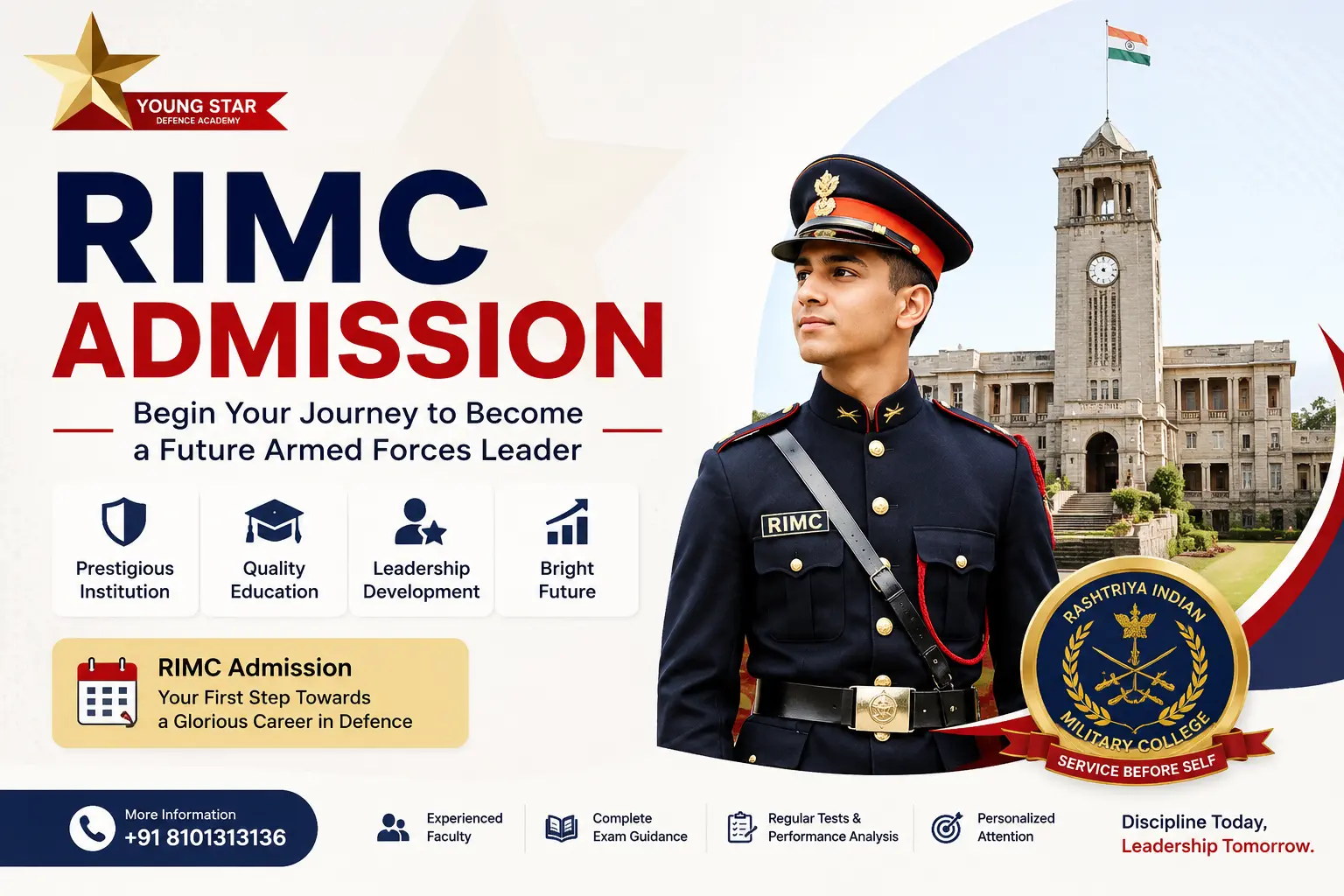
RIMC Admission: Complete Guide to Eligibility, Exam, Fees & Selection Process
Quick Answer: RIMC admission is open to boys and girls who are studying in or have passed Class 7, and who fall between 12½ and 14 years of age on the joining date. Selection happens through a written entrance exam, a Viva Voce (interview), and a medical examination, with roughly one seat allotted per state twice a year. Applications must be routed through your State Government, not sent directly to RIMC.
Rashtriya Indian Military College, Dehradun is not an ordinary boarding school. It is a feeder institution for the National Defence Academy, run by the Ministry of Defence, and it has been shaping military leaders for over a century. Every year, thousands of Class 7 students across India compete for a mere handful of seats. This guide walks you through the complete RIMC admission process, eligibility, exam pattern, fees, documents, and preparation strategy, written the way a mentor would explain it to a worried parent sitting across the table.
Confused about eligibility, dates, or documents? Get free RIMC admission guidance from our counsellors.
Table of Contents
- What is RIMC?
- RIMC Admission Overview
- RIMC Eligibility Criteria
- Age Limit Explained
- Educational Qualification
- How Many Seats Are Available?
- RIMC Admission Process
- Application Process
- Documents Required
- RIMC Entrance Examination
- Selection Process
- Interview (Viva Voce)
- Medical Examination
- Fees Structure
- Hostel Life
- Preparation Strategy
- Common Mistakes Parents Make
- Expert Tips
- Comparison Tables
- Frequently Asked Questions
What is RIMC?
RIMC, or Rashtriya Indian Military College, is a Category ‘A’ residential school in Dehradun run under the Ministry of Defence. Founded in 1922, it exists for one purpose: to identify boys and girls with leadership potential at a young age and prepare them for a career as officers in the Indian Armed Forces. Cadets who complete Class 12 at RIMC move on to the National Defence Academy, and from there into the Army, Navy, or Air Force as commissioned officers. You can explore the college’s own overview on the official RIMC website.
History and Mission
RIMC began as the Prince of Wales Royal Indian Military College and has since produced several Chiefs of the Indian Armed Forces and generations of decorated officers. Spread across roughly 54 hectares in the Doon Valley, the campus blends a public-school academic environment with military discipline. The mission has stayed consistent for a century: catch talent early, at age 11 or 12, and mould it over five formative years.
Why RIMC is Prestigious
Unlike Sainik Schools, where hundreds of students are admitted each year, RIMC admits only around 25 cadets every six months across the entire country. The teacher-student ratio stays close to 1:14, and the college conducts board examinations twice a year, a provision unique to RIMC. This scale of selectivity, combined with direct alignment to the NDA, is what makes an RIMC seat one of the most sought-after outcomes in Indian defence education. Read more about the institution on our Rashtriya Indian Military College page, or see the RIMC full form and background for a quick primer.
Who Can Apply
Both boys and girls who meet the age and educational criteria can apply, regardless of whether a parent has a defence background. RIMC is open to civilian families as much as service families, and domicile of the state matters only for allotment of the state quota seat, not for basic eligibility.
Why Parents Choose RIMC
Parents who choose RIMC are usually looking for more than academics. They want their child immersed in discipline, physical fitness, leadership training, and a guaranteed pathway toward the NDA. The subsidised fee structure relative to the quality of infrastructure, along with the credibility of a century-old military institution, makes it a preferred choice over private boarding schools for defence-minded families.
RIMC Admission Overview
RIMC admission happens twice a year, in January and July terms, entirely into Class 8. Selection runs through a written exam, viva voce, and medical test, with the whole cycle from notification to joining taking roughly six to eight months.
| Parameter | Detail |
|---|---|
| Entry Class | Class 8 only (referred to as Class I at RIMC) |
| Eligible Class | Studying in or passed Class 7 |
| Age Limit | 12½ to 14 years as on 1 January or 1 July of joining term |
| Gender | Boys and girls, both eligible |
| Admission Frequency | Twice a year — January term and July term |
| Exam Stages | Written Exam → Viva Voce → Medical Examination |
| Application Route | Through State Government, not directly to RIMC |
| Seats | Roughly 25 per term, about one per state, more for larger states |
| Final Authority | Merit list prepared state-wise; medical fitness mandatory |
RIMC Eligibility Criteria
To be eligible for RIMC admission, a candidate must be an Indian citizen, aged between 12½ and 14 years on the joining date, and currently studying in or have already passed Class 7 from a recognised school.
Eligibility Table
| Criteria | Requirement |
|---|---|
| Nationality | Indian citizen |
| Gender | Boys and girls |
| Age | Not less than 12½ years, not more than 14 years on 1 Jan or 1 July of joining term |
| Educational Qualification | Studying in Class 7, or has passed Class 7, from a recognised school |
| Domicile | Required for state quota allotment; children of central government employees may apply from place of posting but are considered under their original domicile state |
| Medical Fitness | Must meet RIMC medical standards at the final stage |
Important Notes
- Passing marks in Class 6 or below are irrelevant; only Class 7 status matters.
- A child who has already crossed 14 years by the joining date cannot apply, even by a few days.
- Physical disability or vision issues can affect final medical clearance even after a strong written and interview performance.
Common Mistakes in Eligibility
Many parents calculate age using the exam date instead of the joining date, which is incorrect. Others confuse Class 7 “passed” status with Class 8 enrolment, applying a year late by mistake. Always cross-check the exact cut-off dates on the official notification before assuming eligibility.
Eligibility Checklist
- Age falls within 12½–14 years on 1 Jan or 1 July of the joining term
- Currently in Class 7 or has passed Class 7
- Indian citizen with valid domicile documentation
- No major medical condition that could affect fitness standards
- Parent or guardian ready to support the application through the State Government channel
Not sure which attempt your child qualifies for? Use our eligibility calculator to check instantly based on date of birth.
RIMC Admission Age Limit Explained
The RIMC age limit requires a candidate to be at least 12½ years old but not yet 14 years old on the joining date of the term — either 1 January or 1 July. Because the cut-off shifts with every session, a child’s eligible attempt depends heavily on their exact date of birth.
How the Age Window Works
Since admission happens in January and July, a child effectively gets two or three attempts across the eligible age band, depending on where their birthday falls. A child born in the middle of the range may qualify for three separate sessions, while a child born near either edge of the window may get only one genuine attempt.
Example Scenarios
| Date of Birth | Eligible For | Not Eligible For |
|---|---|---|
| Early in the eligible window | Multiple sessions across two to three years | Sessions after turning 13 |
| Middle of the eligible window | Two to three consecutive sessions | Very early or very late sessions |
| Near the upper edge (close to turning 13) | Only the immediate next one or two sessions | Any session after the 13th birthday cut-off |
Because these cut-off dates are notified fresh for every cycle, parents should always verify the exact date range on the official RIMC notification rather than relying on last year’s chart. Our RIMC age limit page tracks this in more detail, and the eligibility calculator converts your child’s date of birth into eligible sessions automatically.
Educational Qualification
The only academic requirement for RIMC admission is Class 7. A candidate must either be currently enrolled in Class 7 or have already passed Class 7 from a school recognised by a state or central education board at the time of admission.
Recognised Boards
CBSE, ICSE, and state board schools are all accepted, as long as the school is formally recognised. There is no minimum percentage requirement in Class 6 or Class 7 school exams to be eligible for the RIMC entrance exam itself — academic performance is instead tested independently through the written exam.
Common Questions on Eligibility by Class
Parents often ask whether a child in Class 6 can apply — they cannot, since Class 7 status is mandatory. Similarly, a child already in Class 8 cannot apply for the same entry, since RIMC admits into Class 8 as a fresh Class 1 (RIMC’s internal Class 1) intake, and a child already sitting in Class 8 elsewhere has effectively crossed this window for that particular admission cycle.
How Many Seats Are Available?
RIMC admission accepts approximately 25 cadets per term, or roughly 50 across a full year, making it one of the most competitive school admissions in the country. Seats are distributed on a state quota basis, generally one per state, with larger states occasionally getting two.
Understanding the State Quota
Because merit lists are prepared state-wise rather than as one all-India list, a child’s real competition is against other candidates from the same state, not the entire country. This means the level of competition can vary meaningfully between a smaller state and a large, populous one. Reservation norms for SC, ST, and other categories apply within each state’s quota as per government policy.
Why Competition Feels So Intense
With only one or two seats per state and thousands of applicants nationally, the selection ratio is far tighter than most other defence school exams, including Sainik School or RMS. This is exactly why families begin preparation well before Class 7, often starting structured coaching from Class 5 or Class 6.
RIMC Admission Process
The RIMC admission process runs through six stages: notification, application submission via the State Government, written examination, Viva Voce, medical examination, and finally joining instructions after the merit list is published.
Step-by-Step Timeline
| Stage | What Happens |
|---|---|
| 1. Notification | RIMC releases the admission notification on its official website and in leading newspapers |
| 2. Application Form | Prospectus-cum-Application Form obtained online or via demand draft |
| 3. Submission to State Government | Completed form sent to the respective State Government department, not to RIMC directly |
| 4. Written Examination | All India entrance test held at designated centres |
| 5. Viva Voce | Shortlisted candidates called for the oral interview |
| 6. Medical Examination | Candidates who clear viva undergo fitness testing at a Military Hospital |
| 7. Merit List and Joining | Final state-wise merit list published; selected cadets receive joining instructions |
For a fuller breakdown of timelines and what documents to keep ready at each stage, see our dedicated RIMC admission process guide.
Application Process
Applying for RIMC starts with buying the official Prospectus-cum-Application Form, either online through the official RIMC website or offline through a demand draft, and ends with submitting the completed form to your State Government before the deadline.
Where to Get the Application Form
The form can be purchased online with digital payment on the official RIMC website, rimc.gov.in. Alternatively, families can send a demand draft payable to “THE COMMANDANT RIMC FUND” at the designated bank branch in Dehradun to receive the physical form and old question paper booklet by post.
How to Fill the Form
- Fill all fields in block letters using black or blue ink, if filling a physical form
- Match the name and date of birth exactly with the birth certificate
- Attach recent passport-size photographs as specified
- Double-check the domicile state, since the merit list depends on this
Application Fee
The application fee is nominal and typically differs for general category and SC/ST candidates, payable online or through a demand draft as specified in the notification. Fee amounts are revised periodically, so always check the current figure on the official notification before making payment.
Submission
The completed application, along with all supporting documents, must reach the respective State Government’s designated department — not RIMC directly — before the stated deadline. Submission is usually done by registered post or speed post, and only original forms carrying the official hologram are accepted.
Common Mistakes in the Application Process
The most frequent error is sending the form directly to RIMC instead of the State Government office. Others include missing the deadline by a few days, using a photocopied form instead of the original with the hologram, or leaving the domicile certificate out of the document set.
Application Checklist
- Original hologram-bearing application form, fully filled
- Application fee paid and receipt retained
- All supporting documents attached
- Form addressed and sent to the correct State Government department
- Copy of the completed application retained for personal records
Documents Required for RIMC Admission
RIMC admission requires a standard set of documents: birth certificate, school certificate confirming Class 7 status, domicile proof, identity proof, caste certificate where applicable, and recent photographs.
| Document | Type | Purpose |
|---|---|---|
| Birth Certificate | Original + photocopy | Age verification |
| School Certificate / Transfer Certificate | Original + photocopy | Confirms Class 7 status |
| Domicile Certificate | Photocopy | Determines state quota |
| Caste Certificate (if applicable) | Photocopy | Reservation category benefit |
| Aadhaar Card | Photocopy, both sides | Identity proof |
| Passport-Size Photographs | Recent, specified count | Form and admit card |
| Parent/Guardian Identity Proof | Photocopy | Verification during application |
Keep both originals and photocopies ready well in advance, since document verification happens at multiple stages, including at the exam centre and again before the medical examination.
RIMC Entrance Examination
The RIMC written exam tests English, Mathematics, and General Knowledge, is partly descriptive rather than pure multiple choice, and requires a minimum of 50% marks in each subject separately to qualify for the Viva Voce.
Exam Pattern Table
| Subject | Marks | Nature |
|---|---|---|
| English | 125 | Descriptive and objective, English only |
| Mathematics | 200 | Descriptive and objective, English or Hindi |
| General Knowledge | 75 | Objective, English or Hindi |
| Total (Written) | 400 | Minimum 50% required per subject |
| Viva Voce | 50 | Minimum 50% required |
Why RIMC’s Exam Feels Different
Unlike Sainik School or RMS entrance exams, which lean heavily on objective questions, RIMC’s Mathematics and English papers are largely descriptive. This means neat handwriting, clear working, and structured essay-writing genuinely matter. A child who can explain their reasoning on paper has a real advantage here.
Preparation Strategy for the Written Exam
Since each subject needs an independent 50% to qualify, lopsided preparation is dangerous. A child who is brilliant at Mathematics but weak in English can still be eliminated. Balanced daily practice across all three subjects, with special focus on the descriptive answer-writing style, works far better than over-investing in one favourite subject. For syllabus-wise topic breakdowns, see our RIMC syllabus page, and for pattern-specific practice, our RIMC exam pattern page and RIMC previous year question papers are useful starting points.
Selection Process
RIMC selection moves through three filters in sequence — written exam, Viva Voce, and medical examination — with a state-wise merit list finalising admission only after a candidate is found fully fit.
- Written Exam: Tests academic readiness across English, Maths, and GK
- Viva Voce: Assesses intelligence, personality, and confidence
- Medical Examination: Confirms physical fitness as per RIMC’s prescribed standards
- State Quota Merit List: Ranks qualified candidates within their own state
- Final Selection: Only medically fit, top-ranked candidates within the state quota are offered admission
Clearing the written exam does not guarantee a seat — it only opens the door to the viva and medical stages, both of which have eliminated strong academic performers in the past.
Interview (Viva Voce)
The RIMC admission Viva Voce is a 50-mark oral interview designed to judge a candidate’s intelligence, personality, and confidence rather than rote knowledge, and requires a minimum of 50% to qualify.
Purpose
The interview board is not searching for the “smartest” child in the room. They are evaluating whether the child is trainable — calm under pressure, honest, alert, and comfortable holding a conversation with adults.
Typical Areas Covered
- General awareness and current affairs appropriate for the child’s age
- Family background and daily routine
- Hobbies, sports, and extracurricular interests
- Basic reasoning and situational questions
- Comfort with English conversation
Tips for the Viva
Encourage the child to speak naturally instead of memorising scripted answers, since board members can easily spot rehearsed responses. Eye contact, a calm posture, and honest answers — including admitting when they don’t know something — leave a far better impression than an over-confident guess.
Medical Examination
The RIMC admission medical examination checks general fitness, vision, height, weight, and any structural or organic conditions, and only candidates found fully fit are considered for final selection, regardless of how well they performed earlier.
What Gets Checked
- General physical fitness and body proportions
- Vision and eye health
- Hearing
- Any existing medical conditions or old injuries
- Dental health
Common Rejection Reasons
Uncorrected vision problems beyond permissible limits, certain skin conditions, flat feet, or unresolved orthopaedic issues are among the more common reasons candidates get held back at this stage. Because this is the final gate, it is worth getting a general paediatric and vision check-up done well before the exam cycle, so any correctable issue is addressed in time.
Fees Structure
RIMC fees include an annual charge covering tuition, hostel, and mess, along with a one-time refundable security deposit, with SC/ST candidates paying a reduced annual fee compared to the general category.
| Component | Applicability |
|---|---|
| Annual Fee (General Category) | Covers tuition, boarding, and mess |
| Annual Fee (SC/ST Category) | Reduced rate compared to general category |
| Refundable Security Deposit | One-time, refunded when the cadet leaves the college |
| Uniform and Kit | Charged separately as per issued items |
| Books and Stationery | Included or billed as part of annual charges depending on the term |
Fee figures are revised periodically by the Ministry of Defence and should always be confirmed against the latest official notification before budgeting. Our RIMC Dehradun fees page tracks the most recent figures in detail.
Scholarships
Because RIMC fees are already heavily subsidised compared to private boarding schools of similar standard, additional scholarships are limited, though state governments occasionally extend financial support to meritorious candidates from economically weaker backgrounds. Families should check with their respective State Education Department for any such provisions.
Hostel Life
RIMC hostel life follows a structured military-style daily routine that combines academics, physical training, sports, and leadership activities within a disciplined residential campus.
Campus and Daily Routine
Cadets follow a fixed schedule that begins early with physical training, followed by academic classes through the day, sports and drill in the evening, and prep or study hours before lights out. This structure is deliberately designed to build discipline and time management from a young age.
Sports, Leadership, and Facilities
The campus offers extensive sports infrastructure, NCC-style training elements, and leadership responsibilities distributed among senior cadets. Facilities include classrooms, hostels, dining halls, medical support, and sporting grounds built to support both academic and physical development side by side.
RIMC Admission Preparation Strategy
A strong RIMC preparation plan blends daily academic practice across English, Maths, and GK with regular mock interviews and physical fitness routines, ideally started at least twelve months before the exam.
12-Month Plan
Begin with fundamentals across all three subjects, build a GK notebook from daily newspaper reading, and introduce descriptive answer-writing practice early so it becomes a habit rather than a last-minute skill.
6-Month Plan
Shift toward topic-wise revision, timed sectional tests, and start incorporating full-length mock papers under exam conditions at least once every two weeks.
3-Month Plan
Focus almost entirely on previous year papers, weak-area correction, and mock interviews. This is also the stage to schedule a general health and vision check-up ahead of the eventual medical round.
Daily Schedule Suggestion
- Morning: Mathematics practice with timed problem sets
- Afternoon: English grammar, comprehension, and essay writing
- Evening: General Knowledge reading and current affairs notes
- Night: Revision of the day’s mistakes and light physical activity
Structured, mentor-led preparation consistently outperforms self-study for an exam this competitive. Explore our RIMC coaching in Dehradun program for a guided version of this roadmap.
Common Mistakes Parents Make
- Calculating age from the exam date instead of the joining date
- Sending the application directly to RIMC instead of the State Government
- Missing the application deadline by a few days
- Submitting a photocopied form without the official hologram
- Ignoring the descriptive nature of the Maths and English papers
- Over-focusing on Mathematics while neglecting English or GK
- Not practising handwriting speed and neatness for descriptive answers
- Skipping mock interviews before the Viva Voce
- Delaying a vision or health check-up until after the written exam
- Assuming a strong written score guarantees selection
- Not keeping photocopies of every submitted document
- Leaving the domicile certificate out of the document set
- Coaching the child to give rehearsed, robotic interview answers
- Starting preparation only two to three months before the exam
- Not tracking official notification dates closely enough
- Confusing RIMC’s eligibility with Sainik School or RMS eligibility
- Assuming girls are not eligible for RIMC
- Ignoring negative marking or subject-wise minimum qualifying marks
- Not solving previous year papers under timed conditions
- Underestimating how much physical fitness matters for the medical round
- Applying under the wrong state due to unclear domicile documentation
Expert Tips
- Treat English and GK with the same seriousness as Mathematics — subject-wise cut-offs eliminate lopsided preparation.
- Practice writing full, neat answers by hand regularly, since the exam is largely descriptive.
- Read a national newspaper daily and maintain a running GK notebook rather than cramming before the exam.
- Simulate the Viva Voce at home with unfamiliar adults asking questions, not just parents.
- Schedule a general and vision check-up early so any correctable issue doesn’t surface for the first time at the medical round.
- Solve at least the last ten years of previous papers under strict time limits.
Comparison Tables
RIMC vs RMS
| Parameter | RIMC | RMS |
|---|---|---|
| Entry Class | Class 8 only | Class 6 and Class 9 |
| Seats | ~25 per term (state quota) | Larger intake across multiple RMS campuses |
| Exam Style | Largely descriptive | Mostly objective |
| Feeder To | NDA directly | NDA and other defence exams |
If your child has already crossed the RIMC Class 7 window, our RMS coaching program covers both the Class 6 and Class 9 entry points.
RIMC vs Sainik School
| Parameter | RIMC | Sainik School |
|---|---|---|
| Governing Body | Ministry of Defence | Sainik Schools Society |
| Entry Points | Class 8 only | Class 6 and Class 9 |
| Seats per Session | ~25 | Significantly higher across all Sainik Schools combined |
| Girls’ Admission | Eligible | Eligible at most Sainik Schools |
For families exploring both paths for a daughter, see our Sainik School for girls page alongside our broader Sainik School coaching program.
RIMC vs Other Military Schools
| Parameter | RIMC | Other Military Schools |
|---|---|---|
| Selectivity | Extremely high, ~25 seats per term nationally | Comparatively higher intake |
| Board Exam Frequency | Twice a year, unique to RIMC | Standard annual board exam cycle |
RIMC vs NDA Foundation Coaching
| Parameter | RIMC | NDA Foundation Coaching |
|---|---|---|
| Stage | Class 8 entry, school-level | Class 11–12 level foundation for NDA exam |
| Outcome | Direct pathway into NDA after Class 12 | Prepares directly for the NDA written exam and SSB |
How Young Star Defence Academy Helps
Young Star Defence Academy, founded by Prashant Singh, has been guiding Class 6 and Class 7 aspirants through RIMC, RMS, and Sainik School entrance preparation from campuses in Amritsar, Chandigarh, and Kapurthala. Our approach centres on subject-wise strengthening across English, Mathematics, and GK, regular mock tests modelled on RIMC’s descriptive pattern, and dedicated interview preparation so a child walks into the Viva Voce with genuine confidence rather than memorised answers. Explore our RIMC coaching program to see how a structured, mentor-led roadmap can be built around your child’s specific attempt window.
Not sure which RIMC session your child is eligible for? Talk to our counsellors directly.
Frequently Asked Questions
1. What is the age limit for RIMC admission?
A candidate must be at least 12½ years old but must not have crossed 14 years of age as on 1 January or 1 July of the term they intend to join. Since RIMC admits twice a year, the exact eligible date-of-birth range shifts with every notification, so always confirm it against the official RIMC notice before assuming your child’s status.
2. Can girls apply for RIMC admission?
Yes, RIMC admission is open to both boys and girls under the same eligibility criteria for age and education. This is a relatively recent and important shift, and many families are still unaware that daughters are equally eligible for this Class 8 entry alongside sons.
3. Which class can apply for RIMC?
Only Class 7 students, or those who have already passed Class 7 from a recognised school, are eligible. RIMC does not offer lateral entry into Class 9, 10, 11, or 12 — the sole entry point is Class 8.
4. How many times can a child attempt the RIMC exam?
Since admission happens twice a year and eligibility depends on the age band, a child can typically attempt RIMC two to three times depending on where their birthday falls within the eligible window.
5. Is RIMC admission only for defence families?
No. RIMC is open to all eligible Indian citizens regardless of whether the parents have a defence background. Civilian families make up a significant share of successful candidates every year.
6. How do I apply for RIMC admission?
You purchase the Prospectus-cum-Application Form online through the official RIMC website or via demand draft, fill it carefully, attach the required documents, and submit it to your State Government’s designated department before the deadline — never directly to RIMC.
7. What is the RIMC application fee?
The application fee differs for general and SC/ST candidates and is paid either online or through a demand draft as specified in the current notification. Since this fee is revised periodically, check the latest amount on the official notification before making payment.
8. What documents are required for RIMC admission?
Core documents include the birth certificate, school or transfer certificate confirming Class 7 status, domicile certificate, caste certificate if applicable, Aadhaar card, recent photographs, and parent identity proof. Keep both originals and photocopies ready, since verification happens at multiple stages.
9. What is the RIMC exam pattern?
The written exam covers English (125 marks), Mathematics (200 marks), and General Knowledge (75 marks), largely in a descriptive format rather than pure objective questions. A minimum of 50% is required in each subject independently to qualify for the Viva Voce.
10. Is there negative marking in the RIMC exam?
The RIMC written paper is primarily descriptive rather than a pure MCQ format, so the marking scheme differs from typical objective exams. Always refer to the current year’s official exam guidelines for the precise marking instructions before the test.
11. What subjects are tested in the RIMC written exam?
English, Mathematics, and General Knowledge are the three subjects tested, with Mathematics carrying the highest weightage at 200 marks, followed by English at 125 and GK at 75.
12. In which languages can the RIMC exam be attempted?
The English paper must be answered in English, while Mathematics and General Knowledge can be answered in either English or Hindi, depending on the candidate’s comfort.
13. What is the Viva Voce in RIMC admission?
The Viva Voce is a 50-mark oral interview that evaluates a candidate’s intelligence, personality, and confidence rather than testing rote academic knowledge. A minimum of 50% is required to clear this stage and move toward the medical examination.
14. What happens after the Viva Voce?
Candidates who clear the Viva Voce are called for a medical examination at a designated Military Hospital. Only those found medically fit are considered for the final state-wise merit list and admission.
15. Does clearing the written exam guarantee admission?
No. Clearing the written exam only qualifies a candidate for the Viva Voce. Final admission depends on performance in the interview and being declared medically fit, both of which have eliminated academically strong candidates in the past.
16. What medical standards does RIMC require?
RIMC checks general fitness, vision, hearing, height, weight, and any existing medical or orthopaedic conditions against its prescribed standards. Because this is the final gate before admission, it is wise to complete a general health and vision check well ahead of the exam cycle.
17. What are the common reasons candidates fail the medical round?
Uncorrected vision beyond permissible limits, certain skin conditions, flat feet, and unresolved orthopaedic issues are among the more frequent reasons candidates are held back at the medical stage, even after clearing the written exam and interview.
18. How many seats are available in RIMC each year?
RIMC admits roughly 25 cadets per term, or about 50 across a full year, with seats distributed on a state quota basis — generally one per state, with larger states occasionally allotted two.
19. Is the RIMC merit list all-India or state-wise?
The RIMC merit list is prepared state-wise, meaning a candidate competes primarily against other applicants from their own state rather than the entire country, since seat allotment follows the state quota system.
20. What is the RIMC fee structure?
RIMC charges an annual fee covering tuition, hostel, and mess, along with a one-time refundable security deposit. SC/ST candidates pay a reduced annual fee compared to the general category, and figures are revised periodically by the Ministry of Defence.
21. Are there scholarships available for RIMC students?
RIMC fees are already substantially subsidised relative to private boarding schools of comparable standard, so dedicated scholarships are limited, though some state governments extend financial support to meritorious candidates from economically weaker sections.
22. What is daily life like at RIMC?
Cadets follow a structured routine combining early physical training, academic classes, sports, drill, and evening study hours, all designed to build discipline and leadership from a young age within a residential military-style campus.
23. How is RIMC different from Sainik School?
RIMC is run directly under the Ministry of Defence with a much smaller intake of about 25 cadets per term and a largely descriptive exam, while Sainik Schools operate under the Sainik Schools Society with far larger intakes and a more objective exam pattern.
24. How is RIMC different from RMS?
RIMC admits only into Class 8, whereas RMS offers entry at both Class 6 and Class 9. RIMC’s written exam also leans more descriptive compared to the largely objective RMS pattern.
25. Can a child studying in a state board school apply for RIMC?
Yes. RIMC accepts candidates from CBSE, ICSE, and any recognised state board school, as long as the school is formally recognised and the candidate meets the Class 7 requirement.
26. What if my child’s date of birth falls right at the edge of the age limit?
Even a difference of a single day beyond the upper age cut-off can make a candidate ineligible, since RIMC applies the age criteria strictly as on the joining date. Always verify the exact cut-off dates in the current notification rather than assuming based on a previous cycle.
27. How competitive is RIMC compared to other defence school exams?
RIMC is considerably more competitive than Sainik School or RMS because of its very limited seat count of roughly 25 per term against thousands of applicants nationally, making the effective selection ratio one of the tightest among Indian defence school admissions.
28. When should preparation for RIMC ideally begin?
Most successful candidates begin structured preparation at least twelve months before their target exam, giving enough time to build strong fundamentals across English, Mathematics, and GK before shifting into focused revision and mock testing closer to the exam.
29. Is coaching necessary for RIMC admission?
While self-study is possible, RIMC’s descriptive exam format, subject-wise qualifying marks, and structured interview process make mentor-guided coaching genuinely valuable, particularly for answer-writing practice and mock interviews that are hard to simulate at home alone.
30. Where can I find RIMC previous year question papers?
Previous year papers are available directly through the official RIMC application process, and are also compiled by defence coaching institutes for structured practice. Solving at least the last ten years’ papers under timed conditions is one of the most effective preparation steps.
31. How is the RIMC application different from Sainik School’s AISSEE application?
RIMC applications are submitted through the respective State Government, not through a centralised online exam body, unlike AISSEE for Sainik Schools, which is conducted centrally by the National Testing Agency.
32. Can central government employees’ children apply from their place of posting?
Yes, children of central government employees can appear for the exam from their place of posting, but their final candidature and merit list placement is still considered under their original domicile state.
33. What is the significance of RIMC being a Category ‘A’ institution?
Category ‘A’ status under the Ministry of Defence places RIMC among the most prestigious and closely monitored institutions in the country, reflecting its direct role as a feeder school for the National Defence Academy.
34. Does RIMC follow CBSE or its own curriculum?
RIMC follows the CBSE 10+2 pattern, but with additional structuring around defence-oriented subjects and preparation, and is notable for conducting board examinations twice a year, a provision unique among Indian schools.
35. What happens if a cadet is withdrawn from RIMC?
A cadet can be withdrawn at a parent’s request or by a decision of the college, in which case the family may need to refund a proportionate amount of the training cost incurred, as specified in the admission terms.
36. How many attempts should a family plan for realistically?
Most families plan around two attempts within the eligible age window, using the first as valuable exposure to the exam format and the second as the more prepared, focused attempt.
37. Is physical fitness training necessary before applying?
While the written exam and interview come first, physical fitness matters heavily at the medical stage, so incorporating regular outdoor activity and a general health check into the preparation routine well in advance is a wise practice.
38. What role does General Knowledge play in RIMC selection?
General Knowledge carries 75 marks and requires an independent 50% qualifying score, and strong GK awareness also tends to reflect well during the Viva Voce, where current affairs and general awareness are frequently discussed.
39. Can a candidate reapply if they fail the medical examination once?
A candidate can reapply in a subsequent eligible session provided they still fall within the age limit, though any medical condition that caused earlier rejection would need to be resolved or improved before the next attempt.
40. Where can I get authentic, updated information about RIMC admission?
The most reliable source is always the official RIMC website and the notifications published by your respective State Government education or examination department. Coaching institutes can guide preparation, but every date, fee, and eligibility detail should ultimately be verified against the official notification.
Admission rules, dates, fees, and eligibility criteria for RIMC are set by the Ministry of Defence and are subject to change with every notification cycle. Parents and students should always cross-check the latest details on the official RIMC website before making any final decisions.