
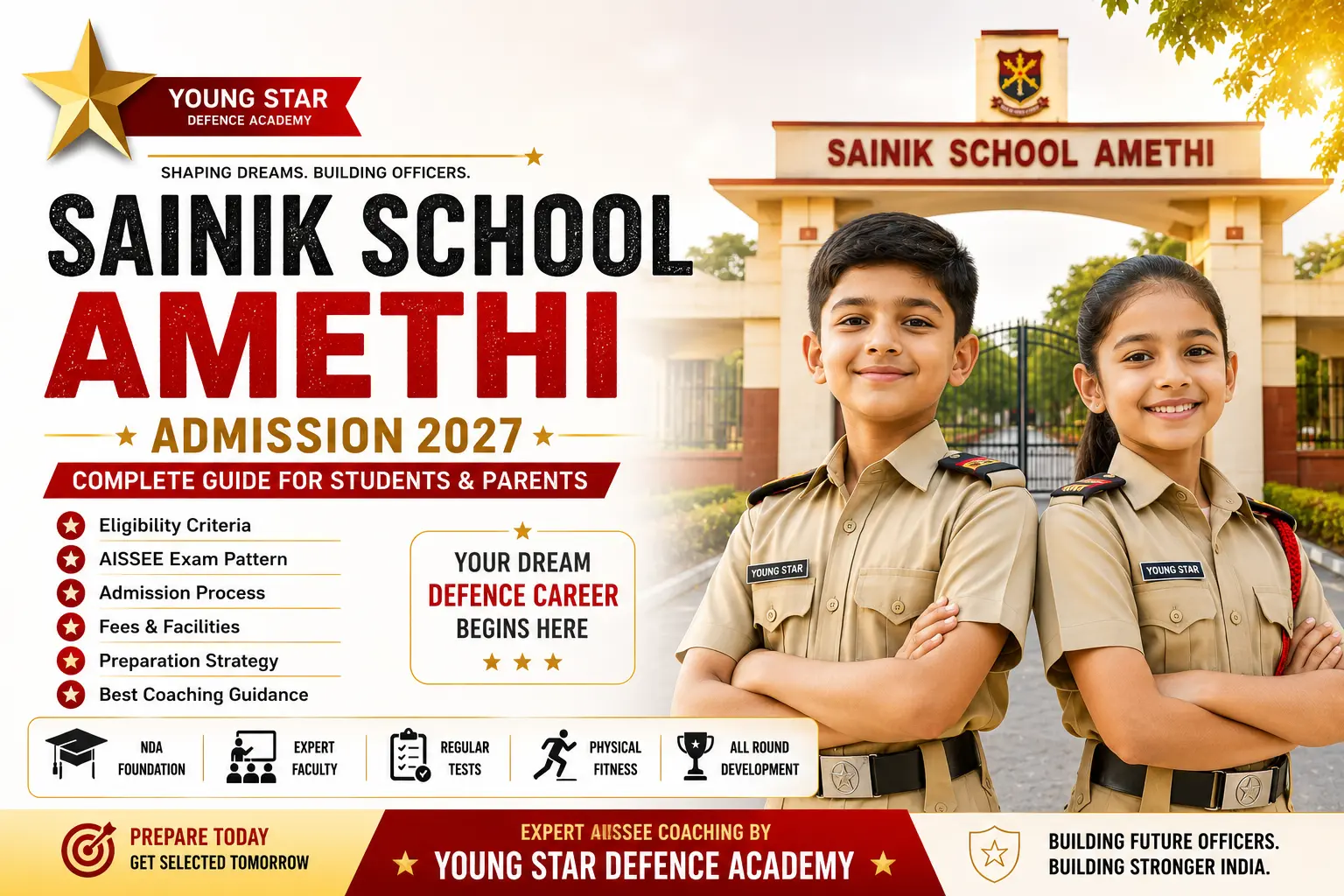
Sainik School Amethi Admission 2027 – Complete Guide for Students & Parents
Every year, thousands of families across Uttar Pradesh dream of securing a seat at Sainik School Amethi. This prestigious residential school blends world-class academics with military-grade discipline, producing young leaders who go on to serve the nation through the Indian Armed Forces and beyond. If you are a parent or student planning to appear in the All India Sainik Schools Entrance Examination (AISSEE) for admission in 2027, this guide is your single most reliable resource.
Sainik School Amethi is not just a school — it is a life-transforming institution. Students who study here develop the mental toughness, academic rigour, and leadership qualities that set them apart from their peers for the rest of their lives. A seat here, however, must be earned through a highly competitive national entrance exam.
In this comprehensive guide, you will find everything you need to know about Sainik School Amethi — including the admission process, eligibility criteria, AISSEE exam pattern, subject-wise preparation strategy, fee structure, and how the right coaching support can make a decisive difference to your child’s result.
Whether you are just beginning to explore this option or you are already deep into preparation, this article will help you create a clear, confident plan of action.
About Sainik School Amethi
Sainik School Amethi is a fully residential, co-educational school located in the Amethi district of Uttar Pradesh. It operates under the Sainik Schools Society, which functions under the Ministry of Defence, Government of India. The school was established with the primary objective of preparing young boys and girls for entry into the National Defence Academy (NDA), the Indian Naval Academy, and other prestigious defence training institutes. You can visit the official Sainik School Amethi website for school-specific announcements, campus details, and contact information.
The school follows the CBSE curriculum from Class 6 through Class 12, ensuring that students receive a nationally recognised academic education while being simultaneously trained in physical fitness, discipline, and leadership. This dual focus is what makes Sainik Schools fundamentally different from conventional boarding schools.
Inside the campus, students experience a structured daily routine that includes morning physical training, academic sessions, sports, extracurricular activities, and evening study hours. This environment is deliberately designed to build mental and physical resilience — qualities that are essential for a career in the armed forces.
The school offers strong facilities in science, mathematics, and humanities, preparing students for competitive examinations like the NDA written test, the National Defence Academy entrance, and UPSC examinations later in life. Students who pass out of Sainik School Amethi carry a significant advantage in terms of discipline, time management, communication skills, and competitive spirit.
Students aspire to study here because the institution represents a clear, structured path from childhood education all the way to a commissioned officer’s rank in the Indian Armed Forces. For many families in Uttar Pradesh, securing a seat at Sainik School Amethi is not just an educational goal — it is a matter of deep family pride.
Why Sainik School Amethi Is Popular Among Defence Aspirants
The popularity of Sainik School Amethi among defence-oriented families stems from a combination of factors that no regular school can offer. Here is why tens of thousands of families compete each year for a limited number of seats:
Foundation for NDA and Armed Forces Entry
Sainik Schools were originally created to serve as feeders to the National Defence Academy. Students who study here are groomed specifically for NDA-level examinations. The academic rigour, physical conditioning, and mental toughness developed here give Sainik School alumni a commanding advantage in NDA selection over candidates from regular schools.
Character and Personality Development
From Day 1, students at Sainik School Amethi are immersed in an environment that demands punctuality, responsibility, and leadership. Cadets learn to manage their own daily schedule, take care of their belongings, lead peers in activities, and handle challenges with composure. These are skills no textbook can teach.
Military Values and Patriotism
The culture of the school is built on the core values of the Indian Armed Forces — honour, courage, loyalty, and selfless service. These values are woven into every aspect of school life, from daily drills to classroom interactions, creating individuals of strong moral character.
Highly Competitive Academic Environment
Because every student at Sainik School Amethi is there by merit, the peer group itself drives academic excellence. Students constantly push each other to perform better, creating a culture of healthy competition that is extremely difficult to replicate in a day school setting.
Long-Term Career Benefits
The value of a Sainik School education extends well beyond the armed forces. Alumni who choose civilian careers still benefit enormously from the leadership training, communication skills, and disciplined mindset instilled in them. Sainik School certificates carry weight in NDA interviews, college admissions, and corporate environments alike.
Subsidised Quality Education
Compared to elite private boarding schools, Sainik Schools offer a remarkably high quality of education at a relatively affordable fee, especially for SC/ST students and wards of defence personnel who receive significant concessions. This makes it accessible to families across all economic backgrounds.
Sainik School Amethi Admission Process – Step-by-Step Guide
The admission process for Sainik School Amethi is centralised through the National Testing Agency (NTA) under the AISSEE framework. Understanding each step in detail helps families plan timelines and avoid costly mistakes.
| Step | Activity | Details | Approximate Timeline |
|---|---|---|---|
| 1 | Official Notification | NTA releases AISSEE notification on the official portal (aissee.nta.ac.in) | October – November |
| 2 | Online Registration | Parents fill in the application form, upload documents, and pay the registration fee online | November – December |
| 3 | Admit Card Download | Hall ticket issued on NTA’s AISSEE portal; must be downloaded and printed before the exam | December – January |
| 4 | Written Entrance Examination | AISSEE conducted at centres across India; OMR-based paper for Class 6 and Class 9 | January |
| 5 | Result Declaration | Results published on the NTA AISSEE portal; merit list prepared school-wise and category-wise | March – April |
| 6 | Merit List & Shortlisting | Shortlisted candidates called for medical examination based on rank and available seats | April – May |
| 7 | Medical Examination | Conducted at designated military hospitals; includes vision, fitness, and general health checks | May – June |
| 8 | Final Admission | Medically fit candidates complete document verification and fee payment to confirm admission | June – July |
Important: Missing any deadline — particularly the registration window and document submission — results in cancellation of the application. Parents should bookmark the official NTA AISSEE portal and monitor it regularly from October onwards.
Eligibility Criteria for Sainik School Amethi Admission
Understanding the eligibility criteria before applying saves families time and avoids disqualification. The criteria differ for Class 6 and Class 9 admissions. For a complete breakdown, also see our dedicated page on eligibility for Sainik School admission.
Class 6 Admission – Eligibility
Age Requirement: The candidate must be between 10 and 12 years of age as on 31 March of the year of admission. (For AISSEE 2027, the relevant date would be 31 March 2027.)
Educational Requirement: The candidate must have passed Class 5 from a recognised school. No specific percentage is required for eligibility, but higher academic standing improves competitive merit.
Nationality: The candidate must be an Indian national.
Gender: Both boys and girls are eligible for admission (subject to the school’s specific intake policy, which may vary year to year).
Class 9 Admission – Eligibility
Age Requirement: The candidate must be between 13 and 15 years of age as on 31 March of the year of admission.
Educational Requirement: The candidate must have passed Class 8 from a recognised school with English as one of the subjects.
Nationality: Indian national only.
Eligibility Comparison Table
| Criteria | Class 6 Admission | Class 9 Admission |
|---|---|---|
| Age (as on 31 March) | 10 to 12 years | 13 to 15 years |
| Last Class Passed | Class 5 | Class 8 |
| English Compulsory | Not mandatory but advisable | Yes, English must be a subject in Class 8 |
| Gender | Boys & Girls (as per school intake) | Boys & Girls (as per school intake) |
| Nationality | Indian | Indian |
| Number of Attempts | No restriction | No restriction (within age limit) |
Note: Age limits and intake policies can be revised by the Sainik Schools Society. Always verify the current year’s notification on the official NTA AISSEE portal before applying. You can also check the latest seats and vacancies in Sainik Schools on our resource page.
AISSEE Exam Pattern – Detailed Breakdown
The AISSEE is an OMR-based objective examination. Every mark counts, so understanding the exact structure of the paper is the first step toward a focused preparation plan.
Class 6 AISSEE Exam Pattern
| Subject | Number of Questions | Total Marks | Marks per Question |
|---|---|---|---|
| Mathematics | 50 | 150 | 3 |
| General Knowledge | 25 | 75 | 3 |
| Language (Hindi or English) | 25 | 50 | 2 |
| Intelligence (Reasoning) | 25 | 50 | 2 |
| Total | 125 | 300 + 25 (Medical)* | – |
*25 marks are awarded for the medical fitness certificate, making the effective total 325 marks for merit purposes.
Class 9 AISSEE Exam Pattern
| Subject | Number of Questions | Total Marks | Marks per Question |
|---|---|---|---|
| Mathematics | 50 | 200 | 4 |
| English | 25 | 50 | 2 |
| General Knowledge / Science / Social Studies | 25 | 75 | 3 |
| Intelligence (Reasoning) | 25 | 50 | 2 |
| Total | 125 | 400 | – |
Duration: 2.5 hours (150 minutes) for both Class 6 and Class 9 papers.
Negative Marking: No negative marking. Students should attempt all questions.
Medium: English and Hindi.
Difficulty Level: For Class 6, the paper is based on Class 5 syllabus. For Class 9, it covers Class 8 syllabus with moderate to high difficulty, particularly in Mathematics. For a topic-by-topic breakdown, refer to our complete guide on the syllabus for Sainik Schools.
Subject-Wise Preparation Strategy for AISSEE
A random study approach will not get your child through the AISSEE. What works is a subject-specific strategy built around the actual exam pattern, combined with regular practice and honest self-assessment.
Mathematics
Key Topics (Class 6): Number system, fractions, decimals, basic geometry, measurement, simple word problems, percentage.
Key Topics (Class 9): Algebra, geometry (triangles and circles), mensuration, statistics, number system, time & work, ratio and proportion.
Common Mistakes: Calculation errors in multi-step problems, skipping steps in geometry, misreading word problems.
Preparation Strategy: Solve at least 20 maths problems daily without a calculator. Focus heavily on speed — AISSEE gives roughly 72 seconds per question on average. Identify the 3 or 4 topic areas where your child loses the most marks and dedicate extra time there.
Score Improvement Tip: Take at least 10 timed mock papers before the exam. Each mock should be reviewed question by question to identify patterns of error. You can practise with our free AISSEE mock tests online.
English Language
Key Topics: Reading comprehension, grammar (tenses, articles, prepositions), vocabulary, fill in the blanks, sentence rearrangement.
Common Mistakes: Confusing tenses, overcomplicating comprehension answers, misunderstanding vocabulary in context.
Preparation Strategy: Read one passage daily and answer comprehension questions in writing. Study grammar rules topic by topic — do not cram all at once. Build vocabulary through reading books and newspapers at the appropriate level.
Score Improvement Tip: Grammar is the most predictable section of the AISSEE English paper. Mastering grammar rules can earn near-perfect scores in that portion alone.
General Knowledge
Key Topics: Indian history, geography, constitution basics, science (biology, physics, chemistry), current events, sports, important days, famous personalities.
Common Mistakes: Ignoring current events, memorising facts without context, skipping science-based GK questions.
Preparation Strategy: Maintain a GK diary where you note 5 new facts daily. Use a well-organised AISSEE GK guide. Watch age-appropriate educational content on Indian history and geography.
Score Improvement Tip: Science-based GK questions (on animals, plants, human body, space) are frequently asked. These are highly scorable because they have definite correct answers and can be systematically revised.
Intelligence and Reasoning
Key Topics: Series completion, analogies, coding-decoding, mirror images, paper folding, Venn diagrams, direction sense, odd one out.
Common Mistakes: Spending too long on one visual puzzle, missing patterns in series questions.
Preparation Strategy: Practice reasoning questions in sets of 10 under a 15-minute time limit. Reasoning improves rapidly with practice — students who initially struggle with this section often become the strongest in their group after consistent practice.
Score Improvement Tip: Do not skip the visual reasoning topics (mirror images, figure series). These appear regularly in AISSEE and carry valuable marks.
Common Reasons Students Fail in AISSEE – And How to Avoid Them
Understanding why students fail is just as important as understanding how to succeed. Based on years of coaching experience, these are the most common pitfalls:
1. No Structured Study Plan
Many students study randomly — whatever subject they feel like on a given day. Without a weekly schedule that allocates time to each subject, some topics remain completely unprepared at exam time.
Solution: Create a weekly timetable with fixed subject slots. Stick to it even on days when motivation is low. Consistency beats intensity.
2. Not Taking Enough Mock Tests
A student who has never attempted a full timed paper before exam day will almost certainly struggle with time management in the actual AISSEE. Mock tests are not optional — they are essential.
Solution: Begin mock tests at least three months before the exam. Attempt a full paper under real exam conditions every week during the final two months. Students in Class 5 should start early — read our guide on Sainik School preparation for Class 5 to build the right foundation from the start.
3. Weak Conceptual Foundation
Many students try to memorise solutions without understanding the underlying concepts. This works for some questions but fails completely when the question is slightly differently worded.
Solution: Focus on building concepts first. Once you understand why a method works, you can apply it to any variation of the question.
4. Poor Time Management During the Exam
Some students spend 10 minutes on a single difficult question while 30 easy questions remain unattempted. This is one of the most common and most avoidable errors.
Solution: Adopt the strategy of moving on immediately from any question that takes more than 90 seconds. Return to difficult questions only after completing all easier ones. Since there is no negative marking, no question should ever be left unattempted.
5. Exam Anxiety
Even well-prepared students can underperform due to exam-day nervousness. This is particularly common among younger students who are appearing in a major competitive examination for the first time.
Solution: Simulate exam conditions at home regularly. Breathing exercises, adequate sleep, and a calm pre-exam routine make a significant difference. A good coaching environment also builds confidence through regular testing and positive feedback.
6. Ignoring the Language and Reasoning Sections
Students often over-invest in Maths and neglect Language and Reasoning. These sections carry significant marks and are relatively easier to improve with focused practice.
Solution: Treat all four sections equally. In the final merit list, it is often the Language and Reasoning scores that separate qualified candidates.
Facilities and Student Life at Sainik School Amethi
Life inside Sainik School Amethi is structured, demanding, and deeply rewarding. Students live on campus in well-maintained hostels and follow a daily routine that balances academics, physical training, and character development.
Hostel Life
Students live in supervised dormitories and are responsible for maintaining their own space, belongings, and personal hygiene. This early exposure to independent living builds self-reliance and organisational skills that serve students throughout their lives.
Physical Training and Sports
Daily PT sessions, drills, and organised sports are integral to life at the school. Students have access to grounds for cricket, football, basketball, and athletics. Regular inter-house and inter-school competitions keep the competitive spirit alive and active. Maintaining good physical health from an early age also helps students meet the medical standards required for Sainik School admission.
Academic Infrastructure
The school is equipped with well-stocked science laboratories, a library, and computer facilities that support the CBSE curriculum. Regular internal tests and assessments track student progress and keep academic standards high throughout the year.
Extracurricular Activities
Music, drama, debate, NCC activities, and cultural events are all part of the school calendar. These activities develop communication skills, team spirit, and confidence — qualities that are directly assessed in armed forces selection processes later in life.
Personality Development Programs
Regular sessions on public speaking, leadership, and personal grooming are conducted. Students learn to present themselves with confidence and command — a skill that becomes priceless during SSB interviews and military careers.
Benefits of Joining Coaching for Sainik School Amethi
The AISSEE is competitive enough that even academically strong students benefit greatly from professional guidance. Here is how structured coaching makes a measurable difference:
Structured Learning Path
A good coaching programme maps out the entire AISSEE syllabus into weekly modules. Students always know what to study next, which eliminates the confusion and wasted time that comes with self-directed preparation.
Expert Faculty Guidance
Experienced teachers who specialise in Sainik School entrance exams know exactly which topics are heavily tested, which types of questions are commonly set, and what mistakes students typically make. This insider knowledge is invaluable.
Regular Testing and Feedback
Weekly tests with detailed result analysis help students track their improvement and identify weak areas before they become a problem on exam day. Self-study rarely provides this kind of structured, honest feedback.
Doubt Clearing Sessions
In a classroom setting, every doubt is cleared in real time. A question that might confuse a student for days when studying alone gets resolved in minutes during a coaching session.
Motivation and Accountability
The presence of like-minded peers working toward the same goal creates a highly motivating environment. Students push each other, share strategies, and hold each other accountable in ways that are simply not possible with home study.
Medical Exam and Interview Preparation
Many coaching institutes also prepare students for the medical examination process and, for Class 9 candidates, provide guidance on interview etiquette, grooming, and personality presentation.
Why Choose Young Star Defence Academy for Sainik School Amethi Coaching
At Young Star Defence Academy, we have dedicated our work to one mission: helping students from across Uttar Pradesh earn their place in India’s most prestigious Sainik Schools. Our track record speaks for itself, but here is exactly what sets us apart:
Experienced and Specialised Faculty
Our teachers are not generalists. Each faculty member specialises in specific AISSEE subjects and has deep knowledge of the exam’s history, pattern, and evolving difficulty levels. They know where every mark is won and lost. Meet our lead educator, Prashant Singh, who brings years of specialised Sainik School coaching experience to every classroom session.
Comprehensive Study Material
We provide meticulously prepared study material that covers every topic in the AISSEE syllabus. Our material is updated every year to reflect any changes in the exam pattern and is written specifically for Sainik School entrance preparation — not repurposed from general CBSE guides.
Online and Offline Classes
We offer both classroom coaching at our centre and live online classes for students who cannot attend in person. Our online programme delivers the same structured curriculum with interactive sessions, live doubt-clearing, and real-time performance tracking.
Weekly Mock Tests with Detailed Analysis
Every week, students take a timed mock test designed to simulate the exact AISSEE exam environment. After each test, our faculty provides detailed subject-wise analysis, highlighting areas of strength and areas requiring immediate attention.
Performance Tracking and Parent Communication
We believe parents should always know where their child stands. We provide regular performance reports and conduct parent counselling sessions so that families can support their child’s preparation effectively at home.
Hostel Facility Available
For students who travel from other districts or cities to attend our coaching programme, we offer a supervised hostel facility. Students in our residential programme follow a structured study schedule designed to maximise preparation time.
Proven Results
Year after year, our students secure admissions in Sainik Schools across Uttar Pradesh and beyond. Our success rate is the strongest endorsement of our methodology.
Ready to begin your child’s journey to Sainik School Amethi?
Contact Young Star Defence Academy today for a free counselling session. Our experts will assess your child’s current level, create a personalised preparation plan, and answer every question you have about the AISSEE 2027.
📞 Call us now | 📧 Enquire online | 🏫 Visit our centre
Month-Wise Success Roadmap for Sainik School Amethi Admission
The AISSEE notification typically comes in October–November. This means most students have 3 to 6 months of preparation time, depending on when they start. Use the roadmap below as your guide.
For Beginners (Starting 6 Months Before Exam)
| Month | Focus Area | Target Outcome |
|---|---|---|
| Month 1 | Diagnostic test + concept building in Maths and Language | Identify strengths and weaknesses; build foundational understanding |
| Month 2 | Maths problem types + GK study routine begins | Comfortable with number system, fractions, basic algebra (Class 9) |
| Month 3 | Reasoning + English grammar | Reasoning score visibly improving; grammar rules memorised |
| Month 4 | Full revision of all subjects + first mock test | Complete syllabus coverage; first mock score as benchmark |
| Month 5 | Mock tests weekly + weak subject intensive revision | Score improving consistently in each mock; time management improving |
| Month 6 | Final revision + 2 mocks per week + exam strategy | Peak performance; calm and confident exam approach |
For Intermediate Students (Starting 3 Months Before Exam)
| Month | Focus Area | Target Outcome |
|---|---|---|
| Month 1 | Rapid syllabus revision + daily GK + reasoning practice | All topics covered once; weak areas identified |
| Month 2 | Mock test every 10 days + weak topic deep-dive | Consistent improvement in mock scores; no major blind spots |
| Month 3 | Mock tests twice weekly + full paper review + final polishing | Exam-ready confidence; strong time management |
For Advanced Students (Final 6 Weeks Polish)
| Week | Focus Area |
|---|---|
| Week 1–2 | Full mock tests + comprehensive error analysis + GK current events update |
| Week 3–4 | High-value topic revision (Maths formulas, grammar rules, reasoning patterns) |
| Week 5 | 2 full mocks under strict exam conditions + mental preparation |
| Week 6 | Light revision only; rest, relaxation, and exam-day strategy finalisation |
Frequently Asked Questions – Sainik School Amethi Admission
1. What is Sainik School Amethi?
Sainik School Amethi is a residential school in Amethi, Uttar Pradesh, operating under the Sainik Schools Society, Ministry of Defence. It follows the CBSE curriculum from Class 6 to Class 12 and is designed to prepare students for careers in the Indian Armed Forces by combining quality academics with military-style discipline and physical training.
2. How can I get admission in Sainik School Amethi?
Admission is through the All India Sainik Schools Entrance Examination (AISSEE), conducted by NTA. Students must register online, appear for the entrance exam, qualify in the merit list, pass a medical examination, and complete the final admission formalities at the school.
3. Is coaching necessary for AISSEE?
Coaching is not compulsory, but it is strongly recommended. The AISSEE is a national-level competitive examination with thousands of aspirants competing for limited seats. Structured coaching provides curriculum coverage, mock tests, performance analysis, and expert guidance that significantly improve selection chances.
4. What is the age limit for Class 6 admission?
Candidates must be between 10 and 12 years of age as on 31 March of the admission year. For Class 9 admission, the age range is 13 to 15 years.
5. What are the fees for Sainik School Amethi?
The approximate annual fee is in the range of ₹1,10,000 to ₹1,30,000 (subject to revision). Fee concessions are available for SC/ST category students and wards of defence personnel. Exact current fees should be confirmed directly with the school or through the official notification. For a school-wise comparison, see our detailed guide on the fee structure for Sainik Schools.
6. Does Sainik School Amethi admit girls?
Most Sainik Schools, including newer ones, now admit girls following the Government of India’s policy to open Sainik Schools to female students. The availability of seats for girls in a specific school and year is confirmed in the annual AISSEE notification. Always check the latest notification for school-specific intake details. For a complete guide on opportunities for female students, visit our dedicated page on Sainik School for girls.
7. Is hostel compulsory at Sainik School Amethi?
Yes. Sainik Schools are residential institutions. All admitted students are required to live in the school hostel. Day-scholar admission is not available.
8. What is the AISSEE syllabus?
For Class 6 admission, the syllabus is based on the Class 5 curriculum and covers Mathematics, Language (English or Hindi), General Knowledge, and Intelligence/Reasoning. For Class 9 admission, it covers Class 8-level Mathematics, English, General Knowledge (including Science and Social Studies), and Intelligence/Reasoning. Read our complete Sainik School syllabus guide for a topic-level breakdown of every subject.
9. How difficult is the AISSEE?
The AISSEE is moderately to highly competitive. The Maths section tends to be the most challenging. With consistent preparation — ideally beginning 4 to 6 months before the exam — a well-prepared student can score in the qualifying range. The key challenge is not raw difficulty but competition from thousands of well-prepared candidates.
10. Which coaching is best for Sainik School Amethi?
Young Star Defence Academy is one of the most trusted AISSEE coaching institutes in the region, with experienced faculty, comprehensive study material, regular mock tests, and a proven track record of results. We offer both classroom and online coaching options to suit every student’s circumstances.
11. What documents are required for AISSEE registration?
Typically required documents include the student’s birth certificate, last class mark sheet/report card, passport-size photographs, domicile certificate, caste certificate (if applicable), and the parent’s service certificate (for defence wards). For a complete checklist, refer to our detailed guide on documents required for Sainik School admission.
12. How many students apply for Sainik School Amethi every year?
The total AISSEE attracts over two lakh applicants nationally every year. Competition for specific schools like Sainik School Amethi is intense, as students from the entire state and surrounding regions compete for a limited number of seats.
13. Can students prepare for AISSEE from home?
Self-study at home is possible, but it requires exceptional self-discipline, a clear study plan, access to quality study material, and regular practice through mock tests. Most families find that professional coaching — even online — provides the structure and accountability that significantly improves results compared to unguided home preparation.
14. What is the selection process for Sainik School Amethi?
The selection process involves four stages: the written AISSEE examination, result declaration and merit list preparation, medical examination for shortlisted candidates, and final document verification with fee payment for medically fit candidates.
15. What are the medical requirements for Sainik School admission?
Candidates must be physically and medically fit as per the standards prescribed by the Sainik Schools Society. Key requirements include acceptable vision (with or without prescribed correction in some cases), height and weight within expected ranges for age, no major physical disabilities, and general good health. The medical examination is conducted at designated military hospitals or medical boards. Read our full guide on medical standards for Sainik School admission for the complete list of requirements.
16. What career opportunities are available after Sainik School?
Sainik School alumni have a clear pathway into the National Defence Academy (NDA), leading to a commissioned officer’s career in the Army, Navy, or Air Force. Alumni who choose civilian careers also benefit enormously from the leadership, discipline, and communication skills the school instils. Many Sainik School graduates have excelled in IAS, IPS, civil services, medicine, engineering, and corporate leadership roles.
17. How is the merit list prepared for Sainik School Amethi?
The merit list is prepared on the basis of written exam marks (300 marks for Class 6, 400 for Class 9), plus 25 marks for the medical fitness certificate, giving a total of 325 marks (Class 6) or 425 marks (Class 9). Students are ranked category-wise (General, SC, ST, Defence Ward) and school-wise.
18. What is the registration fee for AISSEE?
The registration fee is typically ₹650 for General/Defence category candidates and ₹500 for SC/ST candidates. These figures are subject to change; verify the current year’s notification on the NTA AISSEE portal.
19. When does AISSEE registration open?
Registration for AISSEE typically opens in October–November for examinations conducted in January. Families should monitor the NTA website from October onwards to ensure they do not miss the registration window.
20. What is the difference between a Sainik School and a Military School?
Sainik Schools are residential schools managed by the Sainik Schools Society under the Ministry of Defence, primarily designed to prepare students for NDA entry from Class 6 and Class 9. Military Schools (like Rashtriya Military Schools / RMS) operate under the Army and admit students primarily at Class 6, with their own separate entrance examination. Both are prestigious institutions with defence-oriented education, but they have different administrative structures and entrance processes. Learn more about RMS Coaching here.
Conclusion – Your Child’s Path to Sainik School Amethi Starts Today
A seat at Sainik School Amethi is one of the most valuable gifts a family can give a child. It is not just admission to a school — it is an investment in a lifetime of discipline, achievement, and purpose. The students who walk through those gates emerge as leaders, ready to serve the nation and succeed in whatever path they choose.
But that seat must be earned. The AISSEE is a competitive examination, and the families who treat preparation seriously — starting early, following a structured plan, and seeking the right guidance — are the ones who succeed.
The importance of early preparation cannot be overstated. Students who begin 5 to 6 months before the examination enter the exam hall with confidence, speed, and accuracy. Those who begin only weeks before often find themselves overwhelmed and underprepared.
At Young Star Defence Academy, we exist to bridge the gap between where your child is today and where they need to be on exam day. Our experienced faculty, proven study material, regular mock tests, and personalised performance tracking give students from every background a genuine, fair shot at the merit list.
Whether your child is just starting their Class 5 or already in Class 8 and targeting Class 9 admission, we have a programme designed specifically for their current level and timeline. We also guide parents through every step of the process — from AISSEE registration to medical preparation to final admission.
The journey to Sainik School Amethi is demanding, but it is absolutely achievable with the right preparation and the right support. Take the first step today. Contact Young Star Defence Academy and let us help your child earn their place among India’s future leaders.
Also explore:
Sainik School Coaching |
Sainik School for Girls |
RMS Coaching |
RIMC Coaching |
AISSEE Mock Tests |
Sainik School Syllabus |
Eligibility Criteria |
Fee Structure |
Documents Required |
Medical Standards |
Seats & Vacancies |
Class 5 Preparation