
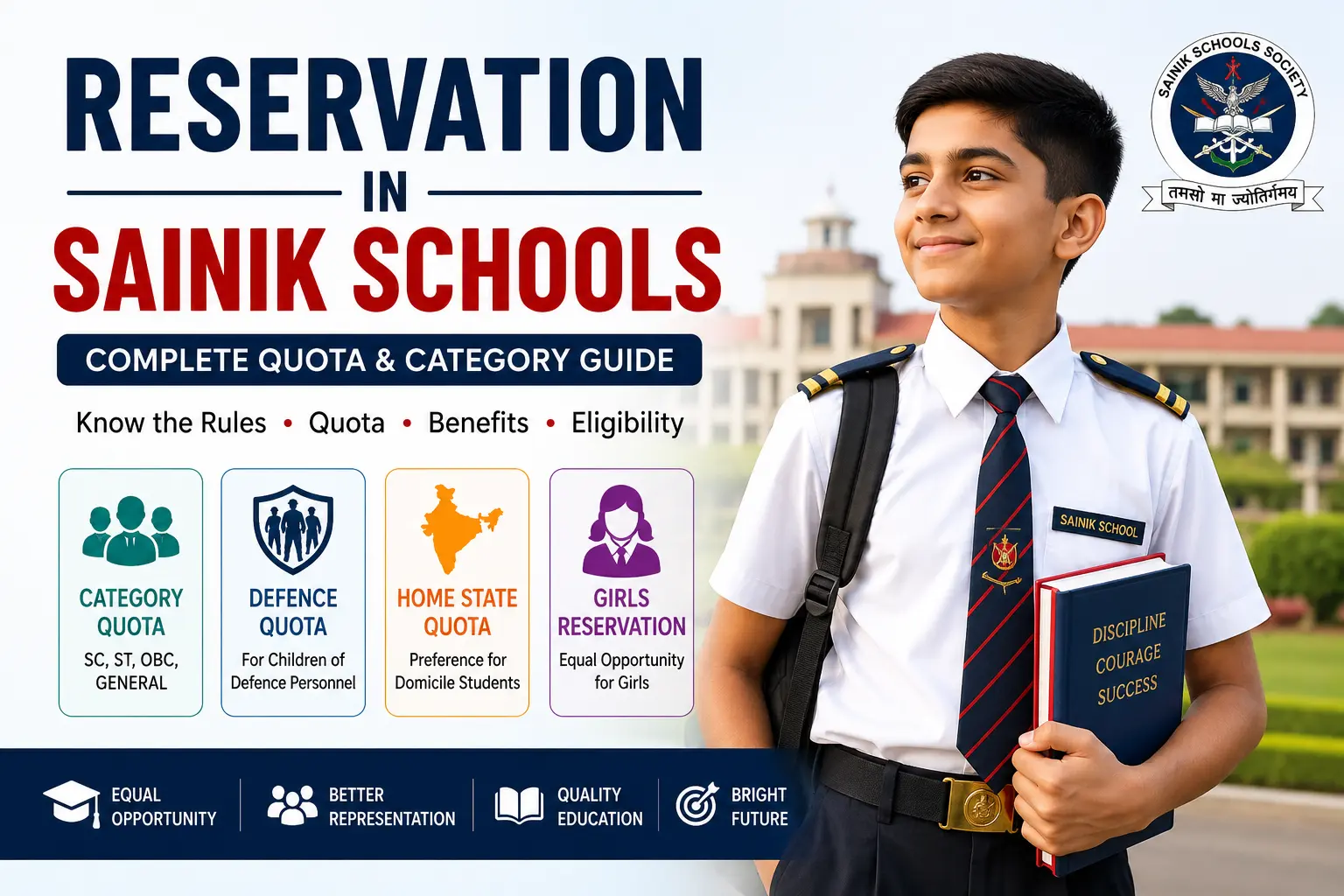
Reservation in Sainik Schools – Complete Quota & Category Guide
Every year, thousands of parents sit with their children and wonder the same thing: “My child has worked so hard — but will the seats even be available for us?” It is a fair question, and if you have ever felt confused about the Sainik School reservation policy, you are not alone.
Sainik Schools are among the most prestigious residential institutions in India. They groom students for the National Defence Academy (NDA) and other defence services. But like most government-funded educational institutions, Sainik Schools follow a structured reservation system — designed not to reduce your child’s chances, but to ensure that students from every corner of India, from every background, get a genuine shot at military education.
This guide breaks down every category of reservation — defence quota, SC/ST/OBC, girls’ reservation, home state quota, and more — in plain language. Whether you are a parent, a student, or a coaching aspirant, by the end of this article you will know exactly how reservation works in Sainik School admissions and what you need to do to claim your rightful benefits.
Let’s start from the beginning.
Table of Contents
- What Is Reservation in Sainik Schools?
- Category-Wise Reservation in Sainik Schools
- Home State Quota Explained
- Defence Reservation in Sainik Schools
- Reservation for Girls in Sainik Schools
- OBC, SC & ST Reservation Rules
- Documents Required for Reservation Benefits
- How Reservation Affects Sainik School Counseling
- Seat Distribution Example
- Common Mistakes Students Make
- Benefits of Reservation in Sainik Schools
- Official Information & Updates
- Frequently Asked Questions
1. What Is Reservation in Sainik Schools?
Reservation in Sainik Schools refers to the policy of setting aside a fixed percentage of seats for specific categories of students — such as Scheduled Castes, Scheduled Tribes, Other Backward Classes, defence personnel children, girls, and students from the home state where the school is located.
Sainik School admissions happen through the All India Sainik Schools Entrance Examination (AISSEE), conducted by the National Testing Agency (NTA) on behalf of the Sainik Schools Society. AISSEE is a national-level competitive exam for Class 6 and Class 9 entry.
The examination is the same for all students — but the merit list and seat allocation that follows is where reservation comes into play. Seats at each Sainik School are divided into multiple sub-categories, and students compete within their own category for those reserved seats.
The reservation system serves a dual purpose:
- It gives students from historically disadvantaged communities access to premier military education.
- It ensures regional representation, so that a Sainik School in Punjab, for example, primarily serves children from Punjab.
Understanding this system well can genuinely improve your child’s admission chances — because many families either claim a wrong category or miss out on benefits they were fully entitled to.
2. Category-Wise Reservation in Sainik Schools
Here is a consolidated overview of the reservation categories followed in Sainik Schools:
| Category | Approximate Reservation | Who Qualifies |
|---|---|---|
| Home State Quota | 67% of total seats | Students domiciled in the state where the school is located |
| Outside State Quota | 33% of total seats | Students from any other state in India |
| SC (Scheduled Caste) | 15% (within home + outside) | Students with valid SC caste certificate |
| ST (Scheduled Tribe) | 7.5% (within home + outside) | Students with valid ST caste certificate |
| OBC (Other Backward Class) | 27% (within home + outside) | Students with non-creamy layer OBC certificate |
| Defence Quota | 25% (within each state quota) | Children of serving/ex-servicemen/martyrs |
| Girls Reservation | 10% (in schools open to girls) | Girl students applying to co-educational Sainik Schools |
Note: Percentages may vary slightly between individual schools and are subject to revision by the Sainik Schools Society. Always verify from the official notification.
Scheduled Caste (SC) Reservation
Students belonging to Scheduled Castes, as recognized by the Government of India, are entitled to reservation in Sainik Schools. The SC category reservation applies separately within the home state quota and the outside state quota. This means SC students from the home state compete among themselves for SC seats under the home state quota, and similarly for the outside state quota.
Scheduled Tribe (ST) Reservation
ST students follow the same structure as SC students. Since the ST population is smaller, the reservation percentage is lower. However, the benefit is significant because cutoffs for ST students are generally lower than the general category, giving genuinely deserving students from tribal communities a real opportunity.
OBC Reservation
The OBC category follows the central government’s list of Other Backward Classes (not state OBC lists). Importantly, students must fall under the Non-Creamy Layer to claim OBC benefits. If your family income exceeds the prescribed limit (currently ₹8 lakh per annum), you may not be eligible even if you belong to an OBC community.
General Category
General category students — those who do not belong to SC, ST, or OBC — compete for the unreserved seats. In schools where the general category pool is large, competition is intense. This is why coaching and consistent preparation matter so much for general category applicants.
Defence Category
This is one of the most sought-after quotas. Children of serving military personnel, ex-servicemen, and war widows or martyrs fall under this category. They get reserved seats within both the home state and outside state quota. We explain this in detail in Section 4.
Girls Reservation
Since several Sainik Schools have begun admitting girls, a dedicated quota has been introduced. This is a significant step in increasing female participation in military education. See Section 5 for the full picture.
3. Home State Quota Explained
The home state quota is perhaps the most impactful — and most misunderstood — part of Sainik School reservation.
Each Sainik School is affiliated with a particular state or union territory. Approximately 67% of seats at that school are reserved for students who are domiciled in that state. The remaining 33% are open to students from any other state in the country.
Why Does Home State Quota Exist?
The idea behind home state reservation is simple: Sainik Schools were set up with state government support to serve the local population. It would defeat the purpose if a school in Rajasthan filled most of its seats with students from Maharashtra. The home state quota ensures local children benefit from the institution in their own state.
A Simple Example
Say a Sainik School has 100 total seats. 67 of those go to students domiciled in that school’s state. Of these 67 home state seats, 25% are further sub-divided for defence category children, and the SC/ST/OBC reservation applies within the remaining seats. The 33 outside-state seats work similarly with their own SC/ST/OBC sub-division.
What Is Domicile?
Domicile means the state where the student officially resides. For Sainik School admission, a student is considered domiciled in a state if they have a valid domicile certificate or residence certificate issued by the competent authority of that state. Simply being born there or having relatives there is not enough — you need a proper document.
Can I Apply to a School in a Different State?
Yes, absolutely. Sainik School admission is all-India. If your child does not get a seat in your home state school under the home state quota, they can try for other state schools under the outside state quota. However, competition in the outside state pool can be fierce, as strong students from across the country compete for just 33% of seats.
Understanding the domicile rules also affects which school you should target during counseling. If you live near a state border, always confirm your domicile state before filling the form. Mistakes here are very common and very costly. You can also learn more about the full admission process on our Sainik School admission process page.
4. Defence Reservation in Sainik Schools
The defence quota is one of the most important privileges available to military families — and one of the most commonly misused or misunderstood categories at the time of application.
Who Qualifies for Defence Quota?
The following students are eligible to apply under the defence reservation category:
- Children of serving defence personnel — Army, Navy, Air Force
- Children of ex-servicemen — retired personnel who served honourably
- Children of war widows or martyrs — whose parent died in service
- Children of para-military personnel — in some schools, CAPF/BSF/CRPF personnel may also qualify (check individual school notification)
How Many Seats Are Reserved?
Typically, 25% of seats within each quota (home state and outside state) are set aside for defence category students. This means in a school with 67 home state seats, roughly 16–17 seats go to defence category children domiciled in that state.
Documents Required for Defence Quota
- Service certificate issued by the Commanding Officer (for serving personnel)
- Discharge certificate + pension book (for ex-servicemen)
- Dependency certificate confirming the child’s relationship to the serviceman
- Death certificate + NOK certificate (for martyr families)
Common Mistakes Parents Make
Many families lose their defence quota benefit at the counseling stage due to avoidable errors:
- Submitting a service certificate that is older than the prescribed date
- Not getting the certificate countersigned by the correct authority
- Applying under general category when they were eligible for defence quota (missing the advantage)
- Not matching the serviceman’s details in the certificate with Aadhaar/birth certificate of the child
Get your defence certificate verified and countersigned well before the AISSEE application deadline. Do not leave this for the last day.
5. Reservation for Girls in Sainik Schools
For a long time, Sainik Schools were exclusively for boys. That changed when the Government of India announced that all Sainik Schools would be opened to girls — a landmark decision that has transformed military education access in India.
Current Admission Policy for Girls
Most Sainik Schools now admit girls at the Class 6 level. A dedicated 10% reservation for girls has been introduced at participating schools. This means girls compete in a separate pool, reducing direct competition with the much larger male applicant pool.
What This Means in Practice
If a school has 100 seats, 10 seats are reserved specifically for girls under the girls’ quota. Within these 10 seats, SC/ST/OBC sub-reservation and defence category reservation further apply. So a girl belonging to the SC category who is also a defence ward can actually benefit from multiple layers of reservation.
Why This Matters for Families
If you have a daughter who is bright, disciplined, and motivated — this is genuinely one of the best opportunities in India for her. The combination of a girls-only pool and sub-category reservation makes the competition far more manageable than the general pool. Encourage her to prepare seriously and apply strategically.
Sainik School education gives girls access to NDA — where girls are now eligible — and other prestigious military and civil service career paths.
6. OBC, SC & ST Reservation Rules
If your child belongs to SC, ST, or OBC category, here is what you must know to avoid losing your reservation benefit.
Certificate Requirements
For SC and ST: You need a caste certificate issued by a competent authority — usually the District Magistrate, SDM, or Tehsildar of your district. The certificate must mention your caste by its official name as listed in the Constitutional schedule.
For OBC: You need a Non-Creamy Layer (NCL) OBC certificate issued by a competent authority. Crucially, this must be from the Central OBC list — not the state OBC list. Many parents get confused between the two. If your caste appears only on the state OBC list but not the central list, you cannot claim OBC reservation in AISSEE.
Central vs State Certificate Confusion
This is one of the most common points of failure at counseling. AISSEE follows Central Government reservation norms. A caste that is OBC in your state may not appear in the Central OBC list. Always verify on the National Commission for Backward Classes (NCBC) official portal before applying under OBC category.
Verification at Counseling
During counseling, your category certificate will be physically verified. If the certificate is found invalid — wrong issuing authority, expired validity, incorrect caste name — your reservation benefit will be cancelled and you will be pushed to the general category. In many cases, this means losing the seat entirely.
Can I Change My Category After Applying?
No. The category you select at the time of AISSEE application is final. You cannot switch from OBC to general or vice versa after the form is submitted. This makes it critical to get the category right the first time.
For more details on what documents to arrange, also visit our dedicated page on documents required for Sainik School admission.
7. Documents Required for Reservation Benefits
Having the right documents ready — and verified — is non-negotiable. Here is a category-wise checklist:
| Document | Applicable For | Issuing Authority |
|---|---|---|
| Caste Certificate (SC/ST) | SC / ST students | DM / SDM / Tehsildar |
| OBC Non-Creamy Layer Certificate | OBC students | DM / SDM / Tehsildar (Central List) |
| Domicile / Residence Certificate | All students (for home state quota) | State govt. authority |
| Defence Service Certificate | Defence quota students | Commanding Officer / Record Office |
| Income Certificate | OBC / scholarship claims | Revenue authority |
| Birth Certificate | All students | Municipal body / hospital |
| Aadhaar Card (student + parent) | All students | UIDAI |
| School Character/Transfer Certificate | All students | Current school principal |
| Passport-size photographs | All students | — |
Pro tip: Make 5–6 self-attested photocopies of every document the moment you get it. Sainik School counseling requires multiple sets. Running around for copies during counseling is stressful and avoidable.
8. How Reservation Affects Sainik School Counseling
Many families do not understand that the AISSEE merit list is just the starting point. The actual seat allotment happens during category-wise counseling — and this is where reservation really matters.
Merit List + Category Allocation
After AISSEE results are declared, NTA publishes a merit list. But this list is then split into multiple sub-lists: home state general, home state SC, home state ST, home state OBC, home state defence, and the same set for outside state students. Each sub-list has its own cutoff score.
Why Cutoffs Differ by Category
Because reserved category students compete only among themselves for reserved seats, their cutoff scores are lower than the general category. A student who scores 170 out of 300 might not get a seat in the general category but can easily secure admission under the SC or defence quota at the same school.
Why Some Students Miss Seats Despite Qualifying
This is heartbreaking — and it happens more often than you think. Common reasons include:
- Applying under the wrong category (general instead of OBC, for example)
- Not applying to the correct school matching their domicile
- Document rejection at the counseling stage
- Missing the counseling date or reporting late
- Not applying for the right quota (defence children sometimes apply under general)
Understanding seats and vacancies at each school also helps you make smarter choices. Check our detailed page on Sainik School seats and vacancies before finalizing your school preference.
9. Seat Distribution Example
Let us take a hypothetical Sainik School with 100 total seats for Class 6, so you can see exactly how reservation plays out in practice.
| Quota / Category | Seats | Notes |
|---|---|---|
| Home State Total | 67 | Students domiciled in the school’s state |
| — Defence (within home state) | ~17 | 25% of home state seats |
| — SC (within home state) | ~8 | 15% of non-defence home state seats |
| — ST (within home state) | ~4 | 7.5% of non-defence home state seats |
| — OBC (within home state) | ~14 | 27% of non-defence home state seats |
| — General (within home state) | ~24 | Unreserved seats in home state |
| Outside State Total | 33 | Students from all other states |
| — Defence + SC/ST/OBC/General | 33 | Same sub-structure as home state |
| Girls Quota | 10 | Separate pool, carved from total seats |
This is an illustrative example. Actual seat distribution is notified by the Sainik Schools Society each year and varies by school.
10. Common Mistakes Students Make During Reservation Selection
After years of guiding families through AISSEE preparation at Young Star Defence Academy, we have seen the same mistakes repeated. Here is what to avoid:
1. Selecting the Wrong Category
OBC students sometimes apply as general because they think OBC is “less prestigious.” This is a costly error — they compete in a larger pool with a higher cutoff and often miss seats they would have easily secured under OBC.
2. Invalid or Expired Certificates
OBC Non-Creamy Layer certificates are typically valid for one year. If your certificate has expired, it will be rejected at counseling. Get a fresh certificate before applying.
3. Domicile Errors
Some families have a certificate from one state but apply for home state quota at a school in another. This mismatch gets caught during document verification and results in losing the home state advantage.
4. Document Mismatch
The child’s name, date of birth, and parent’s name must match exactly across birth certificate, Aadhaar, school certificate, and caste/defence certificate. Even minor spelling differences can cause problems.
5. Missing Deadlines
The AISSEE form, fee payment, and counseling have strict deadlines. Missing even one results in forfeiting the chance entirely. Mark every date in your calendar the moment the official notification is released.
6. Not Claiming Defence Quota
Defence families sometimes do not claim the defence quota because they are unaware of it or think it is difficult to claim. In reality, it is one of the most significant advantages available — always claim it if you qualify.
11. Benefits of Reservation in Sainik Schools
Reservation is sometimes misunderstood as a shortcut. It is not. It is a mechanism to level a field that would otherwise be skewed in favour of students from privileged urban backgrounds. Here is what it genuinely offers:
Equal Opportunity
A student from a remote tribal village has the same right to a Sainik School education as a student from a metropolitan city. Reservation makes this possible by protecting seats for those who would otherwise be squeezed out by fierce competition.
Access to Military Education
Sainik Schools are feeders to NDA and later to the Indian Armed Forces. Defence quota reservation ensures that children of those who served the nation also get to serve — creating a tradition of service that strengthens the military.
Better Representation
India is diverse. Reservation ensures that the students at Sainik Schools reflect this diversity — bringing together children from different states, communities, and economic backgrounds. This itself becomes a part of their education.
Educational Support
Students admitted through reserved categories also benefit from scholarships and fee concessions in Sainik Schools, making the education genuinely affordable for families who need it most.
Career Pathways
A Sainik School education opens doors to NDA, Indian Military Academy, Officers Training Academy, and eventually a commissioned officer career. For a student from a reserved category, this can be a life-changing opportunity that changes the trajectory of the entire family.
12. Official Information & Updates
Reservation percentages, seat distribution, and eligibility criteria are updated every year in the official AISSEE notification. Never rely on what a friend told you or what you read on an unofficial website — the rules can and do change.
The authoritative source for all Sainik School reservation and admission policies is the Sainik Schools Society. Before you fill the AISSEE application form, visit the official Sainik School website and download the current year’s information brochure. Read it completely. If something is unclear, ask a qualified counselor — not a neighbour or a Facebook group.
If you are looking for structured guidance on how to navigate the complete Sainik School admission process, our coaching team at Young Star Defence Academy has helped hundreds of families through every step — from form filling to counseling. We are based in Amritsar but guide families across Punjab, Haryana, Delhi, and beyond.
13. Frequently Asked Questions (FAQs)
Q1. Is there reservation in Sainik Schools?
Yes. Sainik Schools have a structured reservation policy covering SC, ST, OBC, defence personnel children, girls, and home state domicile quota. Each category has a fixed percentage of seats reserved within the overall seat matrix of a school.
Q2. What is the defence quota in Sainik Schools?
The defence quota reserves approximately 25% of seats within each state’s allocation for children of serving military personnel, ex-servicemen, war widows, and martyrs. Both Army, Navy, and Air Force personnel’s children are eligible. A valid service or discharge certificate from the Commanding Officer is required.
Q3. Is OBC reservation available in Sainik Schools?
Yes. OBC students from the Central OBC list with a valid Non-Creamy Layer certificate are eligible for 27% reservation. Students whose caste is on the state OBC list but not the central list do not qualify. The NCL certificate must be current and issued by a competent authority.
Q4. Do girls get reservation in Sainik Schools?
Yes. Since Sainik Schools opened their doors to girls, a dedicated 10% girls’ reservation has been introduced in participating schools. Girls compete in a separate pool and can also benefit from SC/ST/OBC and defence sub-category reservation simultaneously.
Q5. Is a domicile certificate mandatory for Sainik School admission?
Yes. A domicile or residence certificate is necessary to claim the home state quota, which covers 67% of seats at each school. Without a valid domicile certificate, a student is treated as an outside-state applicant and competes for the more limited 33% outside-state quota.
Q6. Can I change my reservation category after submitting the AISSEE form?
No. The category selected during the AISSEE application is final and cannot be changed after submission. This is why it is critical to verify your eligibility and select the correct category before submitting the form.
Q7. What documents are required to claim reservation in Sainik Schools?
Depending on your category: caste certificate (SC/ST), OBC Non-Creamy Layer certificate (OBC), domicile certificate (all), service/discharge certificate (defence), income certificate if required, birth certificate, Aadhaar card, and school transfer certificate. All documents must be valid and from the correct issuing authority.
Q8. Is there a state quota in Sainik Schools?
Yes. This is called the home state quota — 67% of seats at each Sainik School are reserved for students who are domiciled in that school’s state. The remaining 33% are allocated to students from other states across India.
Q9. How many seats are reserved in a typical Sainik School?
In a school with 100 seats: approximately 67 go to home state students and 33 to outside-state students. Within each pool, about 25% are reserved for defence category, and SC/ST/OBC reservation (15%, 7.5%, 27% respectively) applies to the remaining seats. Girls have an additional 10% carved out separately at co-educational schools.
Q10. Can general category students apply to any Sainik School?
Yes. General category students can apply to any Sainik School across India. However, they will compete for unreserved seats under either the home state or outside state quota depending on their domicile. Outside-state general category competition can be very intense as students from all over India compete for a limited number of seats.
Q11. What happens if my reservation certificate is rejected at counseling?
If a reservation certificate is rejected — due to expiry, wrong authority, incorrect caste name, or document mismatch — you are moved to the general category. In most cases, this means losing your allocated seat, as general category cutoffs are higher. Always get your documents verified in advance.
Q12. Are children of CRPF, BSF or CAPF eligible for defence quota?
This varies by individual school. Some Sainik Schools include para-military personnel (CRPF, BSF, CISF, ITBP) under the defence category while others do not. Always check the specific school’s official admission notification for the current year before selecting the defence quota.
Also read: