
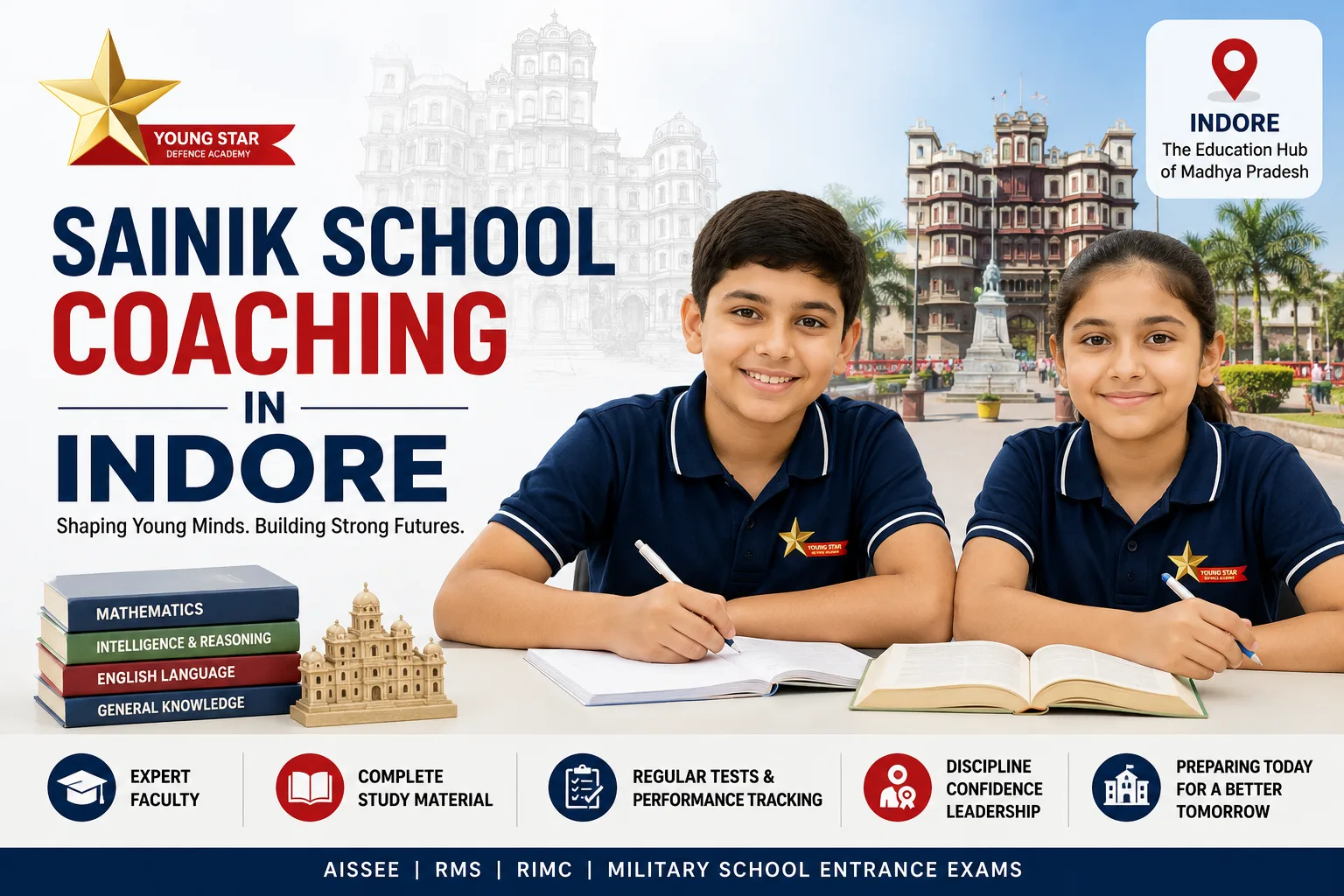
Sainik School Coaching in Indore – Complete Preparation Guide for AISSEE
Indore has always been known for its ambition. Whether it is business, academics, or competitive exams, families in this city take preparation seriously. In the last few years, that same seriousness has extended to Sainik School admissions. Parents from Vijay Nagar, Bhawarkuan, Palasia, and even from towns like Dewas and Ujjain are now actively looking for structured Sainik School coaching for their children — and they are starting early.
The All India Sainik Schools Entrance Exam, or AISSEE, is not a test you can crack with last-minute revision. It demands consistent preparation, subject-by-subject practice, and a clear understanding of how the exam works. Yet many students in Indore still rely on general tuition centres that are not equipped to handle the specific demands of this exam.
This guide is written specifically for students and parents in Indore and the surrounding region. Whether your child is preparing for Class 6 or Class 9 entry, this page will walk you through everything you need to know — the exam structure, preparation strategy, common mistakes, a month-by-month roadmap, and answers to the most frequently asked questions.
Read this fully before you make any decision about your child’s preparation. A well-informed parent is the biggest advantage a student can have.
Why Indore Students Are Choosing Sainik Schools
Madhya Pradesh has a long connection with military service. The state has produced officers across all three services, and that tradition continues in homes across Indore, Mhow, and nearby districts. But beyond family legacy, there are very practical reasons why Sainik School admissions have become so competitive among Indore families.
Academic Rigour with a Structured Environment
Sainik Schools follow the CBSE curriculum and are among the best-maintained residential schools in India. The academic standard is consistently high, and students who graduate from these schools are well-prepared not just for NDA but for IITs, medical colleges, and civil services as well. For parents in Indore who want a disciplined boarding school option with genuine academic quality, Sainik Schools stand out clearly.
Leadership and Character Development
The residential life at a Sainik School shapes students in ways that a regular day school cannot. Students learn time management, self-discipline, and team responsibility from the first week itself. These are not soft skills listed on a brochure — they are habits that develop through a structured daily routine, physical training, and inter-house competitions. Students from Madhya Pradesh who have attended Sainik Schools consistently report that the experience changed how they approach challenges in life.
Sports and Physical Fitness
Indore has produced national-level athletes, and Sainik Schools provide exactly the environment that nurtures sporting talent alongside academics. Students have access to grounds, courts, swimming pools, and trained physical education instructors. Many NDA cadets and Army officers who played at the national level began their serious sporting careers inside Sainik School campuses.
NDA Foundation and Defence Career Opportunities
The most direct benefit is this: students who pass through Sainik Schools have a clear pathway to NDA, and from there to the Indian Army, Navy, or Air Force as commissioned officers. The school prepares students not just academically but physically and psychologically for the demands of a defence career. For families in Mhow — a town with deep Army roots — and across greater Indore, this pathway holds enormous value.
State and National Scholarships
Sainik Schools have a fee structure that includes scholarship provisions for students from reserved categories and lower-income families. This makes quality residential education accessible to students across the economic spectrum, including those from Pithampur, Sanwer, and Rau who may not have access to expensive private boarding schools.
Complete Guide to AISSEE for Indore Students
What Is AISSEE?
The All India Sainik Schools Entrance Exam (AISSEE) is a centrally conducted examination held every year for admission to Sainik Schools across India. It is administered by the National Testing Agency (NTA) on behalf of the Sainik Schools Society. The exam is held in January each year, and admissions are offered for two classes: Class 6 and Class 9.
There are currently 33 operational Sainik Schools across India. Admissions are based on merit, with state-wise and category-wise reservations applied during the selection process.
Eligibility for Class 6 Admission
For Class 6, a student must be between 10 and 12 years of age as on 31 March of the year of admission. The student must have passed Class 5 from a recognised school. Both boys and girls are eligible — Sainik Schools were opened to girl students in a phased manner and most schools now admit girls in Class 6. Parents who want to understand how to build the right foundation during Class 5 can refer to our detailed guide on Sainik School preparation for Class 5.
Eligibility for Class 9 Admission
For Class 9, the student must be between 13 and 15 years of age as on 31 March of the admission year. The student must have passed Class 8 from a recognised school. The exam for Class 9 is significantly more advanced and competition is higher because fewer seats are available compared to Class 6.
Exam Pattern for Class 6
The Class 6 exam is a written test carrying 300 marks. It consists of four subjects:
- Mathematics – 150 marks
- General Knowledge – 25 marks
- Language (English or Hindi) – 25 marks
- Intelligence – 100 marks
The paper is objective type with multiple choice questions. There is no negative marking in the Class 6 paper. For a complete topic-by-topic breakdown, refer to the AISSEE syllabus guide.
Exam Pattern for Class 9
The Class 9 exam carries 400 marks and is divided into:
- Mathematics – 200 marks
- Intelligence – 50 marks
- English – 50 marks
- General Science – 75 marks
- Social Studies – 25 marks
The Class 9 paper is more demanding and requires a higher level of conceptual clarity in Mathematics and Science.
Selection Process
Selection happens in two stages. First, there is the written exam. Students who clear the written exam are then called for a medical examination. Medical clearance is mandatory — students who do not meet the prescribed health standards are not admitted even if they have a high written score. After medical clearance, the final merit list is prepared and students are allocated schools based on preference and availability. Families who want to understand how many seats are available state-wise and category-wise can check the detailed breakdown on Sainik School seats and vacancies.
Medical Standards
The medical examination checks for height and weight in proportion to age, eyesight, hearing, and general physical fitness. Flat feet, knock knees, and colour blindness are among the conditions that may lead to rejection at the medical stage. Parents are advised to get a preliminary health check done well in advance so that any correctable conditions can be addressed before the medical exam. A full list of requirements is available in our guide on medical standards for Sainik Schools.
Counselling and School Allocation
After the written exam and medical clearance, students participate in a centralised counselling process. Students from Madhya Pradesh are considered under the MP state quota first. Sainik School Rewa and Sainik School Satna are the schools under MP quota, though students with strong merit scores may also be considered for schools in other states.
What to Look for in a Good Sainik School Coaching Programme
Not every coaching centre that claims to prepare students for Sainik Schools actually understands the exam. Here is what genuinely good coaching looks like — so you can evaluate any programme you consider for your child.
Faculty with Exam-Specific Knowledge
The AISSEE is not the same as a school board exam or a general competitive test. The Intelligence section, in particular, requires specific training in pattern recognition, spatial reasoning, and analogical thinking. A teacher who handles standard Class 5 or Class 8 board coaching may not be equipped for this. Look for faculty who have specifically studied the AISSEE pattern and who have a track record of preparing students for it.
Structured Study Material
AISSEE-specific study material is different from standard NCERT guides. It should include topic-wise practice sets mapped to the exam pattern, previous years’ question papers with analysis, and separate modules for the Intelligence section. If a coaching programme hands your child general Class 5 workbooks and calls it AISSEE preparation, that is a red flag.
Regular Mock Tests
Mock tests are the single most reliable indicator of where a student stands. A good programme will conduct full-length timed mock tests at least once every two weeks during the final four months of preparation. These tests should mirror the actual exam format, and results should be analysed subject-by-subject so weak areas can be targeted. Students can also practise with our AISSEE mock test series to benchmark their readiness.
Performance Tracking and Parent Communication
Parents in Indore are increasingly expecting data-backed feedback on their child’s progress. Good coaching programmes maintain records of test scores over time and share these with parents regularly. A student’s score trajectory is more informative than a single result — if scores are improving consistently, the preparation is on track.
Doubt-Solving Sessions
Group classes alone are not sufficient. Students need time to get specific doubts resolved, especially in Mathematics and the Intelligence section. A programme that offers scheduled doubt-solving sessions — either in person or through an online platform — gives students a significant advantage.
Online Learning Support
For students from Rau, Pithampur, Sanwer, or Mhow who cannot travel daily to a coaching centre in central Indore, online access to recorded lectures and test platforms is essential. The best programmes today offer a hybrid model — live classes, recorded sessions, and online tests — so preparation is not limited by geography.
Subject-Wise Preparation Strategy for AISSEE
Mathematics Preparation
Mathematics carries the highest weightage in both Class 6 and Class 9 papers. For Class 6, the syllabus covers topics from Class 3 to Class 5 NCERT — number systems, basic operations, fractions, decimals, simple geometry, and word problems. For Class 9, it extends to Class 6–8 level content including algebra, mensuration, percentage and profit-loss, and basic geometry proofs.
The key to performing well in AISSEE Mathematics is speed and accuracy together. Students who are conceptually strong but slow will lose marks. Daily timed practice of 20–25 questions is more effective than studying theory for long periods. Start with NCERT textbooks, master each chapter, and then move to AISSEE-specific practice sets that replicate the question style used in the actual exam.
Word problems are consistently the area where students lose the most marks. Practice reading problems carefully and identifying the question type before attempting the calculation. Students in Indore who have strong foundations from their school should focus on speed drills once concepts are clear.
Intelligence and Reasoning Preparation
The Intelligence section is where coaching makes the biggest difference. Most students in Class 5 or Class 8 have never encountered formal reasoning questions in their school exams. The AISSEE Intelligence section tests pattern completion, mirror images, odd one out, coding-decoding, series completion, analogy, classification, and spatial reasoning.
The first step is exposure — students need to see enough question types to stop being surprised by new formats. This takes around four to six weeks of dedicated practice. After that, accuracy and speed improve rapidly. Parents often notice that students who struggle with Intelligence questions initially become the most confident in this section after consistent practice, because the section rewards pattern recognition, which improves with repetition.
Avoid teaching shortcuts blindly. Students who understand why a pattern works will perform better than those who memorise rules without understanding them.
Language Preparation
The Language section in Class 6 tests comprehension, grammar, and vocabulary at a Class 4–5 level. For Class 9, the English section is more demanding and covers comprehension passages, grammar rules, and vocabulary. Students who read regularly — even simple English story books or newspapers — build a natural advantage here.
For students in Indore whose primary medium has been Hindi, the English section deserves focused attention. A minimum of 20–30 minutes of English reading daily is recommended from at least six months before the exam. Grammar basics — tenses, subject-verb agreement, prepositions, and conjunctions — should be practised through exercises, not just studied from rules.
The Hindi medium option is available in AISSEE, and students who are more comfortable in Hindi should use it — there is no disadvantage in choosing Hindi as the language medium.
General Knowledge Preparation
The GK section carries 25 marks in the Class 6 paper. It covers current affairs at a basic level, Indian history and geography, national symbols, sports personalities, and science facts. The best approach is a combination of a standard GK book for the relevant class level and a monthly current affairs digest.
Students from Indore and Madhya Pradesh should also be aware that questions about MP geography, history, and culture occasionally appear. Knowing major rivers, historical sites, and state facts is worth the small investment of time it takes.
Why Parents in Indore Are Preferring Specialised Coaching
Ten years ago, parents in Indore who wanted their child to sit for AISSEE would simply have them prepare at home or add a few extra sessions to their existing tuition. That approach no longer works. The number of students appearing for AISSEE from Madhya Pradesh has grown significantly, and the competition for seats — especially under the MP state quota — is intense.
A parent from Vijay Nagar whose daughter appeared for AISSEE Class 6 two years ago described it this way: “We thought she was well-prepared because she was doing well in school. When she saw the Intelligence section paper, she had never seen anything like it. We realised too late that school performance and AISSEE performance are two completely different things.”
This gap — between school-level readiness and AISSEE-level readiness — is exactly what specialised coaching addresses. It is not about making students study more. It is about making them study the right things, in the right format, with enough practice tests to build exam-day confidence.
Parents in Bhawarkuan, Palasia, and Scheme 78 are increasingly choosing programmes that offer regular test series, parent-teacher communication, and performance tracking. They want to see their child’s score improving over months, not just receive vague reassurances about progress. The coaching landscape in Indore is evolving to meet this expectation.
Students from Nearby Cities Also Enrol for AISSEE Preparation
Indore serves as the natural education hub for a large region. Students and parents from several surrounding cities and towns are actively enrolling for Sainik School coaching, either by travelling to Indore or through online programmes.
Ujjain
Ujjain is approximately 55 kilometres from Indore. Families in Ujjain who are serious about AISSEE preparation often combine weekend visits to Indore coaching centres with daily online sessions at home. The demand for Sainik School admissions has grown significantly among Ujjain families in recent years.
Dewas
Dewas, around 35 kilometres from Indore, has a strong industrial workforce community where families increasingly value disciplined residential education. Students from Dewas often find that the structured environment of a Sainik School aligns with the values their families hold, and enrolment for AISSEE coaching from Dewas has been rising steadily.
Mhow
Mhow is significant because of its Army Cantonment. Many families stationed there or settled in Mhow have a direct connection to the Indian Army and understand the value of Sainik School education. Mhow students are among the most motivated AISSEE aspirants in the greater Indore region, and their discipline and physical readiness often give them an edge in the final selection process.
Pithampur
Pithampur is an industrial township about 25 kilometres from Indore. Families with children preparing for Sainik School from Pithampur benefit significantly from online coaching options, as daily commuting to the city is not always practical. A good online programme allows students from Pithampur to access the same preparation quality as those studying in central Indore.
Dhar and Khargone
Students from Dhar and Khargone, further away from Indore, rely almost entirely on online coaching. These are often highly motivated students, and the ones who combine self-discipline with quality online preparation frequently perform very well in the exam. Distance is no longer a barrier to quality AISSEE preparation.
Sanwer
Sanwer, close to Indore on the Agra-Mumbai highway, has families who commute to Indore regularly and integrate coaching visits into that routine. Students from Sanwer who enrol in weekend batch programmes in Indore tend to do well when they supplement those sessions with consistent weekday practice at home.
RMS and RIMC Preparation Alongside Sainik School
Many parents who are exploring Sainik School coaching do not initially realise that there are two other prestigious defence school entrance exams — RMS and RIMC — that their child can prepare for simultaneously. Understanding all three options gives families a much stronger strategy.
Rashtriya Military Schools (RMS)
There are five Rashtriya Military Schools in India — in Ajmer, Bengaluru, Belgaum, Chail, and Dholpur. These schools are run directly by the Ministry of Defence and have an even more rigorous selection process than Sainik Schools. RMS schools admit students in Class 6 and Class 8 through a separate entrance exam conducted by CBSE.
The RMS exam syllabus overlaps significantly with the AISSEE syllabus, particularly in Mathematics, English, and Intelligence. A student preparing seriously for AISSEE can, with some additional targeted preparation, also sit for the RMS exam and improve their chances of securing a seat in a prestigious defence school. Detailed guidance on this is available on our RMS coaching page.
Rashtriya Indian Military College (RIMC), Dehradun
RIMC is one of the oldest and most prestigious military preparatory schools in India. It admits boys in Class 8 through a highly competitive entrance exam held twice a year — in June and December. The RIMC exam is significantly harder than both AISSEE and RMS and demands strong performance in English, Mathematics, and General Knowledge at a Class 7 level.
RIMC graduates have an extraordinary track record — they hold senior positions across all three services and in civilian life. For students in Indore who have exceptional academic ability and aspire to the highest levels of defence leadership, RIMC preparation is worth pursuing seriously.
Why Preparing for All Three Makes Sense
The core preparation for AISSEE, RMS, and RIMC is highly compatible. All three exams test Mathematics, English, Intelligence, and General Knowledge. A student who builds a strong foundation in these areas during Class 4 and Class 5 is well-positioned to attempt all three exams and dramatically improve the likelihood of securing a seat in at least one of these schools.
For families in Indore investing in their child’s defence school preparation, the combined strategy offers significantly better returns than focusing on a single exam alone.
Common Mistakes Made by AISSEE Aspirants in Indore
These mistakes appear repeatedly among students who appear for AISSEE without adequate guidance. Avoiding them will put your child ahead of a large portion of the competition.
Mistake 1 – Starting too late. Many families in Indore begin looking for coaching six to eight weeks before the exam. AISSEE preparation ideally begins six to twelve months in advance. Starting late forces students into cramming mode, which never works well for an exam that tests understanding and application.
Mistake 2 – Ignoring the Intelligence section. Parents who focus entirely on Mathematics and Language often discover on exam day that their child struggled with the Intelligence section. This section carries 100 marks in the Class 6 paper and cannot be prepared at the last minute.
Mistake 3 – Relying on school performance as a benchmark. A student who scores 90% in their school exams is not necessarily ready for AISSEE. School exams test subject knowledge. AISSEE also tests reasoning, speed, and exam-specific question formats that are rarely seen in school papers.
Mistake 4 – Not practising timed tests. Understanding a topic and answering questions under time pressure are two very different skills. Students who study without timed practice often run out of time in the actual exam and leave questions unattempted.
Mistake 5 – Skipping previous years’ papers. Previous AISSEE question papers are one of the most reliable preparation tools available. Students who solve at least five years of papers understand the actual difficulty level, question types, and time distribution required for each section.
Mistake 6 – Neglecting physical fitness before the medical exam. Some students focus entirely on the written exam and then discover that they do not meet the medical standards. Basic physical fitness — healthy weight, good eyesight, no flat feet — should be monitored throughout the preparation period.
Mistake 7 – Overstudying one subject. A student who spends 80% of study time on Mathematics while neglecting GK and Language will have an unbalanced score profile. AISSEE rewards consistency across sections, not perfection in one.
Mistake 8 – Not reviewing mock test results carefully. Many students attempt mock tests but do not spend time analysing what went wrong. The review session after a mock test is as important as the test itself. Identifying patterns in mistakes — which question types are consistently wrong, where time is being lost — is what drives improvement.
Mistake 9 – Memorising answers instead of understanding concepts. Some students try to memorise answers to practice questions rather than understanding how to solve that type of problem. This approach breaks down immediately when the exam presents a slightly different variant of a question.
Mistake 10 – Exam-day anxiety from poor preparation for the format. Students who have never sat through a full-length 150-minute timed test before exam day are often hit by anxiety simply from the experience of sitting in an exam hall for that long. Full-length mock tests in a structured setting — ideally replicating actual exam conditions — eliminate this anxiety before it can affect performance.
Mistake 11 – Parents comparing children to others during preparation. Parental pressure during the preparation period can significantly damage a child’s confidence. Each student’s preparation timeline is different. Comparing your child to neighbours or relatives preparing for the same exam creates anxiety without adding value.
Mistake 12 – Changing study material repeatedly. Families who keep switching books and programmes because they hear about something “better” rarely complete any single resource thoroughly. One good, complete study programme followed with discipline is worth more than five partially completed resources.
One-Year Study Roadmap for AISSEE (Class 6)
This roadmap assumes the exam is in January and preparation begins twelve months in advance, around the previous February or March.
February to April – Foundation Stage
The first three months are about building the base. Students should focus on completing Class 3, 4, and 5 Mathematics NCERT chapters systematically. Basic concepts in fractions, decimals, geometry, and measurement should be covered thoroughly. For Intelligence, introduce the section gradually — two question types per week, with daily practice of 15–20 questions. This stage is not about speed. It is about understanding.
May to July – Concept Building Stage
By May, students should have a clear picture of which subjects and topics feel comfortable and which need more work. This stage is about strengthening weak areas. Harder Mathematics topics — word problems, ratio and proportion, basic geometry — should get extra attention. GK reading should become a daily habit. English grammar exercises should begin here for students who are not confident in the Language section.
August to October – Practice Stage
This stage shifts the focus from understanding to application. Students should be solving topic-wise practice sets daily. Previous years’ AISSEE papers should be attempted at this stage — not for scoring, but to understand the actual question format and distribution. The first full-length timed mock test should happen in October. The result will almost certainly be disappointing — that is expected and normal. The purpose is to identify gaps.
November to December – Mock Test Stage
One full mock test every week is the minimum target. After each test, spend 45–60 minutes reviewing mistakes — not just the wrong answers, but why each mistake happened. Scores during this stage typically improve by 15–25 marks over six to eight weeks when the review process is followed seriously. Speed drills in Mathematics should be a daily practice. Short revision of GK facts should happen every two to three days.
January – Final Revision Stage
In the two to three weeks before the exam, revision replaces new learning. Students should not attempt new topics or unfamiliar question types at this stage. The focus is on consolidating what has already been prepared, maintaining confidence, and ensuring physical health and sleep. One mock test in the week before the exam helps maintain sharpness without causing fatigue.
Frequently Asked Questions – Sainik School Coaching in Indore
1. What is the best age to start Sainik School preparation?
For Class 6 entry, preparation is most effective when it begins in Class 4 or early Class 5 — that is, roughly one to two years before the exam. Starting in Class 4 allows for a relaxed pace in the foundation stage and a more intensive approach in the final year. Students who start in the same year as the exam can still succeed, but it requires a more concentrated effort and leaves no room for gaps or slow periods.
2. Can students from Indore prepare for AISSEE through online classes?
Yes, absolutely. Online coaching has become a very effective option, particularly for students from areas like Pithampur, Rau, Sanwer, and Mhow who cannot travel daily to a coaching centre. Online programmes that combine live instruction, recorded sessions, and digital test series are functionally equivalent to in-person coaching when the student is disciplined about attendance and daily practice.
3. Is coaching really necessary for AISSEE, or can students prepare on their own?
Self-preparation is possible and some students do succeed with it, particularly if parents are knowledgeable about the exam and can guide the child’s study plan. However, the Intelligence section is genuinely difficult to prepare for independently because most students have no prior exposure to reasoning questions. Structured coaching ensures complete syllabus coverage, regular testing, and expert guidance on question-solving strategies — all of which are difficult to replicate through independent study alone.
4. How many mock tests should a student attempt before the AISSEE?
A minimum of 15 to 20 full-length mock tests is recommended over the course of the preparation period. The final two months before the exam should involve at least one full test per week. Quality of review matters more than quantity — a student who completes 10 tests with thorough review will outperform one who does 25 tests without analysing results.
5. Can girls apply for Sainik School admissions?
Yes. Sainik Schools have been open to girl students since the 2021 admission cycle, and girls now compete for seats alongside boys in the AISSEE. Girls from Indore and across Madhya Pradesh have successfully qualified for and enrolled in Sainik Schools. All the preparation guidance in this article applies equally to girl students.
6. Which Sainik Schools are available under the Madhya Pradesh state quota?
Sainik School Rewa and Sainik School Satna fall under the Madhya Pradesh state quota. Students from MP are prioritised under this quota. However, students with strong merit scores may also be considered for schools in other states during counselling.
7. What is the difference between Sainik School, RMS, and RIMC?
All three are prestigious defence-oriented schools, but they differ in admission process, management, and focus. Sainik Schools are managed by the Sainik Schools Society and admit students for Class 6 and Class 9 through AISSEE. Rashtriya Military Schools are managed directly by the Ministry of Defence and admit boys and girls in Class 6 and Class 9 through the RMS CET, conducted by NTA. RIMC in Dehradun admits boys and girls for Class 8 through a highly competitive exam and has a very strong track record of producing senior military officers. The academic and competitive standard rises from Sainik School to RMS to RIMC.
8. How is the AISSEE score used for school allocation?
AISSEE scores are used to prepare a merit list, with state-wise and category-wise reservations applied. Students rank within their state quota and category. After medical clearance, students participate in counselling and indicate their school preferences. Allocation is based on rank and availability of seats in preferred schools.
9. Is there negative marking in AISSEE?
There is no negative marking in the Class 6 paper. For the Class 9 paper, it is advisable to check the current year’s official AISSEE notification, as marking scheme details can be updated by NTA. Students should always refer to the official information bulletin before finalising their exam strategy.
10. How important is the medical examination in the selection process?
The medical examination is mandatory and eliminates students who do not meet the prescribed health standards, regardless of their written exam score. Common reasons for medical rejection include below-average vision, flat feet, and weight significantly outside the healthy range for age. Parents should have their child examined by a doctor a few months before the exam so that any correctable issues can be addressed in time.
11. What documents are required at the time of AISSEE application?
Typically required documents include the student’s birth certificate, school-issued documents confirming current class, passport-size photographs, category certificate if applicable, and a domicile certificate for state quota claims. For a complete checklist, refer to our dedicated page on documents required for Sainik School admission. The exact document list is published in the official AISSEE notification each year. Families should collect and organise these documents well before the application deadline.
12. What is the fee structure at Sainik Schools?
The fee structure at Sainik Schools is significantly subsidised compared to private boarding schools of similar quality. Fees vary slightly by school and category. Scholarship provisions are available for students from SC, ST, and economically weaker sections. Families interested in specific fee details should refer to the official Sainik Schools Society website or the specific school’s admission notice.
13. Can a student from a Hindi-medium school perform well in AISSEE?
Yes. The AISSEE is available in both English and Hindi medium. Hindi-medium students have no disadvantage when they choose the Hindi language option. Mathematics, Intelligence, and GK are fully accessible regardless of medium. Many students who studied in Hindi-medium schools in Madhya Pradesh have performed excellently in AISSEE and gone on to successful careers in the Indian Armed Forces.
14. How many hours per day should a student study for AISSEE preparation?
During the foundation and concept-building stages (eight to twelve months before the exam), one to two focused hours per day is sufficient. As the exam approaches, this can increase to three hours. Quality of study is more important than raw hours — a student who studies with full focus for ninety minutes will make more progress than one who sits at a desk for four hours while distracted. Weekends can be used for longer practice sessions and mock tests.
15. What should students from Vijay Nagar, Bhawarkuan, and Palasia do if they want to enrol in a coaching programme?
Students from these central Indore localities have the advantage of easy access to coaching centres in the city. The practical steps are: identify programmes that offer AISSEE-specific preparation (not just general competitive exam coaching), ask specifically about the Intelligence section curriculum, request details of the mock test schedule and parent reporting system, and if possible speak to parents of students who have already gone through the programme. A good coaching programme will be transparent about its methodology and results.
Closing Thoughts for Indore Families
Indore is a city that has always backed its children to succeed. The same ambition that drives students from this region to perform at state and national levels in business, academics, and sports is now finding a strong channel in Sainik School admissions. And the opportunity is real — Sainik Schools offer an education that shapes the whole person, not just the student.
But success in AISSEE does not come from wishful thinking or last-minute effort. It comes from understanding the exam clearly, preparing systematically, and building skills that take months to develop. The Intelligence section cannot be crammed. Mathematical speed cannot be rushed. Exam confidence cannot be built overnight.
For students in Indore, Vijay Nagar, Bhawarkuan, Mhow, Dewas, or Ujjain — the advantage is geography. Indore offers access to coaching infrastructure, both in-person and online, that smaller towns cannot match. That advantage is worth using well.
Start early. Prepare the right way. Know the exam before you sit it. And if your child earns that Sainik School seat, know that the journey of discipline, growth, and purpose that comes next will be one of the best decisions your family ever made. To learn more about the expertise and experience behind Young Star Defence Academy’s preparation programmes, visit the profile of Prashant Singh, founder and lead mentor.