
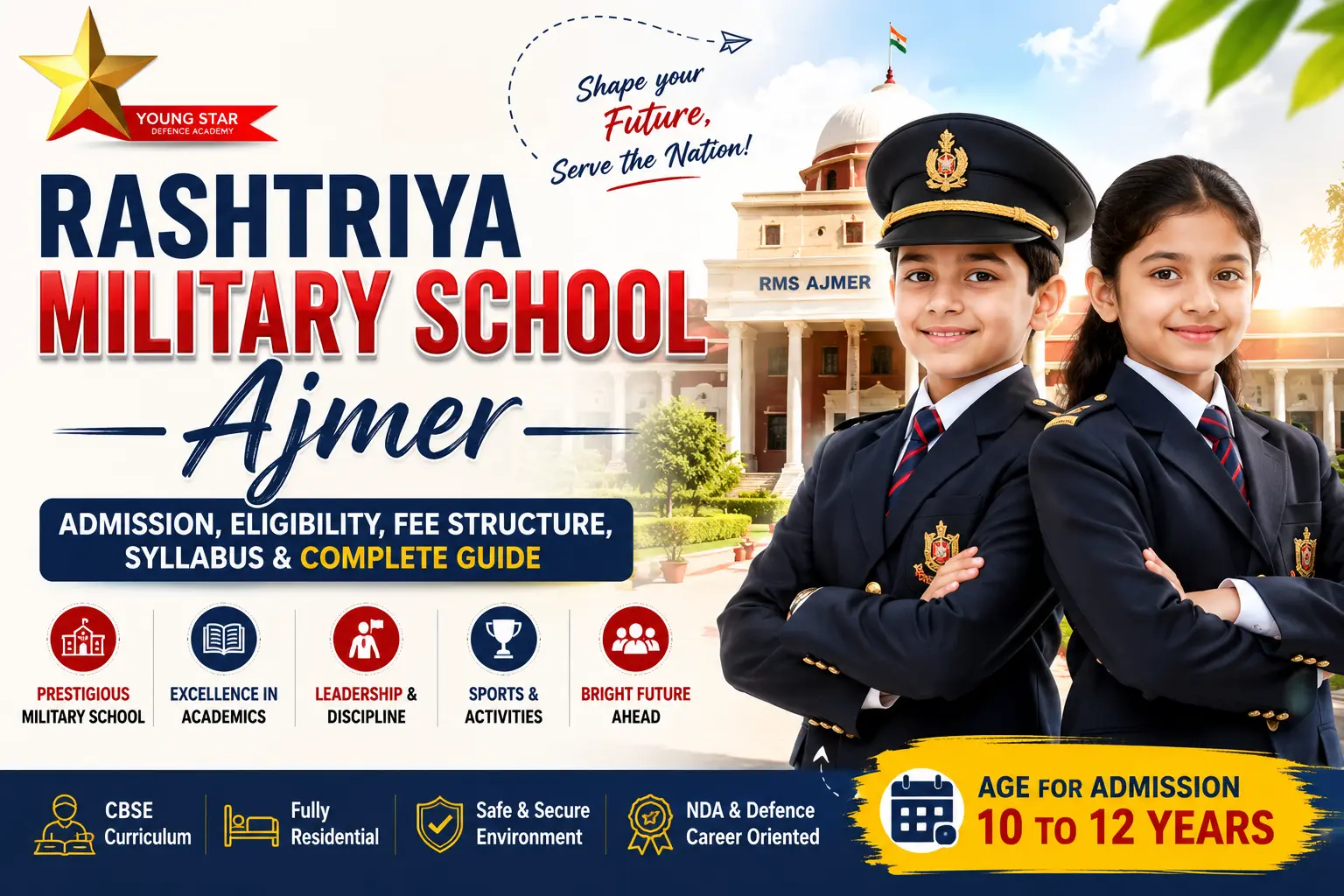
Rashtriya Military School Ajmer: Complete Admission Guide (Class 6 & 9)
If you are a parent researching Rashtriya Military School Ajmer, you probably have a dozen questions running through your head at once. How old does my child need to be? What does the entrance exam actually look like? Is this really as affordable as people say? What is hostel life like for a ten-year-old away from home for the first time?
This guide answers all of that, in plain language, without the marketing gloss you find on most school-fee comparison sites. It is written for parents in Ajmer, across Rajasthan, and across India who are trying to make one of the more important decisions of their child’s schooling years. Wherever a fact could change from year to year — fees, dates, cut-offs — we say so clearly and point you to where to verify it, because getting this decision right matters more than getting a page to rank.
Have a specific question about your child’s RMS Ajmer eligibility or preparation? Message us directly on WhatsApp and we’ll get back to you personally.
Quick Overview: RMS Ajmer at a Glance
Rashtriya Military School Ajmer is a fully residential, CBSE-affiliated public school run by the Ministry of Defence, admitting boys and girls to Class 6 and Class 9 through a national Common Entrance Test. Here are the essentials before we go deeper.
| Detail | Information |
|---|---|
| Full Name | Rashtriya Military School, Ajmer |
| Established | 15 November 1930 (as King George’s Royal Indian Military School) |
| Present Name Since | 25 June 2007 |
| Location | Kundan Nagar, Ajmer, Rajasthan 305001 |
| Campus Size | Approximately 87 acres |
| Governing Body | Ministry of Defence, Government of India (under Directorate General of Military Training) |
| Board Affiliation | CBSE, New Delhi |
| Medium of Instruction | English |
| Classes Offered | VI to XII |
| School Type | Fully residential (boarders only, no day scholars) |
| Entry Classes | Class VI and Class IX only |
| Eligible Candidates | Boys and girls |
| Entrance Exam | RMS Common Entrance Test (CET), OMR-based, offline |
| Motto | “Sheelam Param Bhushanam” (Character is the Highest Virtue) |
| Other RMS Locations | Chail, Belgaum, Bengaluru, Dholpur |
Key takeaway: RMS Ajmer is not a private boarding school you can simply “apply and pay” your way into. It is a government-run military school where admission depends entirely on performance in a national entrance test, followed by an interview and a medical examination.
What Is Rashtriya Military School Ajmer?
Rashtriya Military School Ajmer is one of five Rashtriya Military Schools in India, set up to give quality, disciplined, CBSE-based education to children — with a strong emphasis on preparing interested cadets for a future career in the Armed Forces. It functions as a Category ‘A’ military training institution, placing it in the same administrative bracket as the Rashtriya Indian Military College (RIMC) and the National Defence Academy (NDA).
Unlike Sainik Schools, which are run by the Sainik Schools Society under the Ministry of Defence but function somewhat independently of each other, the five Rashtriya Military Schools share one common entrance test, one common prospectus, and one central administration. RMS Ajmer is a sister institution to RMS Chail, RMS Belgaum, RMS Bengaluru, and RMS Dholpur — all following identical eligibility rules, fee structures, and academic calendars, with only location and campus character differing.
The school is coeducational at entry (boys and girls are both eligible for Class VI and Class IX admission), fully residential, and CBSE-affiliated. Cadets who join move through Class VI to Class XII living entirely on campus, with academics running alongside military-style discipline, NCC training, sports, and adventure activities.
History of RMS Ajmer
RMS Ajmer traces its roots to 15 November 1930, when it was founded as the King George’s Royal Indian Military School, meant to educate the children of defence personnel. In 1952, the school was reorganised along public-school lines, and admission was opened to the wards of Defence Service Officers and civilians as well. In 1954, it became a member of the Indian Public Schools Conference (IPSC), a status it retains today.
The school was renamed Military School in 1966, when its earlier motto, “Play the Game,” was replaced with “Sheelam Param Bhushanam” — Character is the Highest Virtue. It received its present name, Rashtriya Military School, on 25 June 2007, along with the other four sister institutions.
Nearly a century of history means RMS Ajmer has produced generations of alumni who have gone on to serve in the Army, Navy, and Air Force, as well as in civil services, business, and academia — a track record that continues to shape the school’s reputation for discipline and character-building today.
Why Students Choose RMS Ajmer
Parents and students are drawn to RMS Ajmer for reasons that go well beyond academics. Here is what genuinely sets it apart from a typical CBSE day school or even most private boarding schools.
- Structured, disciplined daily life — a fixed routine of PT, classes, sports, and self-study that builds consistency in a way most day schools cannot replicate.
- Low-cost, high-quality residential education — because it is government-subsidised, the actual value delivered (boarding, meals, coaching, sports facilities, medical care) far exceeds what families pay.
- A direct pathway toward defence careers — cadets who wish to join the Armed Forces get early exposure to NCC, drill, and the values expected of future officers, which helps later at NDA and CDS interviews.
- Strong peer environment — living and competing alongside motivated cadets from across the country tends to push students to perform better than they might in a purely academic setting.
- Character and leadership development — the emphasis on teamwork, punctuality, and responsibility shows up in how cadets carry themselves well beyond school years.
It’s worth being balanced here: RMS is not the right fit for every child. A ten- or thirteen-year-old moving into a fully residential, disciplined environment away from home for the first time needs genuine willingness, not just parental ambition. We say more about this later in the “Common Mistakes” section.
Campus Facilities at RMS Ajmer
The RMS Ajmer campus spans roughly 87 acres in the Kundan Nagar area of Ajmer, with panoramic views of the surrounding Aravalli hills. The infrastructure includes academic blocks, a library, science and computer laboratories, an auditorium, a school hospital (an eight-bed facility with a part-time Medical Officer and nursing staff, with referral tie-ups to JLN Hospital, Ajmer, and Military Hospital, Nasirabad, for specialist care), parade grounds, and multiple sports fields.
Cadets also have access to riding, shooting ranges, and adventure-training facilities that are typical of Rashtriya Military Schools, though exact facilities and their availability can vary by year and should be confirmed with the school directly for the current session.
Hostel Facilities and Boarding Life
RMS Ajmer admits boarders only — there is no day-scholar option. Every cadet, regardless of where their family lives, stays on campus in dormitory-style hostel accommodation supervised by house masters and hostel staff.
Hostel life is built around a fixed routine: shared dormitories organised by “houses,” communal dining in a mess hall, supervised prep/study time, and lights-out discipline. Meals, laundry, and basic amenities are provided as part of the boarding arrangement, and mess charges are billed separately from tuition fees (see the fee section below).
For a child who has never been away from home, hostel life at RMS is often the biggest adjustment of the entire experience — bigger, in most cases, than the academics. Parents preparing a child for RMS should spend as much time preparing them emotionally for independent living as they do preparing them academically for the entrance exam.
Academic Curriculum
RMS Ajmer follows the CBSE curriculum from Class VI through Class XII. The academic year runs from April to March, in line with the CBSE calendar. From Class XI onward, Rashtriya Military Schools offer the Science stream only — a detail worth knowing if your child is considering Commerce or Humanities later, since that path is not available within the RMS system.
Academics at RMS are structured around regular class hours, supervised evening study periods, and periodic testing, with teaching staff who are used to working within a residential, discipline-first environment. The goal is not just CBSE board results but building the kind of study habits and self-discipline that carry into competitive exams like NDA later on.
Sports and Extracurricular Activities
Sports form a core part of daily life at RMS Ajmer, not an optional extra. Cadets typically participate in athletics, football, basketball, volleyball, hockey, and other team and individual sports, along with cultural activities such as music, drama, and debate. Inter-house and inter-RMS competitions are a regular feature of the school calendar, giving cadets structured opportunities to compete and represent the school.
Military Training and Leadership Development
What distinguishes RMS from a typical CBSE school is the military and leadership component woven into everyday life. Cadets take part in NCC (National Cadet Corps) training, drill, and physical training (PT) as a standard part of the daily routine — not as an after-school club. This early, structured exposure to discipline, chain-of-command thinking, and physical fitness gives cadets a genuine head start if they later pursue NDA, CDS, or other officer-entry examinations.
Leadership responsibilities — house captaincies, prefect duties, cadet-led activities — are distributed among senior cadets, giving them real accountability rather than symbolic titles. This is one of the more understated but genuinely valuable parts of the RMS experience.
Eligibility Criteria for RMS Ajmer Admission
Direct answer: To be eligible for RMS Ajmer, a candidate must be currently studying in or have passed Class V (for Class VI admission) or Class VIII (for Class IX admission) from a recognised school, and must meet the specified age criteria as on 31 March of the admission year. Both boys and girls are eligible.
| Criteria | Class VI | Class IX |
|---|---|---|
| Educational Qualification | Studying in or passed Class V | Studying in or passed Class VIII, from a government/recognised school |
| Gender | Boys and Girls | Boys and Girls |
| Nationality | Indian citizen | Indian citizen |
| Admission Basis | Available vacancies, through CET merit | Available vacancies, through CET merit |
| Residency Requirement | Boarder only (no day scholars) | Boarder only (no day scholars) |
Age Criteria for RMS Ajmer
Direct answer: For Class VI admission, a candidate must not be less than 10 years and not more than 12 years of age as on 31 March of the year of admission. For Class IX admission, the candidate must not be less than 13 years and not more than 15 years of age as on the same date. A six-month relaxation in the upper age limit applies to wards of personnel killed in action.
| Class | Minimum Age | Maximum Age | Age Cut-off Date |
|---|---|---|---|
| Class VI | 10 years | 12 years | 31 March of admission year |
| Class IX | 13 years | 15 years | 31 March of admission year |
Important note: the date of birth accepted for verification must be from a birth certificate issued by a Municipal Corporation or an authorised local government body. Certificates issued by a Gram Panchayat or any unauthorised local body are not accepted, and any mismatch between the date of birth on the application and on the school leaving certificate can lead to disqualification. Double-check this document carefully before applying — it is one of the most common, and most avoidable, reasons candidates get rejected at the verification stage.
Not sure whether your child falls within the eligible age window this year? Use our Eligibility Calculator to check instantly for both Class VI and Class IX before you start the application.
Reservation Policy at RMS Ajmer
Direct answer: RMS reserves 70% of seats for wards of Junior Commissioned Officers (JCOs) and Other Ranks (OR) of the Army, Navy, and Air Force, including ex-servicemen, and 30% of seats for wards of officers and for civilians. Within these categories, statutory reservation for SC and ST candidates also applies, and a fixed proportion of seats is reserved for girls.
| Category | Reservation |
|---|---|
| Wards of JCOs/OR (Army, Navy, Air Force, including ex-servicemen) | 70% of total seats |
| Wards of Officers and Civilians | 30% of total seats |
| SC Candidates (within each category) | As per statutory reservation norms (commonly cited as 15%) |
| ST Candidates (within each category) | As per statutory reservation norms (commonly cited as 7.5%) |
| OBC (Non-Creamy Layer) | As per statutory reservation norms (commonly cited as 27%) |
| Girls | A fixed proportion of seats reserved (commonly cited as around 10%) |
Because exact reservation percentages and category definitions are revised from time to time by the Ministry of Defence, always confirm the current year’s breakdown in the official RMS prospectus for that admission cycle rather than relying solely on any third-party source, including this one.
Admission Process: Step by Step
Direct answer: Admission to RMS Ajmer follows a three-stage process — online registration and CET application, the written Common Entrance Test, and finally an interview plus medical examination for candidates who clear the merit cut-off. Selection is based purely on merit; there is no direct or management-quota admission. For a broader look at how this process works across all five campuses, see our RMS Admission guide.
- Notification: RMS releases an admission notification (usually mid-year) announcing the CET dates and registration window for the following academic session — track the current RMS admission form last date so you don’t miss the window.
- Online Registration: Candidates register on the official Rashtriya Military Schools website and fill in personal, academic, and category details.
- Document Upload: Scanned photograph and signature are uploaded in the specified format (commonly JPG/JPEG, size limits as instructed).
- Fee Payment: The CET application fee is paid online through the payment gateway on the NIELIT CET application portal, where the actual form is filled and submitted.
- Admit Card: An admit card is issued closer to the exam date, downloadable from the official website.
- Written CET: Candidates appear for the OMR-based Common Entrance Test at their allotted exam centre.
- Answer Key and Result: The provisional answer key is published first, followed by the official result and category-wise cut-off marks — check our RMS Results & Merit List page for how to read these once declared.
- Interview Call Letter: Candidates who clear the written cut-off are called for an interview and medical examination.
- Interview and Medical Test: Conducted at the respective RMS campus or a designated centre.
- Final Merit List and Admission: A final merit list is published; selected candidates complete admission formalities and join the school in the new academic session.
RMS CET Exam Pattern (Class VI and Class IX)
Direct answer: The RMS Common Entrance Test is an OMR-based, offline, multiple-choice exam with no negative marking. Class VI has a single paper of 100 marks (written) plus an interview component; Class IX has two written papers of 100 marks each, followed by an interview. Questions for Class VI are set at a Class V level, and for Class IX at a Class VIII level.
| Class | Subjects Tested | Marks | Negative Marking |
|---|---|---|---|
| Class VI (single paper) | Intelligence, Mathematics, General Knowledge, English | 100 (written) + interview component | No |
| Class IX (Paper I) | English, plus a section from the broader syllabus | 100 | No |
| Class IX (Paper II) | Mathematics, Science, Social Science, Hindi (as per the notified pattern) | 100 | No |
Two points are worth flagging clearly for parents:
- The exact weightage per subject and the exact interview marks allotted can vary slightly between cycles, so always cross-check against the current year’s official prospectus published on the RMS admission portal before finalising a preparation plan.
- Cut-off scores are calculated on aggregate performance, with minimum qualifying marks generally required in each individual subject — not just the overall total. A student who is very strong in Mathematics but weak in General Knowledge can still miss the cut-off if they don’t clear the individual subject threshold.
Detailed Syllabus for RMS CET
The RMS CET syllabus is closely tied to the NCERT curriculum of the class immediately below the one a candidate is applying for — Class V syllabus for Class VI admission, and Class VIII syllabus for Class IX admission. For a topic-wise breakdown you can track week by week, see our detailed RMS Syllabus page.
Class VI Syllabus (Based on Class V Level)
- English: Grammar basics, vocabulary, comprehension passages, sentence formation.
- Mathematics: Number system, basic arithmetic, fractions, geometry basics, measurement.
- Intelligence/Reasoning: Analogy, classification, series, pattern recognition, coding-decoding basics.
- General Knowledge: Current affairs, Indian history and geography basics, defence forces, sports, general science, important days and events.
Class IX Syllabus (Based on Class VIII Level)
- English: Grammatical structures, comprehension, synonyms and antonyms, vocabulary, composition, error correction, sentence types.
- Mathematics: Full Class VIII NCERT syllabus — algebra, geometry, mensuration, data handling.
- Science: Physical and biological science topics from Class VIII — light, electricity, reproduction, materials, natural phenomena, energy.
- Social Science: History, civics, geography from the Class VIII NCERT curriculum.
- Hindi: Grammar and comprehension as per the notified pattern (confirm current-year inclusion, as language sections can be revised).
A well-structured six-to-eight-month preparation window using NCERT textbooks as the base, supplemented with previous years’ RMS CET papers for practice, remains the most reliable approach regardless of which coaching resource a family eventually chooses.
Preparation Strategy for RMS CET
Based on years of guiding students through defence-school entrance exams, a few strategies consistently separate students who clear the cut-off from those who don’t:
- Anchor preparation in NCERT. Class V NCERT books for Class VI aspirants, Class VIII NCERT books for Class IX aspirants — this is the actual base the paper is set from.
- Build daily current-affairs habits early. General Knowledge is often where students lose the most avoidable marks. A short daily habit of reading age-appropriate news beats last-minute cramming.
- Practice previous years’ papers under timed conditions. This builds both speed and familiarity with the OMR format, which matters more than most students expect on exam day — our RMS Mock Test series is built around this exact pattern.
- Don’t neglect the interview. The interview carries real weight in the selection process and tests confidence, general awareness, and communication — not rote knowledge.
- Prepare physically too. The medical examination and the physical demands of hostel life mean basic fitness should not be an afterthought.
- Start 6-8 months in advance. Late starts are one of the most common causes of underpreparation we see among families reaching out close to the exam date. Working from a consistent set of RMS Books from day one helps keep this preparation structured.
Documents Required for RMS Ajmer Admission
| Document | Purpose |
|---|---|
| Birth Certificate (Municipal Corporation/authorised body) | Age proof and verification |
| School Leaving Certificate / Transfer Certificate | Proof of studying in or having passed the qualifying class |
| Latest Mark Sheet / Report Card | Academic eligibility verification |
| Category Certificate (SC/ST/OBC, where applicable) | Reservation category claim |
| Defence Service Certificate (for JCO/OR/Officer wards) | Category A/B reservation claim |
| Domicile/Residence Proof | Address verification |
| Passport-size Photographs | Application form and admit card |
| Signature Scan | Online application upload |
| Medical Fitness Documents | Required at the medical examination stage |
Fee Structure at RMS Ajmer
Direct answer: RMS Ajmer has a nominal, subsidised annual tuition fee that varies by category — officially cited at around ₹12,000 for wards of Other Ranks (OR) and ₹18,000 for wards of JCOs, with SC/ST candidates in each category paying 25% of the applicable fee. Wards of personnel killed in action are fully exempt from tuition fees. Boarding, mess, and caution money are charged separately, in addition to tuition.
| Category | Approximate Annual Tuition Fee |
|---|---|
| Wards of Other Ranks (OR) | Around ₹12,000 (as per last officially notified structure) |
| Wards of JCOs | Around ₹18,000 (as per last officially notified structure) |
| Wards of Officers / Civilians | Higher slab, notified separately by the school |
| SC/ST candidates (within any category) | 25% of the fee applicable to that category |
| Wards of personnel Killed in Action (KIA) | Full tuition fee exemption |
A few important clarifications on fees:
- The figures above reflect the last officially published RMS fee structure, effective from a prior academic session “till further revision.” Because government fee structures are revised periodically, always verify the current figure directly on the official RMS website or with the school’s admission office before budgeting — we also track category-wise updates on our Military School Fees page.
- Tuition fee is only one component. Boarding and mess charges, caution money (refundable without interest when the cadet leaves), uniform costs, and incidental expenses are billed separately and are not included in the tuition figure above.
- Compared to private boarding schools in Rajasthan — where all-inclusive annual costs can run into several lakhs of rupees — RMS Ajmer’s fee structure is genuinely one of the most affordable residential education options available to Indian families, which is precisely why the entrance test is so competitive.
Scholarships and Fee Concessions
Because RMS is a government-subsidised institution, the fee structure itself functions as a built-in concession compared to private boarding schools. Beyond this, category-based fee relief already covers some of the most vulnerable groups directly:
- Full tuition fee exemption for wards of defence personnel killed in action.
- 25% fee liability (instead of full fee) for SC/ST candidates within their respective category.
- Concessional tuition slabs based on the parent’s service category (OR, JCO, Officer, or civilian).
There is no separate “merit scholarship” scheme widely publicised beyond these category-based concessions, so families should not expect additional scholarship applications beyond correctly claiming their eligible category at the time of admission.
Daily Routine of RMS Ajmer Cadets
Life at RMS Ajmer runs on a fixed daily schedule designed to balance academics, physical training, and personal time. While exact timings can vary slightly by season and house, the general shape of a cadet’s day looks like this:
| Time Block | Activity |
|---|---|
| Early Morning | Wake-up, PT/physical training, parade |
| Morning | Breakfast, followed by academic classes |
| Midday | Lunch break, continued classes |
| Afternoon | Sports, NCC training, extracurricular activities |
| Evening | Dinner, supervised self-study/prep time |
| Night | Lights out at a fixed time |
This structure — repeated daily, week after week — is a large part of what shapes the discipline and time-management habits RMS cadets are known for.
Medical Standards for Admission
Candidates who clear the written CET and interview must also pass a medical examination conducted as per defence-standard medical fitness criteria. This typically checks vision, hearing, general physical fitness, and the absence of any condition that would prevent a child from participating fully in the physically demanding routine of a residential military school. Because standards can be specific and detailed, families with any pre-existing medical concern for their child should review the official medical standards published in the current year’s prospectus well before the exam, rather than after clearing the written test.
Uniform
Like other Rashtriya Military Schools, RMS Ajmer follows a structured uniform system for daily academic wear, PT kit, and ceremonial/parade uniform. Uniform items are typically provided or arranged through the school at the time of admission, with costs forming part of the initial admission expenses rather than the annual tuition fee.
School Rules and Discipline
RMS Ajmer operates under a defined code of discipline consistent with its military-school character: fixed timings, respect for hierarchy and seniority, house-based accountability, and clear consequences for rule violations. Inter-school transfers, for instance, are not permitted as a matter of routine and are considered only under specific, exceptional circumstances approved by the appropriate military training authority — a good illustration of how seriously the system treats continuity and discipline once a cadet is admitted.
Alumni of RMS Ajmer
Over nearly a century, RMS Ajmer has produced alumni who have gone on to serve as officers in the Army, Navy, and Air Force, as well as individuals who have built careers in civil services, business, and other fields. The school’s long affiliation with the Indian Public Schools Conference and its status as a Category ‘A’ military training institution reflect this legacy of producing disciplined, capable graduates.
Contact Information for RMS Ajmer
| Detail | Information |
|---|---|
| Address | Rashtriya Military School, Kundan Nagar, Ajmer, Rajasthan 305001 |
| Official Website (all RMS admissions) | rashtriyamilitaryschools.edu.in |
| CET Application Portal (to fill the form) | apply-delhi.nielit.gov.in (NIELIT-managed) |
For the school’s direct phone numbers and email, always refer to the official RMS website’s current contact page, since administrative contact details are updated from time to time.
Location and How to Reach RMS Ajmer
RMS Ajmer is located in the Kundan Nagar area of Ajmer city, Rajasthan, easily accessible from the main Ajmer-Jaipur Expressway.
By Railway Station
Ajmer Junction is the nearest major railway station, well connected to Delhi, Jaipur, Mumbai, and other major cities, and located a short drive from the school.
By Airport
The nearest airport is Kishangarh (Ajmer) Airport, with Jaipur International Airport serving as the larger, better-connected alternative for most long-distance travellers.
Nearby Attractions
Families travelling to Ajmer for admission-related visits often combine the trip with a visit to the Ajmer Sharif Dargah, Ana Sagar Lake, and the nearby town of Pushkar, known for its lake and temples.
RMS Ajmer vs Other Rashtriya Military Schools
All five Rashtriya Military Schools share the same eligibility rules, fee structure, and CET, so the real differences between them come down to location, campus character, and regional accessibility.
| School | State | Established | Notable Feature |
|---|---|---|---|
| RMS Ajmer | Rajasthan | 1930 | 87-acre campus with Aravalli hill views; oldest continuously running RMS along with Chail’s predecessor lineage |
| RMS Chail | Himachal Pradesh | 1922 (as KGRIMC, later relocated) | Hill-station campus in the Shimla hills |
| RMS Belgaum | Karnataka | 1946 | South India’s primary RMS option |
| RMS Bengaluru | Karnataka | 1946 | Urban-adjacent campus in Karnataka |
| RMS Dholpur | Rajasthan | 1962 | Rajasthan’s second RMS, established as the fifth school in the network |
For families in Punjab, Rajasthan, Haryana, and neighbouring states, RMS Ajmer and RMS Dholpur are typically the most geographically convenient, while RMS Chail is the natural choice for families in Himachal Pradesh and nearby hill regions.
Frequently Asked Questions About RMS Ajmer
1. What is Rashtriya Military School Ajmer?
Rashtriya Military School Ajmer is a CBSE-affiliated, fully residential public school run by the Ministry of Defence, admitting boys and girls to Class VI and Class IX through a national entrance test, combining academics with military-style discipline and training.
2. How do I get admission in RMS Ajmer?
Admission requires registering online for the RMS Common Entrance Test, clearing the written exam, qualifying in the subsequent interview, and passing the medical examination, after which selection is finalised strictly by merit.
3. Who can apply for RMS Ajmer?
Indian boys and girls meeting the age criteria (10-12 years for Class VI, 13-15 years for Class IX as on 31 March of the admission year) and the corresponding educational qualification can apply.
4. Is RMS Ajmer under CBSE?
Yes, RMS Ajmer is affiliated with the Central Board of Secondary Education (CBSE), New Delhi, and follows the CBSE curriculum from Class VI to Class XII.
5. What is the RMS Ajmer entrance exam called?
It is called the RMS Common Entrance Test (CET) — an OMR-based, offline, multiple-choice exam conducted for admission to Class VI and Class IX across all five Rashtriya Military Schools.
6. What are the RMS Ajmer fees?
Tuition fees are nominal and category-based — historically around ₹12,000 to ₹18,000 annually for OR/JCO ward categories, with SC/ST candidates paying 25% of the applicable fee. Boarding and mess charges are additional. Always confirm current figures officially.
7. Does RMS Ajmer have hostel facilities?
Yes, RMS Ajmer is a fully residential school. All admitted cadets, regardless of distance from home, live on campus in hostel accommodation; there is no day-scholar option.
8. Can girls apply for RMS Ajmer?
Yes. Rashtriya Military Schools, including RMS Ajmer, admit both boys and girls to Class VI and Class IX, with a defined proportion of seats reserved for girl candidates.
9. What is the age limit for RMS Ajmer Class 6?
Candidates must be not less than 10 years and not more than 12 years of age as on 31 March of the year of admission for Class VI.
10. What is the age limit for RMS Ajmer Class 9?
Candidates must be not less than 13 years and not more than 15 years of age as on 31 March of the year of admission for Class IX.
11. Is there negative marking in the RMS CET?
No. The RMS Common Entrance Test does not have negative marking, though candidates must still clear minimum qualifying marks in individual subjects, not just the overall total.
12. What subjects are tested in the RMS Class 6 exam?
Class VI CET tests English, Mathematics, Intelligence/Reasoning, and General Knowledge, at a difficulty level equivalent to Class V.
13. What subjects are tested in the RMS Class 9 exam?
Class IX CET is conducted across two papers covering English, Mathematics, Science, Social Science, and Hindi, at a difficulty level equivalent to Class VIII.
14. Is there an interview after the RMS CET written exam?
Yes. Candidates who clear the written cut-off are called for an interview, followed by a medical examination, before the final merit list is prepared.
15. How many Rashtriya Military Schools are there in India?
There are five Rashtriya Military Schools in India — located at Ajmer and Dholpur (Rajasthan), Chail (Himachal Pradesh), and Belgaum and Bengaluru (Karnataka).
16. What is the reservation policy at RMS Ajmer?
70% of seats are reserved for wards of JCOs/OR of the Army, Navy, and Air Force (including ex-servicemen), and 30% for wards of officers and civilians, with further SC/ST/OBC and girls’ reservation applied within these categories.
17. What documents are required for RMS Ajmer admission?
Key documents include a municipal birth certificate, latest school mark sheet, transfer/school leaving certificate, category certificates where applicable, photographs, and signature scans for the online application.
18. Is RMS Ajmer only for children of defence personnel?
No. While 70% of seats are reserved for wards of JCOs/OR of the Armed Forces, the remaining 30% is open to wards of officers and civilians, making RMS accessible to non-defence families as well.
19. What is the medium of instruction at RMS Ajmer?
English is the medium of instruction across all classes at RMS Ajmer, consistent with all Rashtriya Military Schools.
20. Does RMS Ajmer offer Commerce or Arts streams after Class 10?
No. Rashtriya Military Schools, including RMS Ajmer, offer only the Science stream from Class XI onward.
21. How is RMS Ajmer different from a Sainik School?
Both are Ministry of Defence-affiliated residential schools with a similar mission, but Sainik Schools operate under the Sainik Schools Society with more independent state-linked administration, while the five Rashtriya Military Schools share one common central administration, prospectus, and entrance test.
22. What is the campus size of RMS Ajmer?
RMS Ajmer’s campus spans approximately 87 acres in the Kundan Nagar area of Ajmer, Rajasthan.
23. When was RMS Ajmer established?
RMS Ajmer was established on 15 November 1930 as the King George’s Royal Indian Military School, later renamed Rashtriya Military School on 25 June 2007.
24. Can a student who has completed Class 5 apply directly for Class 9 at RMS Ajmer?
No. Admission is only offered into Class VI and Class IX as entry points; a candidate must meet the specific age and qualification criteria for whichever class they are applying to, and cannot skip directly from Class V eligibility to a Class IX seat.
25. What happens if a candidate is selected but fails the medical examination?
A candidate who does not meet the prescribed medical fitness standards is not offered final admission, regardless of their written exam or interview performance, since medical fitness is a mandatory stage in the selection process.
26. Is coaching necessary to crack the RMS CET?
Coaching is not mandatory, but structured guidance helps many students, particularly with time management, current affairs coverage, and interview preparation — self-study with NCERT books and previous papers can also work well for disciplined students.
27. What is the caution money at RMS Ajmer?
Caution money is a refundable deposit collected at the time of admission and returned to the cadet without interest when they leave the school; it is separate from the annual tuition and mess fees.
Common Mistakes Parents and Students Make During RMS Admission
After years of guiding families through defence-school admissions, certain mistakes come up again and again — and most of them are entirely avoidable.
- Submitting an incorrect or unauthorised birth certificate. Only certificates from Municipal Corporations or authorised local bodies are accepted; Gram Panchayat certificates are routinely rejected.
- Starting preparation too late. Six to eight months of consistent preparation gives a far stronger foundation than a rushed two-month sprint.
- Ignoring General Knowledge until the last moment. This section is often where otherwise strong students lose the most ground.
- Not preparing the child emotionally for hostel life. Academic readiness without emotional readiness for boarding life often leads to a difficult first few months even after successful admission.
- Treating the interview as an afterthought. Some families focus entirely on the written exam and walk into the interview underprepared.
- Overlooking the medical fitness requirement. Families sometimes discover a disqualifying medical issue only at the final stage, when addressing it earlier could have changed the outcome.
- Missing application deadlines due to last-minute document gathering. Documents like category certificates can take time to obtain — start early.
Tips to Crack the RMS Entrance Exam
- Build a subject-wise study timetable and stick to it — don’t let Mathematics or English preparation crowd out General Knowledge or Reasoning.
- Use NCERT textbooks as your primary source, not assorted guidebooks, since the CET syllabus maps closely to them.
- Take at least 8-10 full-length previous-year or model papers under strict timed conditions before the actual exam.
- Read a simplified daily current-affairs digest rather than adult newspapers, to keep General Knowledge preparation age-appropriate and consistent.
- Practice basic interview questions about the child’s family background, ambitions, and general awareness — confidence matters as much as content here.
- Maintain a basic level of physical activity and fitness throughout preparation, not just in the weeks before the medical exam.
- Revisit weak areas identified from mock test performance rather than repeatedly practicing what the child is already strong at.
Why Students Need Proper, Structured Preparation
The RMS CET is a genuinely competitive, national-level exam, with thousands of applicants competing for a limited number of seats across five schools. Because the syllabus, question style, and interview expectations are specific to this exam — different from typical CBSE school tests — students preparing only through regular schoolwork often find themselves underprepared for the pace, format, and general-knowledge depth the CET demands.
Structured preparation — whether self-directed with the right resources or supported by focused coaching — helps students cover the syllabus systematically, build exam-taking speed through timed practice, and walk into the interview with genuine confidence rather than memorised answers. This is where proper guidance, rather than last-minute cramming, makes the real difference between a good attempt and a successful one.
About Young Star Defence Academy
Young Star Defence Academy (YSDA), founded by Prashant Singh, is a defence entrance exam coaching institute headquartered in Amritsar, Punjab, with branches in Chandigarh and Kapurthala, focused on preparing students for AISSEE (Sainik School), RIMC, RMS, and NDA Foundation exams, including RMS Class VI and Class IX entrance preparation.
Our RMS Coaching program for RMS aspirants is built around structured, syllabus-mapped teaching (NCERT-based for both Class VI and Class IX levels), regular timed mock tests modelled on the actual CET pattern, focused General Knowledge and current-affairs sessions, and dedicated interview preparation — because, as this guide has explained, the interview and medical stages matter just as much as the written exam. Parents of younger children can also explore our Scholarship Test for Class 4 as an early head start before the Class VI RMS cycle begins.
If your child is preparing for RMS Ajmer, RMS Dholpur, or any of the five Rashtriya Military Schools, and you would like guidance on building a realistic study plan, reach out to Young Star Defence Academy at +91 81013 13136 for a conversation about where your child currently stands and what a focused preparation plan could look like.
Conclusion
Rashtriya Military School Ajmer offers something genuinely rare in Indian education: a disciplined, CBSE-based, fully residential schooling experience at a fraction of the cost of comparable private boarding schools, backed by nearly a century of institutional history. But because admission is purely merit-based, through a genuinely competitive national exam, getting in requires real preparation — academically, physically, and emotionally.
Whether your child ultimately joins RMS Ajmer or one of its sister schools, understanding the eligibility rules, exam pattern, fee structure, and daily realities of hostel life — as covered in this guide — is the first real step toward making an informed decision for your family. Verify time-sensitive details like fees, dates, and reservation percentages directly on the official RMS website closer to your application cycle, and give your child the preparation time they genuinely need to compete for one of these seats.