
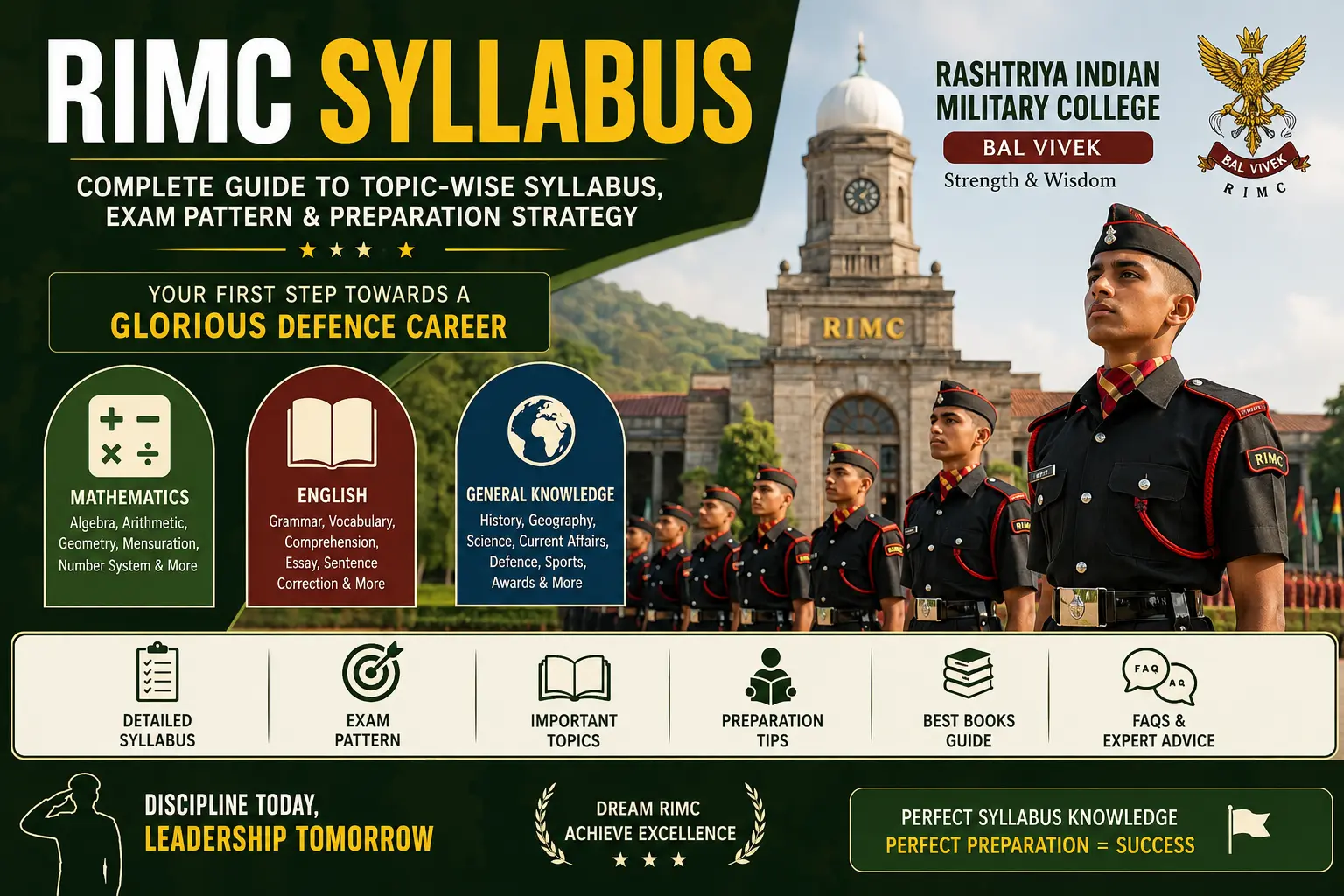
RIMC Syllabus – Complete Subject-Wise Breakdown, Exam Pattern & Preparation Guide
Table of Contents
- Introduction
- What is RIMC?
- RIMC Entrance Exam Overview
- RIMC Exam Pattern
- Complete RIMC Syllabus
- Important Topics for RIMC Exam
- Difficulty Level of RIMC Exam
- Best Books for RIMC Preparation
- How to Prepare for RIMC Entrance Exam
- Common Mistakes Students Make
- Why Coaching Helps
- Tips for Parents
- Frequently Asked Questions
- Conclusion
Introduction – The Dream That Demands Discipline
Every year, thousands of young boys and girls across India sit down with one dream burning inside them — to wear the uniform of a Rashtriya Indian Military College cadet. It is not just an entrance exam. For most families, it is the moment when a childhood aspiration begins its first serious test against reality.
I have seen it closely, year after year. Parents driving hours from small towns to enrol their child. Students waking at five in the morning to revise before school. Notebooks filled with formulas, grammar rules, and GK notes. That kind of dedication is not unusual in the world of RIMC preparation — it is the baseline.
RIMC is not a school that simply teaches subjects. It is an institution that shapes character, builds mental toughness, and produces leaders who go on to serve India in the armed forces at the highest levels. A seat in RIMC is rare. The competition is national, the standards are high, and the selection process is thorough. Yet every year, students do crack it — and almost without exception, they share one thing in common: they understood the syllabus deeply and prepared accordingly.
That is exactly what this guide is about.
Whether you are a student in Class 6 beginning your RIMC preparation journey, or a parent trying to understand what your child needs to study, this article will give you everything — the complete RIMC syllabus, detailed subject-wise breakdowns, preparation strategies, book recommendations, and honest guidance from someone who has spent years guiding defence aspirants.
The RIMC entrance exam syllabus is not a secret. But knowing it and mastering it are two very different things. This guide bridges that gap.
What is RIMC? – India’s Most Prestigious Military School
RIMC stands for Rashtriya Indian Military College. Located in the foothills of the Himalayas in Dehradun, Uttarakhand, it is one of India’s oldest and most honoured military preparatory institutions, established in 1922. For over a century, RIMC has been the breeding ground for some of India’s finest armed forces officers.
RIMC is affiliated with the Central Board of Secondary Education (CBSE) and functions under the direct supervision of the Ministry of Defence. After completing their education at RIMC, cadets typically join the National Defence Academy (NDA) and go on to serve as commissioned officers in the Indian Army, Navy, and Air Force.
The institution is not just academically rigorous — it builds the entire personality. Cadets at RIMC follow a structured daily routine that includes physical training, academics, extracurricular activities, leadership exercises, and character development. It is this holistic environment that makes a RIMC education so uniquely valuable.
You can read more about the institution’s legacy on the RIMC coaching and information page at Young Star Defence Academy.
RIMC Motto – “Bal Vivek” (Strength and Wisdom)
The motto of Rashtriya Indian Military College is Bal Vivek — a Sanskrit phrase that translates to Strength and Wisdom. These two words carry far more weight than they might appear to at first glance.
Strength here does not refer merely to physical power. It encompasses mental resilience, emotional courage, and the grit to face adversity without breaking. Wisdom means not just academic knowledge but the ability to think clearly under pressure, make sound judgements, and lead others with integrity.
Everything about RIMC — its daily schedule, its discipline, its academics, its sports — is designed to build both these qualities simultaneously. When a young cadet endures gruelling PT at dawn and then sits for a mathematics examination an hour later, that is Bal Vivek in action.
As a student preparing for the RIMC entrance exam, internalising this motto matters. The examination tests whether you are ready to begin that journey of strength and wisdom. Discipline in your preparation, honesty in your self-assessment, and the courage to keep going when revision feels endless — that is what RIMC is looking for, even at the entry stage.
The official RIMC website provides additional institutional information, admission schedules, and notices for aspiring candidates and their families.
RIMC Entrance Exam Overview
The RIMC selection process has multiple stages. Clearing the written exam is only the beginning. Here is how the complete process works:
Stage 1 – Written Examination
The first stage is a written examination held twice annually — once in June (for the January intake) and once in December (for the July intake). The paper covers three subjects: Mathematics, English, and General Knowledge. It is objective and subjective in nature, testing both accuracy and expression.
Stage 2 – Merit Shortlisting
Based on written exam performance, a merit list is prepared. Only the top-scoring candidates — typically a few hundred nationally — are called for the next stage. Given that thousands of students appear for the exam, this shortlisting is itself highly competitive.
Stage 3 – Viva Voce (Interview)
Shortlisted candidates appear before an interview board for the Viva Voce. This carries 50 marks and evaluates personality, communication, general awareness, confidence, and officer-like qualities. Students who are academically strong but poorly prepared for the interview have lost seats here. The Viva is taken seriously.
Stage 4 – Medical Examination
Candidates who clear the Viva Voce undergo a thorough medical examination as per Indian Army standards. Physical fitness and health standards are strictly evaluated.
Final Selection
The final merit list is prepared based on the combined score of the written examination and the Viva Voce. Only approximately 25 seats are available per term (the number may vary), making each seat extremely competitive. Boys and girls are eligible, with girls admitted since January 2023.
RIMC Exam Pattern – Marks, Duration, and Structure
Before diving into the syllabus, it is essential to understand the exam pattern clearly. Knowing how many marks each subject carries and how much time is available shapes your entire preparation strategy.
| Subject | Maximum Marks | Duration | Medium |
|---|---|---|---|
| Mathematics | 200 | 2 Hours | English / Hindi |
| English | 125 | 1 Hour 15 Min | English |
| General Knowledge | 75 | 1 Hour | English / Hindi |
| Written Total | 250 | ~4 Hours 15 Min | – |
| Viva Voce (Interview) | 50 | Variable | English / Hindi |
| Grand Total | 450 | – | – |
Key Takeaways from the Exam Pattern
- Mathematics is the heavyweight — carrying 200 out of 400 written marks (50%), it deserves the most preparation time.
- The Viva is not optional preparation — 50 marks for the interview means a well-prepared student can make up or lose significant ground here.
- English and GK together carry 200 marks — often neglected, these subjects can be the deciding factor when Mathematics scores are similar across candidates.
- The exam is conducted in a single day, across multiple sessions. Physical stamina and exam-day focus matter.
We have put together the complete RIMC syllabus, exam pattern, and 2026–27 exam calendar in a single PDF — download it below and keep it handy through your preparation.
⬇ Download RIMC Syllabus PDF
💬 WhatsApp Us for Guidance
Complete RIMC Syllabus – Subject-Wise Detailed Breakdown
The RIMC entrance exam syllabus is broadly aligned with the Class 7–8 CBSE curriculum. However, the questions — especially in Mathematics — demand genuine conceptual clarity, not just memorisation. Below is the most detailed breakdown you will find anywhere.
RIMC Mathematics Syllabus
Mathematics is the pillar of the RIMC paper. With 200 marks at stake, it separates the well-prepared from the average candidate decisively. The good news is that the syllabus is not impossible — it is Class 7–8 level. But the questions test application, not rote learning.
1. Number System & Arithmetic
This includes natural numbers, integers, rational numbers, LCM and HCF, divisibility rules, prime factorisation, BODMAS, and basic operations. These questions appear every year without fail. Students often underestimate this section and make careless errors. Practice mental arithmetic daily — it saves time in the exam.
2. Fractions and Decimals
Operations on fractions, converting between fractions and decimals, comparing fractions, and mixed numbers. The common mistake here is calculation errors while adding or subtracting mixed fractions. Practise until it becomes automatic.
3. Percentages
Calculating percentage of a number, percentage increase/decrease, and converting fractions/decimals to percentages and vice versa. Percentage problems are frequently linked to profit & loss and simple interest questions, so treat these as a connected cluster.
4. Ratio and Proportion
Basic ratios, equivalent ratios, dividing quantities in a given ratio, direct and inverse proportion, and unitary method. Proportion problems in RIMC papers often appear in the form of word problems that require two-step reasoning.
5. Profit, Loss and Discount
Cost price, selling price, profit percentage, loss percentage, marked price, and discount calculations. The difficulty is usually moderate, but multi-step problems that combine profit and percentage can trip up under-prepared students. Focus on understanding the logic behind each formula rather than memorising them blindly.
6. Simple Interest and Compound Interest
Simple Interest formula, compound interest (annually, half-yearly), and comparison of the two. Compound interest questions require careful step-by-step calculation. A common error is applying the formula to the original principal instead of the accumulated amount in subsequent years.
7. Time, Distance and Speed
Uniform motion, average speed, relative speed (trains, boats), time calculations, and conversion of units. This is one of the trickier areas of the RIMC Maths syllabus. Students who have not understood relative speed at a conceptual level often guess on these problems. Spend time on worked examples before attempting practice questions.
8. Time and Work
Work done by individuals in a given time, combined work, efficiency-based problems. Short but targeted problems appear here. The fraction-based approach (1/n method) must be mastered thoroughly.
9. Algebra – Linear Equations
Forming and solving simple linear equations in one variable, word problems based on linear equations. Algebra is where many students lose marks unnecessarily. The issue is usually forming the equation correctly from the word problem. Practice translating word problems into equations methodically.
10. Geometry – Angles, Lines and Triangles
Types of angles (complementary, supplementary, vertically opposite), properties of triangles (angle sum property, exterior angle), congruence of triangles, and Pythagoras theorem. Geometry requires both visual understanding and formula knowledge. Drawing neat diagrams while solving is not optional — it prevents errors.
11. Mensuration – Perimeter and Area
Area and perimeter of squares, rectangles, triangles, circles, trapezoids. Area of combined shapes. Surface area of cubes and cuboids. Volume of cubes, cuboids, and cylinders. Mensuration problems in RIMC often combine two shapes. The trick is to read the problem carefully and identify which dimensions correspond to which shape.
12. Data Handling – Averages
Mean, median, mode. Simple bar graphs, pie charts, and reading data from tables. These questions are scoring opportunities. Once the formulas are clear, the calculation is straightforward. Do not skip these in favour of more exciting topics — they give easy marks.
13. Squares, Cubes and their Roots
Squares up to 20, cubes up to 10, square roots and cube roots. Questions involving these come up both directly and embedded in algebra and mensuration problems. Knowing these by heart eliminates the need for long calculations during the exam.
RIMC English Syllabus
The English paper of 125 marks tests both language knowledge and communication ability. It is highly scoring for students who have been reading regularly and practising grammar systematically. Many students make the mistake of treating English as a secondary subject and paying for it on exam day.
1. Grammar – Tenses
All 12 tenses with their structure and usage — simple, continuous, perfect, and perfect continuous in present, past, and future forms. Tense errors are the most common grammar mistakes in the RIMC English paper. The solution is not to memorise rules but to develop a feel for correct usage through extensive reading and practice.
2. Parts of Speech
Nouns (types and number), pronouns (types and case), adjectives (degrees of comparison), verbs (transitive/intransitive), adverbs, prepositions, conjunctions, and interjections. These form the foundation of all grammar questions. Students who are weak here struggle across multiple sections of the paper.
3. Subject-Verb Agreement
Matching the subject and verb correctly across a variety of sentence structures, including collective nouns, indefinite pronouns, and compound subjects. This is a high-frequency area in RIMC English papers.
4. Sentence Correction
Identifying and correcting grammatical errors in given sentences. These questions cover a wide range of grammar rules and test overall language sense. The best preparation is reading well-written English — the correctness becomes instinctive over time.
5. Active and Passive Voice
Converting sentences from active to passive and vice versa across different tenses. Many students make errors in passive constructions involving the future tense or modals. Practise these specifically.
6. Direct and Indirect Narration (Reported Speech)
Converting direct speech to indirect speech and vice versa, including changes in pronoun, tense, time expressions, and reporting verbs. This is a moderately difficult area that rewards careful systematic practice.
7. Vocabulary – Synonyms and Antonyms
Knowledge of word meanings, opposite meanings, and correct usage in context. The vocabulary tested in RIMC papers is at the Class 7–8 level but expects genuine understanding. The best way to build vocabulary is to read a chapter of a book daily and note unfamiliar words.
8. Comprehension Passage
Reading an unseen passage and answering questions based on it. This section tests reading speed, retention, and the ability to infer meaning from context. Students who read regularly find this section straightforward. Those who do not — struggle for time. Practise reading at least one short passage with questions every day.
9. Essay / Paragraph Writing
Writing a short essay or paragraph on a given topic — usually related to current events, nature, patriotism, sports, or national values. Marks are awarded for content, organisation, vocabulary, and grammar accuracy. Practice writing one short essay (150–200 words) weekly. Focus on a clear introduction, body, and conclusion structure.
10. Letter Writing
Formal and informal letter formats are occasionally tested. Know the standard format for both types, including the correct placement of date, address, salutation, and closing.
RIMC General Knowledge Syllabus
The GK paper carries 75 marks and is often treated as an afterthought. That is a mistake. In a competitive field where Mathematics and English scores cluster closely together, a well-prepared GK paper can be the difference between selection and rejection.
1. Indian History
Ancient Indian history (major dynasties, Maurya, Gupta), medieval history (Delhi Sultanate, Mughal Empire), modern Indian history (British rule, independence movement, key figures like Mahatma Gandhi, Subhas Chandra Bose, Bhagat Singh), and post-independence India. Focus on facts — dates, rulers, events, significance.
2. Indian Geography
Physical geography of India (rivers, mountains, plateaus, deserts, climate zones), states and capitals, national parks and wildlife sanctuaries, major crops and minerals, and India’s borders. Questions on rivers and mountains are particularly frequent.
3. World Geography
Continents, oceans, major world rivers, important mountains, major countries and their capitals, and geographical phenomena. Keep this preparation lighter than Indian geography but do not ignore it entirely.
4. Indian Constitution and Civics
Preamble, fundamental rights and duties, directive principles, Parliament, President, Prime Minister, Supreme Court — basic structure and functions. Constitutional knowledge is tested at an introductory level.
5. Science – General
Basics of physics (motion, force, light, sound, electricity), chemistry (basic elements, compounds, chemical reactions, everyday chemistry), and biology (cell, body systems, plants, diseases). The science questions are factual and at Class 7–8 level.
6. Indian Defence and Armed Forces
This is the most unique area of the RIMC GK syllabus. Know the Indian Army, Navy, and Air Force — their structure, chief ranks, current Chiefs, major operations, significant wars (1947, 1962, 1965, 1971, Kargil 1999), important military awards (Param Vir Chakra, Vir Chakra, Mahavir Chakra), and India’s defence organisations (DRDO, HAL, OFB). A student aspiring for RIMC should be passionate about this knowledge — not treating it as rote learning.
7. National Awards and Honours
Bharat Ratna, Padma Vibhushan, Padma Bhushan, Padma Shri — recent recipients. Sports awards (Rajiv Gandhi Khel Ratna / Major Dhyan Chand Khel Ratna, Arjuna Award). National bravery awards for children (specifically relevant for RIMC aspirants).
8. Sports and Games
National sports of India, major sports tournaments (Olympics, Asian Games, Cricket World Cup, Commonwealth Games), India’s achievements, important sports personalities, and recent results.
9. Current Affairs
Key national and international events from the past 6–12 months. Focus on government initiatives, defence developments, science and technology, economic policies, sports achievements, and social issues. Reading a newspaper for 20 minutes daily (or using a curated current affairs app) is not optional — it is essential for this section.
10. Books, Authors, and Capitals
Famous books by Indian authors, important international books, and country-capital-currency combinations. These small factual questions carry marks and take very little time to prepare if covered methodically.
Important Topics for RIMC Exam – A Mentor’s Perspective
After years of guiding RIMC aspirants, I can tell you with certainty that there is a clear pattern in what gets tested most heavily. Here is my honest assessment of where to focus your energy:
High-Weightage Mathematics Chapters
- Percentages, Profit & Loss — These appear in almost every paper and often carry 15–20 marks collectively. Master these first.
- Time, Speed & Distance — Moderately difficult but always present. Especially boat-stream and train problems.
- Mensuration — Area, perimeter, and volume questions are consistent and highly scoring once formulas are memorised.
- Linear Equations — Word problems here separate strong students from average ones. Practice 10 word problems daily.
- Simple & Compound Interest — Direct formula application; few mistakes if fundamentals are clear.
Easiest Scoring Opportunities
- Data handling (averages, mean, median, mode)
- Number system basics
- Squares and cubes
- Synonyms/Antonyms in English
- State capitals, country capitals in GK
- National sports awards
Chapters Students Often Struggle With
- Relative speed (trains crossing, boats against current)
- Compound interest with half-yearly compounding
- Congruence of triangles (proof-based questions)
- Active-passive voice with modals
- Reporting speech with questions (interrogative sentences)
Critical GK Focus Areas for RIMC
- Indian wars and military history — this is where RIMC aspirants should be passionate learners, not reluctant memorisers
- Current defence developments — new weapon systems, military exercises, defence budgets
- Indian constitution basics — more often tested than students expect
- Science facts and everyday science
Difficulty Level of the RIMC Exam – An Honest Analysis
Let me be direct with you, because I think many parents and students get confused by conflicting information about how difficult the RIMC exam actually is.
The RIMC exam is moderately to highly competitive. The difficulty of the paper itself is around Class 7–8 level — which sounds manageable. But you have to put that in context: only around 25 seats are available nationally per term, and hundreds of well-prepared students from across the country are competing for them.
That changes everything. The student who clears RIMC is not just someone who has read the textbook. They are someone who has practised consistently, made and corrected mistakes repeatedly, and built genuine mastery — not surface familiarity.
Subject-Wise Difficulty
- Mathematics: Moderate to High. Conceptual clarity required, not just formula application. Multi-step word problems are common.
- English: Moderate. Scoring well is very achievable for students who read regularly and have practised grammar systematically.
- GK: Moderate. The breadth of topics is wide, but depth per topic is limited. Regular daily revision is the key.
Why Students Fail Despite Preparation
- They prepared topics but not applied problem-solving — they knew formulas but froze on word problems.
- They treated GK as the last-minute section and ran out of time to revise it properly.
- They were unprepared for the Viva Voce — a good written score was nullified by a nervous, underprepared interview.
- They took mock tests but never analysed mistakes — so the same errors repeated.
The Difference Between Average and Successful Candidates
In my experience, the students who crack RIMC are not necessarily the most talented. They are the most consistent. They sit down every single day, follow the schedule, revise what they have studied, and approach mock tests seriously. They treat every mistake as a lesson rather than a discouragement.
Talent opens the door. Discipline walks through it.
Best Books for RIMC Preparation
With so many books available in the market, students and parents often waste precious time choosing. Here are my honest recommendations based on years of working with RIMC aspirants:
Mathematics Books
- R.D. Sharma Mathematics (Class 7 & 8) — The gold standard for RIMC Maths preparation. Comprehensive, well-structured, and covers every topic on the syllabus with adequate exercise questions. Start with conceptual examples, then work through the exercises. Do not skip the harder problems at the end of each chapter.
- RS Aggarwal Mathematics (Class 7 & 8) — Especially strong for arithmetic topics (percentages, profit & loss, SI/CI, time and work). Use this alongside RD Sharma for extra practice on these specific chapters.
- RIMC Previous Year Question Papers — Absolutely essential. Practising actual past papers reveals question patterns, common topics, and the difficulty level better than any textbook.
English Books
- Wren & Martin – High School English Grammar and Composition — The definitive English grammar reference for competitive exams at this level. Cover Parts of Speech, Tenses, Voice, Narration, and Sentence Correction chapters thoroughly.
- Word Power Made Easy by Norman Lewis — For vocabulary building. Even 15 minutes a day with this book over a few months makes a noticeable difference in how students approach comprehension and essay writing.
- RIMC Sample Papers (English) — Practise comprehension passages and essay formats from actual RIMC-style papers. Understand the expected answer length and format for essay questions.
General Knowledge Books
- Lucent’s General Knowledge — Comprehensive, well-organised, and covers all GK topics tested in RIMC. Ideal for systematic chapter-by-chapter coverage.
- Manorama Yearbook (current year) — The best resource for updated facts, current affairs, recent awards, sports results, and national events. Every serious RIMC aspirant should have this.
- Current Affairs Monthly Digest (any reputed publisher) — For the last 6–12 months of current affairs. Choose one trusted source and stick to it rather than collecting from multiple random sources.
How to Prepare for RIMC Entrance Exam – A Practical Strategy
Generic advice like “study hard” or “stay focused” does not actually help a Class 7 student sitting down at their desk on a Tuesday morning. What helps is a concrete, realistic plan. Here is what genuinely works:
1. Build Your Foundation First
Before attempting RIMC-specific preparation, ensure Class 7 NCERT Mathematics and English are completely solid. RIMC questions are application-based, and applications require a strong foundation. Students who skip this step and jump straight to advanced practice papers almost always plateau early.
Many students also use the AISSEE Class 6 Syllabus PDF as a foundation checklist at the Class 5–6 stage, since its topics align closely with the base knowledge RIMC preparation builds on.
2. Daily Study Schedule – What an Ideal Week Looks Like
- Monday, Wednesday, Friday: Mathematics — 90 minutes. Cover one chapter per week, solving 20–30 practice problems minimum.
- Tuesday, Thursday: English — 60 minutes. Alternate between grammar practice and comprehension/essay writing.
- Saturday: General Knowledge — 90 minutes. Read from Lucent’s or Manorama, and revise the week’s current affairs notes.
- Sunday: Weekly revision + one full-length mock test (every two weeks initially, weekly as the exam approaches).
- Daily habit: 15 minutes of GK facts + one comprehension passage. These small daily inputs compound dramatically over months.
3. Mock Tests – Do Them Right
A mock test that you take but do not analyse is nearly useless. After every mock test, spend at least as much time reviewing your mistakes as you spent taking the test. Categorise errors: was it a concept gap? A calculation mistake? A misread question? Each category demands a different fix.
4. Revision Strategy
Use the spaced repetition approach: revise a topic 1 day after first learning it, then 3 days later, then a week later, then a month later. This is not a complex system — it is just disciplined note-keeping combined with a weekly revision session. Students who revise consistently retain 80% more than those who cram before the exam.
5. Note-Making
Maintain a dedicated notebook for GK facts and English grammar rules. Handwritten notes are more effective for memory retention than typed ones. Keep your Maths notebook organised by chapter with formulas clearly highlighted on the first page of each chapter. Review these formula pages the evening before a mock test.
6. Balancing School and RIMC Preparation
This is a real concern for many students, and the answer is not to sacrifice school performance — school marks are also evaluated. The key is finding the overlap: Class 7–8 school Maths and English are almost entirely aligned with the RIMC syllabus. If you study for RIMC, you are studying for school, and vice versa. Frame it that way and the workload becomes less overwhelming.
7. Viva Voce Preparation
Start personality development early. Practise speaking about yourself, your interests, and your motivation to join RIMC. Read about India’s armed forces and be ready to discuss current events. Stand in front of a mirror and practise maintaining eye contact and speaking clearly. This cannot be prepared in two days.
Common Mistakes Students Make During RIMC Preparation
I want to share these mistakes not to discourage anyone, but because recognising them is the first step to avoiding them. I have seen genuinely talented students miss selection because of errors that were entirely preventable.
- Ignoring fundamentals in Mathematics. The student who cannot add fractions quickly or is shaky on LCM/HCF will never build a strong platform for the harder problems. Fundamentals are not boring — they are the foundation everything else stands on.
- Treating GK as a last-minute add-on. GK requires months of regular reading, not a week of cramming. Students who discover this reality three weeks before the exam cannot fix it in time.
- Taking mock tests without analysis. A mock test score without post-test analysis is just a number. The value lies in understanding exactly why each wrong answer was wrong.
- Focusing exclusively on Mathematics. Yes, Maths carries the most marks. But students who score 160/200 in Maths but 65/125 in English are not competitive. The all-round preparation matters.
- Inconsistent daily routine. Preparing seriously for three weeks and then taking ten days off because of a school event or family function destroys momentum. Consistency — even 45 minutes on a busy day — matters far more than heroic 6-hour sessions once a week.
- Neglecting the interview. Too many families invest everything in written preparation and leave the Viva Voce to chance. Fifty marks cannot be left to chance in an exam this competitive.
- Using too many books. One good book per subject, practised deeply and completely, beats five books studied partially every single time. Choose your resources and commit to them.
Why Expert Coaching Makes a Difference in RIMC Preparation
Let me be honest here too — coaching is not a magic solution. A student who does not put in the daily work will not be saved by the best coaching in the country. But for a sincere, hardworking student, expert coaching makes a measurable and often decisive difference.
What Good Coaching Provides
- Structured study plan: Instead of guessing what to study next, students follow a tested, chapter-by-chapter plan that ensures complete syllabus coverage without last-minute gaps.
- Expert Mathematics guidance: A good RIMC Maths teacher does not just show you how to solve a problem — they show you how to think about it. That difference in approach is what makes complex word problems manageable.
- Regular mock tests with analysis: Quality coaching institutes conduct weekly mocks and detailed performance reviews. This feedback loop is hard to replicate through self-study alone.
- Doubt resolution: A doubt that sits unanswered for a week damages an entire chapter’s understanding. Having access to a teacher who can resolve it immediately keeps momentum intact.
- Interview and personality development: This is where coaching often makes the most decisive impact. Mock interviews, GD sessions, current affairs discussions, and personality development exercises — these cannot be done alone.
- Motivation and accountability: For a Class 7 student, the journey to RIMC is long. Having a peer group of equally motivated students and mentors who track progress and provide encouragement keeps the preparation from losing steam.
At Young Star Defence Academy’s RIMC Coaching Programme, we have developed a preparation system specifically designed around the RIMC entrance exam pattern. Our students receive structured Mathematics, English, and GK coaching alongside regular mock tests, interview preparation, and personal mentoring.
We also work with students preparing for military school entrance exams and Sainik School entrance preparation, giving us a comprehensive understanding of what the defence education pathway demands at every stage. Students who have appeared for AISSEE Class 9 — or are planning to — often find the move to RIMC preparation very natural, as both exams share significant overlap in Maths, English, and GK. You can refer to the AISSEE Class 9 Syllabus PDF to see exactly how closely the two programmes align.
A Section for Parents – Your Role in Your Child’s RIMC Journey
Parents often ask me: “What should we do to help?” The honest answer is that your role in this preparation journey is more important than you might realise — and it is different from what most parents expect.
Create the Right Environment, Not Pressure
Your child is 11–12 years old. The last thing they need is to feel that their worth as a person depends on clearing this examination. Pressure shuts down the learning brain. Create an environment of quiet consistency — a fixed study time, a distraction-free space, healthy meals, and adequate sleep. These basics matter more than any study hack.
Celebrate Effort, Not Just Results
When your child solves 20 tough Maths problems without giving up, that deserves acknowledgement — not just when they score well on a mock test. Building the habit of persistence is the real goal. The RIMC result is the outcome; the habit is the asset they will carry for life.
Be Informed Without Micromanaging
Understand the RIMC syllabus and the exam pattern at a broad level — this guide helps with that. But do not sit next to your child during every study session. Trust the process, and trust your child. Check in regularly but lightly: “How did today’s Maths practice go?” is more supportive than “Did you do your 2 hours today?”
Manage Your Own Anxiety
Children absorb parental stress like sponges. If you are visibly anxious about the outcome, your child will be too — and anxiety is one of the most effective destroyers of exam performance. Remind yourself that this is a preparation journey with value regardless of the final result, and communicate that clearly to your child.
Support the Viva Voce Preparation
Have dinner table conversations about current events, India’s military history, and your child’s aspirations. These natural conversations build the confidence and general awareness that the Viva Voce tests. No formal preparation needed — just genuine engagement.
Frequently Asked Questions – RIMC Syllabus & Preparation
1. What is the RIMC syllabus for the entrance exam?
The RIMC entrance exam syllabus covers three subjects: Mathematics (200 marks), English (125 marks), and General Knowledge (75 marks). The Maths syllabus includes arithmetic, algebra, geometry, and mensuration at the Class 7–8 level. English covers grammar, comprehension, essay writing, and vocabulary. GK includes history, geography, science, current affairs, and Indian defence knowledge.
2. What is the total marks of the RIMC entrance exam?
The written examination is out of 400 marks. The Viva Voce (interview) carries an additional 50 marks. The grand total used for final merit is 450 marks.
3. How many times a year is RIMC exam conducted?
Twice annually — in June (for the January admission session) and in December (for the July admission session).
4. What is the age limit to appear in the RIMC exam?
Candidates must be between 11 years 6 months and 13 years of age on the first day of the month in which the exam is held. The candidate should be studying in Class 7 or should have passed Class 7.
5. Is the RIMC entrance exam difficult?
The paper is set at Class 7–8 level, but the competition is intense. Only about 25 seats are available nationally per term. A candidate scoring 320+ out of 400 in the written exam stands a realistic chance, which requires consistent, well-directed preparation over at least 6 months.
6. Are girls eligible to appear for the RIMC entrance exam?
Yes. Girls have been eligible for RIMC admission since January 2023 — a landmark change in India’s military education system. The examination process is the same for boys and girls.
7. What are the best books for RIMC entrance exam preparation?
For Mathematics: R.D. Sharma (Class 7–8) and RS Aggarwal. For English: Wren & Martin. For GK: Lucent’s General Knowledge and Manorama Yearbook. Supplement all three with RIMC previous year question papers, which are the most accurate practice resource available.
8. How long should I prepare for the RIMC entrance exam?
A minimum of 6 months of focused preparation is recommended. Ideally, if a student begins preparing in Class 6, they have a natural 12–18 month window to build genuine mastery. Starting early allows for a lower daily study load with far better retention than last-minute cramming.
9. How should I prepare GK for RIMC?
Read the GK book (Lucent’s) chapter by chapter and maintain a personal notes diary. Follow current affairs daily for 15–20 minutes. Pay special attention to Indian defence history, military awards, national events, science, and geography. Review your GK notes at least once every week to consolidate retention.
10. Does coaching really help in cracking the RIMC exam?
Yes, significantly — but only when combined with personal effort. A structured coaching programme provides expert guidance across all three subjects, regular mock tests, personalised feedback, doubt resolution, and interview preparation. These elements together give a well-directed advantage that self-study alone rarely replicates fully.
Conclusion – Every Great Officer Started With a Decision to Begin
Every alumnus of Rashtriya Indian Military College — every officer they produced, every battle they fought, every honour they brought to this country — started with a young student who decided to take the entrance exam seriously. That decision was not made once. It was remade every morning when the alarm rang, every evening when revision felt tedious, and every week when progress felt slow.
The RIMC syllabus is not your obstacle. It is your map. Follow it with discipline, understand it with depth, and practise it with consistency — and the exam becomes manageable, no matter how competitive the field.
Focus on fundamentals before speed. Practise problems before mock tests. Revise before moving ahead. These are not complicated ideas. They are the ones that work.
If you are a student reading this — you have already done something right by seeking genuine guidance. Now do the harder part: close this page, open your notebook, and start. Not tomorrow. Today.
And if you are a parent: your child’s dream of wearing this uniform is worth every bit of the support you can give — not by removing difficulty, but by making it safe to keep trying through difficulty.
RIMC is waiting for the best. Make sure you show up prepared.
For structured guidance, expert teaching, and a proven preparation system, explore our RIMC Coaching Programme at Young Star Defence Academy. We have helped over 1,325 students reach RIMC — and we are ready to help your child write their own chapter in that story.
Young Star Defence Academy, Amritsar | For queries: +91 81013 13136