
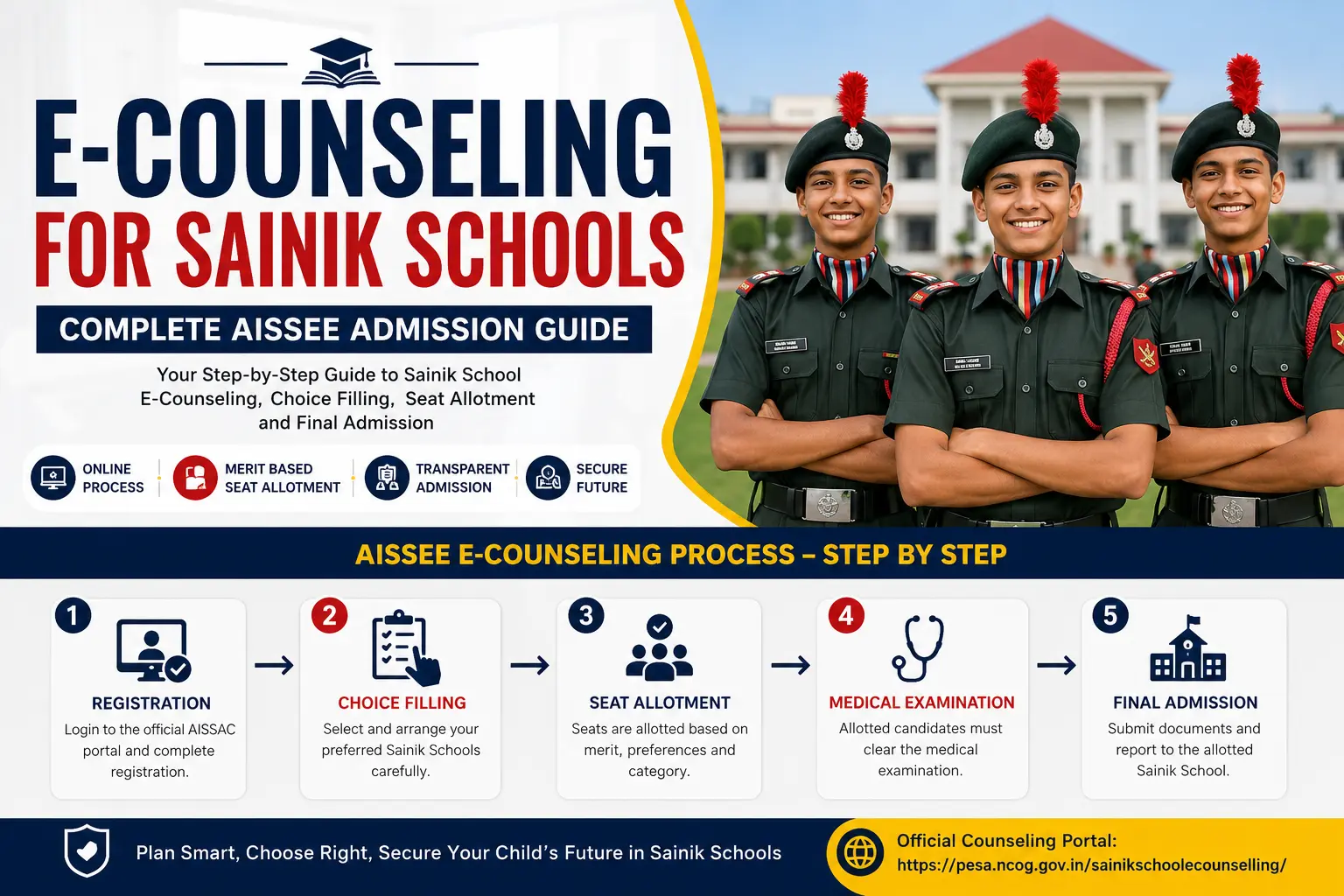
E-Counseling for Sainik Schools – Complete AISSEE Admission Guide
Your child cleared the AISSEE. You are proud. But now the real confusion begins — Which school to choose? How does the online counseling portal work? What documents do we need? What if we miss a deadline?
Every year, thousands of families across India find themselves in exactly this situation. Students who scored well in the All India Sainik Schools Entrance Examination still end up without a seat — not because of low marks, but because of avoidable mistakes during the e-counseling process.
The Sainik School e-counseling process (officially called AISSAC) is fully online and merit-based. It sounds straightforward, but parents often make small errors — wrong choice filling, missing quota benefits, uploading incorrect documents — that cost their child a precious seat. The system is unforgiving. Missed steps mean missed opportunities.
This guide is written specifically for parents and students who want to understand the AISSEE counseling process thoroughly, avoid common pitfalls, and complete every step with confidence. Whether you are navigating this for the first time or looking for clarity after confusion, you will find everything you need right here.
What is Sainik School E-Counseling?
After the AISSEE results are declared, qualified and shortlisted students are called for a centralized online admission process known as AISSAC – All India Sainik Schools Admission Counseling. This entire process is managed by the Sainik Schools Society, which is the apex body responsible for running all 33+ Sainik Schools across India.
The AISSAC portal facilitates seat allotment based on merit, category, and school preferences entered by students and parents. It is a 100% digital process — you register online, fill your school preferences online, and get your seat allotment letter online.
The official e-counseling portal is hosted at pesa.ncog.gov.in/sainikschoolecounselling. All steps — from registration to document upload — happen on this portal.
Why Counseling Rounds Matter
Seat allotment does not happen in a single step. There are typically multiple counseling rounds. If a student is not allotted a seat in Round 1, they may get one in Round 2 or 3. However, students must actively participate in each round — waiting passively means losing your chance. Understanding this is critical.
Seats that go unfilled in one round get redistributed in the next. This is why smart choice filling and timely participation can make a huge difference even for students with average scores.
Complete AISSEE E-Counseling Process Step by Step
The AISSAC process may seem intimidating at first glance. But once you break it down into clear steps, it becomes manageable. Here is how the entire process works from start to finish.
Step 1 – Registration Process
Once the AISSEE results are published on NTA’s official AISSEE portal, qualified students receive communication about counseling registration. Parents must log in to the AISSAC portal using their AISSEE roll number and registered mobile number or email ID.
During registration, you will be asked to:
- Verify your basic personal details as per the application form
- Confirm your category (General / SC / ST / OBC / Defence / Ex-Servicemen)
- Select your home state for state quota eligibility
- Upload a recent passport-size photograph
- Set a secure password for future logins
Important: Even small mismatches in name spelling, date of birth, or category at this stage can create problems later. Cross-check every detail carefully before submitting.
Step 2 – Choice Filling for Sainik Schools
This is the most critical step of the entire counseling process — and the one where most mistakes happen. Choice filling means selecting and arranging the Sainik Schools you want, in order of preference.
Here is what you must understand before filling choices:
- Home State Quota: Every Sainik School reserves a certain percentage of seats for students from the state where that school is located. If you are from Uttar Pradesh, you have a stronger chance of getting into Sainik School Lucknow than a student from Kerala. Use this strategically.
- Girls Quota: Many Sainik Schools now admit girls. Dedicated seats are reserved under the girls quota. Parents of girl students must ensure they tick the correct quota box during choice filling.
- Category Reservation: SC, ST, OBC, Defence, and Ex-Servicemen candidates have reserved seats in each school. Do not apply under the wrong category — verify your category certificate before submitting.
- School Preference Strategy: Do not randomly list schools. Research cutoff trends, available seats, and your child’s score. Place your strongest probability schools higher in the list, not just your dream schools.
You can typically add up to 10–15 school preferences. Rank them thoughtfully. Once choice filling closes, the window does not reopen.
Step 3 – Seat Allotment Process
After all students submit their choices, the AISSAC system runs an automated merit-based allotment algorithm. Seats are allotted based on:
- AISSEE merit score
- Category and quota eligibility
- Home state quota availability
- Order of school preferences submitted
- Seat availability in each round
The seat allotment result is published on the AISSAC portal. Allotted students must log in, download their provisional allotment letter, and accept or reject the seat within the given deadline.
If a student accepts the seat and opts to upgrade (if available), they stay in the pool for Round 2. If they reject, they exit the process. Think carefully before rejecting any allotment.
Step 4 – Medical Examination
Medical fitness is non-negotiable for Sainik School admission. After seat allotment, shortlisted students are called for a medical examination at a designated government hospital or military facility.
The medical test assesses:
- Height and weight as per age standards
- Vision (both eyes tested)
- Hearing ability
- General physical fitness
- Absence of any disqualifying medical condition
Students declared medically unfit can appeal through a Review Medical Board. This right should always be exercised if you believe the initial examination was incorrect.
Step 5 – Final Admission and Reporting
Medically fit students with confirmed seat allotments must complete final document verification at the allotted Sainik School. After successful document verification, they receive their admission confirmation and are required to report to the school hostel by the designated date.
Missing the reporting date — even by one day — can lead to cancellation of the allotted seat. Mark the date in your calendar the moment you receive it.
Documents Required for Sainik School Counseling
Document errors are one of the top reasons for delays and rejections during Sainik School counseling. Prepare all documents well in advance and keep both original and scanned copies ready. For a complete detailed list, you can also refer to our dedicated page on documents required for Sainik School admission.
| S.No. | Document | Purpose | Format Required |
|---|---|---|---|
| 1 | AISSEE Admit Card | Identity verification | PDF/Scan |
| 2 | AISSEE Scorecard / Result | Merit verification | PDF/Scan |
| 3 | Aadhaar Card (Student) | Identity & address proof | PDF/Scan |
| 4 | Birth Certificate | Age verification | PDF/Scan |
| 5 | Domicile / Residence Certificate | Home state quota eligibility | PDF/Scan |
| 6 | Category Certificate (SC/ST/OBC) | Reservation benefit | PDF/Scan |
| 7 | Defence/Ex-Servicemen Certificate | Defence quota benefit | PDF/Scan |
| 8 | Previous Class Marksheet | Academic record | PDF/Scan |
| 9 | Transfer Certificate (TC) | School departure clearance | Original + Scan |
| 10 | Passport-size Photographs | Portal registration & forms | JPEG (recent) |
| 11 | Medical Fitness Certificate | Pre-medical check clearance | Original |
| 12 | Income Certificate (if applicable) | Fee concession eligibility | PDF/Scan |
Pro tip: Keep a dedicated folder on your phone and laptop with all these scanned documents. The portal may ask for re-uploads at different stages, and having them instantly accessible saves panic at the last minute.
How to Choose the Best Sainik School During Counseling
Not every Sainik School is the same choice for every student. The best school for your child depends on several factors, and smart choice filling can significantly improve allotment chances. Here is how to approach it:
Factors to Consider When Selecting Schools
- Home State Quota Advantage: Always prioritize schools in your home state at the top of your preference list. The cutoff for home state quota is consistently lower than the All India quota.
- Previous Year Cutoff Trends: Research what score was needed for seat allotment in each school last year. This gives you a realistic idea of where your child’s score is competitive.
- Distance from Home: Sainik Schools are residential. Students live in hostels. Choosing a school that is too far can add to travel expenses and make emergency visits harder. Balance this practically.
- Seat Availability: Some schools have more seats in specific categories. A school with more SC seats available may be a better choice for an SC category student even if the school ranking is lower.
- School Reputation and Facilities: Academic results, NDA pass-out rates, sports infrastructure, and hostel facilities differ between schools. Do your research before finalizing.
School Category Comparison Overview
| Factor | Importance Level | How to Research |
|---|---|---|
| Home State Quota | Very High | Check your state vs. school location |
| Previous Year Cutoff | High | Previous AISSAC allotment lists |
| Available Seats by Category | High | Official AISSAC seat matrix |
| Distance from Home | Medium | Map distance, travel options |
| School Academic Record | Medium | School official website |
| Hostel Facilities | Medium | School website, parent forums |
Common Mistakes Parents Make During E-Counseling
After years of working with hundreds of families through the AISSEE and counseling process, we have seen the same mistakes happen over and over again. Here are the ones that hurt the most — and how to avoid them.
1. Random or Emotional Choice Filling
Many parents fill school preferences based on name recognition or what neighbors suggest — not data. “Sainik School Rewa sounds close” or “everyone says Sainik School Satara is the best” — these are not valid strategies. Your choices must be based on your child’s score, your home state, and category-specific cutoff data.
2. Not Using Quota Benefits
This one is genuinely heartbreaking. A child who qualifies under the Defence quota, the OBC quota, or the home state quota can often get a seat with a lower score — but only if the quota is correctly claimed during registration and choice filling. Parents who skip this step compete against the general merit pool unnecessarily.
3. Missing Portal Deadlines
The counseling portal opens and closes with strict deadlines. Registration, choice filling, and seat acceptance all have different cutoff times. One missed window and you are out of the round. Set multiple phone reminders. Do not rely on memory alone.
4. Uploading Incorrect or Low-Quality Documents
The portal rejects blurry scans, password-protected PDFs, and oversized files. Use a free scanning app to create clean, clear scans. Check file size limits before uploading. Wrong document uploads (uploading a TC where a domicile certificate is required, for example) cause immediate rejection.
5. Not Understanding Multiple Allotment Rounds
Many parents assume counseling is a one-time event. It is not. If you do not receive a seat in Round 1, you must actively return for Round 2. Some families disappear after Round 1 and miss allotments in later rounds where their child had a real chance.
6. Accepting or Rejecting Seats Without Thinking
Rejecting an allotted seat impulsively — because you wanted a different school — can leave your child without any seat if Round 2 does not yield a better option. Similarly, blindly accepting without reading the terms can cause problems later. Think before you click.
Latest AISSEE Counseling Schedule
The official counseling schedule is published by Sainik Schools Society after AISSEE results. Always verify dates from the official AISSAC counseling schedule page before planning any step.
Note: The dates below are indicative/sample. Actual dates change every year as per official notification. Always check the official portal for confirmed dates.
| S.No. | Activity | Approx. Timeline | Where |
|---|---|---|---|
| 1 | AISSEE Result Declaration | April (typically) | NTA / AISSEE Portal |
| 2 | Counseling Registration Opens | April–May | AISSAC Portal |
| 3 | Choice Filling Window | May | AISSAC Portal |
| 4 | Round 1 Seat Allotment | May–June | AISSAC Portal |
| 5 | Seat Acceptance / Rejection | Within 3–5 days of allotment | AISSAC Portal |
| 6 | Medical Examination | June | Designated Hospital |
| 7 | Round 2 Seat Allotment (if applicable) | June–July | AISSAC Portal |
| 8 | Final Document Verification | July | Allotted Sainik School |
| 9 | Reporting to School / Session Begins | July–August | Allotted Sainik School |
Keep visiting the official AISSAC counseling portal for live updates on dates and notifications.
Why Parents Choose Young Star Defence Academy for Counseling Guidance
Getting into a Sainik School requires more than just clearing the entrance exam. The counseling process demands strategy, awareness, and timely action. That is where expert guidance makes all the difference.
At Young Star Defence Academy, we have been guiding families through the AISSEE preparation and admission counseling process for years. Our founder, Prashant Singh, personally oversees counseling guidance and has helped hundreds of students secure seats in top Sainik Schools across India.
Here is how we help families during the counseling process:
- School Selection Strategy: We analyze your child’s score, category, and home state to recommend the best school choices — ones that maximize allotment probability while meeting family requirements.
- Choice Filling Assistance: We guide parents step-by-step through the AISSAC portal during the choice filling window, ensuring no quota benefit is missed and no preference is placed incorrectly.
- Document Checklist and Verification: Our team reviews your document set before you upload — catching errors before they become rejections.
- Round-by-Round Monitoring: We track allotment results with families and help them make informed decisions at each stage of counseling.
- AISSEE Preparation: If your child has not yet appeared for AISSEE, explore our structured coaching programs and complete Sainik School syllabus guide to start preparation the right way.
Our approach is simple — honest guidance, practical strategy, and genuine care for each student’s future. We do not promise miracles. We deliver clarity, preparation, and the right process.
📞 Want expert counseling guidance? Contact Young Star Defence Academy today and ensure your child’s AISSEE journey ends with a confirmed seat.
Frequently Asked Questions (FAQs)
Below are some of the most common questions parents and students ask about the Sainik School e-counseling and AISSAC process.
1. What is AISSAC counseling?
AISSAC stands for All India Sainik Schools Admission Counseling. It is the centralized, online, merit-based seat allotment process conducted by Sainik Schools Society after AISSEE results. All qualified students must go through AISSAC to get admission into any Sainik School in India.
2. Is counseling compulsory after clearing AISSEE?
Yes, absolutely. Clearing the AISSEE only means you are eligible to participate in counseling. Admission is NOT automatic. You must register on the AISSAC portal, fill school choices, and receive a formal seat allotment to secure admission.
3. Can girls apply in Sainik Schools through e-counseling?
Yes. Many Sainik Schools now admit girls under a dedicated girls quota. Girl students must ensure they select the correct quota option during counseling registration and choose schools that have girls’ admission. The list of schools admitting girls changes, so check the official portal for the latest information.
4. How many schools can a student choose during counseling?
Students can typically fill preferences for up to 10–15 Sainik Schools. The exact number may vary with each year’s counseling rules. Always fill the maximum allowed preferences to increase your chances of getting a seat in at least one school.
5. Can school choices be changed after submission?
Once the choice filling window closes, preferences are locked and cannot be changed. This is why it is critical to plan and verify your choices carefully before the final submission. Do not rush through choice filling.
6. What happens after seat allotment in AISSAC?
After receiving the seat allotment letter, students must log in to the portal and formally accept or reject the seat within the given deadline. If accepted, they proceed to the medical examination. After clearing medical fitness, they complete document verification at the allotted school and report for admission.
7. Is the medical examination compulsory for all allotted students?
Yes, medical examination is mandatory for all students who accept a seat allotment. Only students declared medically fit by the designated medical board can proceed with final admission. Students found unfit can appeal through a Review Medical Board.
8. What documents are needed for Sainik School counseling?
Key documents include the AISSEE admit card and scorecard, Aadhaar card, birth certificate, domicile certificate, category certificate, previous class marksheet, Transfer Certificate (TC), passport-size photographs, and medical certificate. Refer to our detailed Sainik School documents required page for a complete checklist.
9. What if a student misses the counseling registration deadline?
Missing the registration deadline means you cannot participate in that counseling round. There is no grace period. In exceptional cases, some students wait for Round 2 or any supplementary round announced by Sainik Schools Society, but this is not guaranteed. Never miss deadlines.
10. How are seats allotted in AISSAC?
Seats are allotted through an automated computer-based algorithm. The system considers the student’s AISSEE merit score, category (General/SC/ST/OBC/Defence), home state quota eligibility, and the order of school preferences submitted. Higher merit gets priority within each category for each school.
11. What is the home state quota in Sainik School counseling?
Each Sainik School reserves a specific percentage of seats for students who are domicile residents of the state where that school is located. This is called the home state quota. It is a major strategic advantage — students from the home state compete against a smaller pool with lower cutoffs. Always use this benefit by prioritizing your state’s school in your preference list.
12. Can a student participate in Round 2 counseling after rejecting a Round 1 seat?
If a student rejects a Round 1 allotment, they typically exit the process and are not eligible for Round 2. However, students who did not receive any allotment in Round 1 or who were in the waiting list pool may participate in Round 2. Rules can vary by year — always check official notifications carefully.
13. How many rounds of counseling does AISSAC have?
AISSAC typically conducts 2–3 rounds of counseling, sometimes followed by a mop-up round for remaining vacant seats. The exact number of rounds depends on how many seats remain vacant after each round. Participating in all applicable rounds gives students the best chance of securing admission.
14. Is there a counseling fee for AISSAC?
Yes, a non-refundable counseling registration fee is typically charged when registering on the AISSAC portal. The amount may vary by year and category. Details are available on the official AISSAC portal at the time of registration opening. Confirm the current fee on the official website before paying.
15. Where can I find the official counseling schedule and notifications?
All official counseling notifications, dates, and schedule updates are published on the AISSAC e-counseling portal, the Sainik Schools Society website, and the NTA AISSEE portal. Bookmark all three and check regularly during the counseling season.