

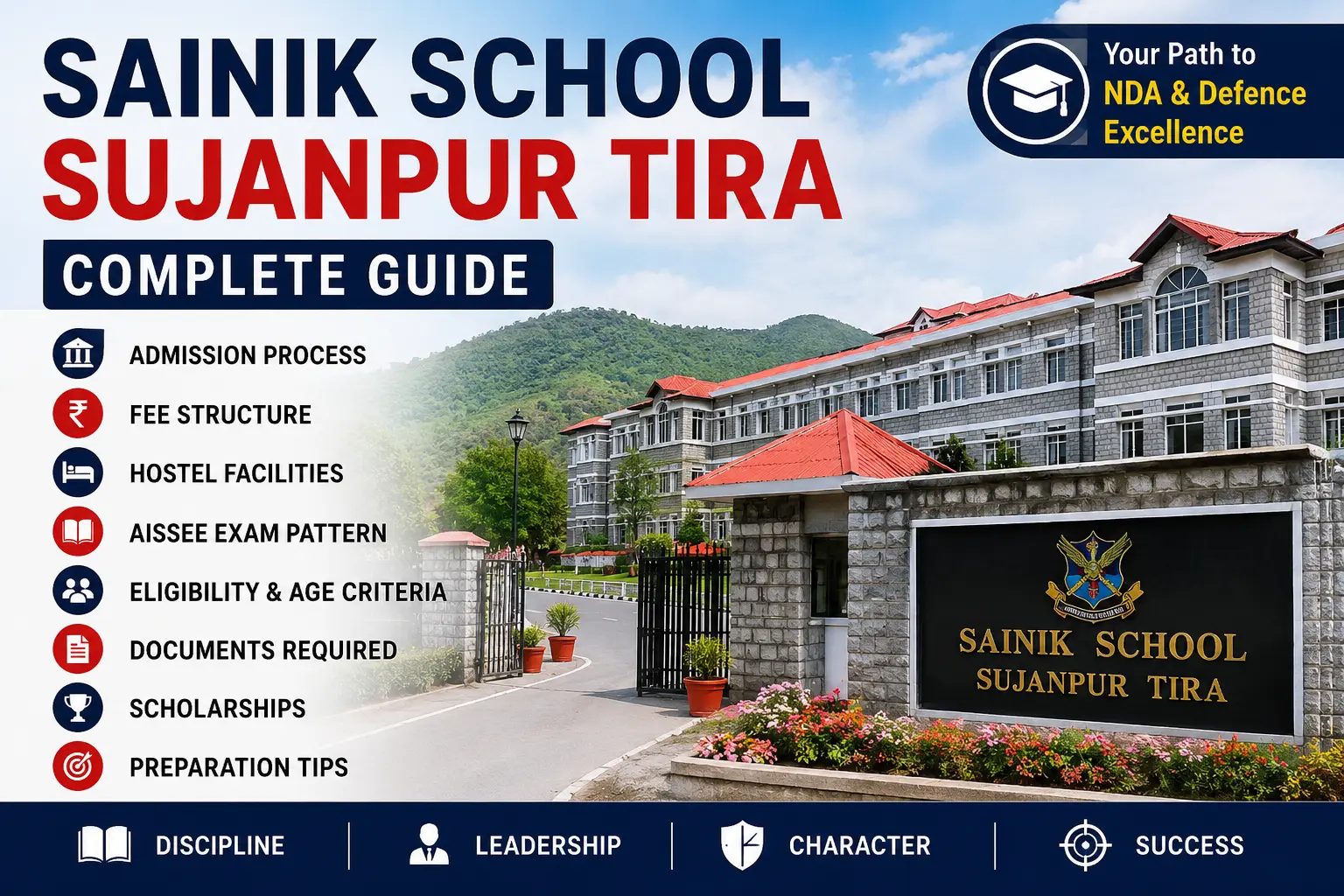
Sainik School Sujanpur Tira, Himachal Pradesh — Complete Admission, Fees & AISSEE Guide
- Location: Sujanpur Tira, Hamirpur district, Himachal Pradesh (~22 km from Hamirpur city)
- Established: 1978, under the Sainik Schools Society, Ministry of Defence
- Annual fee: Approximately ₹1.5–2 lakh/year for general category (concessions for SC/ST and defence families)
- Admission exam: AISSEE (All India Sainik Schools Entrance Examination), conducted by NTA
- Admission classes: Class VI (age 10–12) and Class IX (age 13–15)
- Class VI seats: ~70–100 | Class IX seats: ~5–15
- HP state quota: ~67% of seats reserved for Himachal Pradesh domicile students
- Curriculum: CBSE, Classes VI–XII
If you are a parent dreaming of a disciplined, defence-oriented future for your child — or a student with the ambition to wear a uniform someday — Sainik School Sujanpur Tira is a name you have probably come across more than once. And rightly so.
Nestled in the scenic Hamirpur district of Himachal Pradesh, this school has quietly shaped the futures of thousands of young cadets since its establishment. It is not just a school — it is a structured environment where boys learn to wake up before sunrise, carry responsibility on their shoulders, and still score well in examinations. That balance of discipline and academics is what makes Sainik School Sujanpur Tira so sought after.
This guide is for every parent who has searched for “Sainik School Sujanpur Tira admission,” “AISSEE fees,” or “how to prepare for Sainik School entrance exam” — and ended up confused by incomplete or outdated information. We have put together everything in one place: admission process, eligibility, fee structure, hostel life, seats available, documents required, and preparation tips. Read on.
About Sainik School Sujanpur Tira
History and Establishment
Sainik School Sujanpur Tira was established in 1978 under the Sainik Schools Society, which functions under the Ministry of Defence, Government of India. The school is located in Sujanpur Tira, a small but historically significant town in the Hamirpur district of Himachal Pradesh. It was one of the early Sainik Schools set up with a clear mission: to prepare young boys from across the country — and especially from Himachal Pradesh — for eventual entry into the National Defence Academy (NDA) and other premier defence institutions.
Over the decades, the school has built a reputation not just within the state but nationally. Alumni of this institution have gone on to serve at the highest levels of the Indian Armed Forces — as officers in the Army, Navy, and Air Force. That track record alone speaks volumes about the kind of foundation the school provides.
Location and Setting
The school sits on a sprawling campus in Sujanpur Tira, surrounded by the hills of Himachal Pradesh. The location itself contributes to the school’s character — the clean air, open grounds, and distance from urban distractions create an environment where students can genuinely focus on learning and self-development. The nearest major city is Hamirpur, which is roughly 22 km away. Dharamsala and Shimla are accessible for those travelling from larger centres.
Academic Environment
Sainik School Sujanpur Tira follows the CBSE curriculum. Classes VI through XII are offered, meaning a student who joins in Class VI will spend seven years at this institution — seven years of structured learning, physical training, and gradual leadership development. The school holds CBSE board examinations and consistently produces students who clear NDA and other defence entrance exams at a higher rate than the national average.
Academics here are serious business. But they are balanced with sports, NCC activities, debates, cultural programmes, and house competitions that develop the whole student — not just a student who can solve equations.
Defence-Oriented Discipline
The defining characteristic of Sainik School Sujanpur Tira — and indeed of all Sainik Schools — is its semi-military discipline. Students wake up early, follow a structured daily routine, wear uniforms, participate in morning PT (Physical Training), and are evaluated not just academically but on their overall conduct, fitness, and character. This is not a conventional school where you drop your child off at 8 AM and pick them up at 3 PM. This is a residential institution where students live, breathe, and grow together as a unit.
That structure is precisely what prepares cadets for the NDA selection process and, eventually, for life as an officer in the Indian Armed Forces.
Sainik School Sujanpur Tira Admission Process
Admission to Sainik School Sujanpur Tira is not done through any walk-in process or school-level interview. Entry is strictly through the All India Sainik Schools Entrance Examination (AISSEE), conducted by the National Testing Agency (NTA) on behalf of the Sainik Schools Society.
Here is how the process works, step by step:
Step 1 – Online Application through NTA
When NTA announces the AISSEE cycle (usually between October and December for admissions in the following academic session), parents must register their child at the official portal: exams.nta.nic.in/sainik-school-society/. The application requires basic details about the student, school preference, category, and domicile.
Step 2 – Admit Card Download
After successful registration, NTA issues an admit card which contains the exam centre and schedule. Students must carry this admit card to the examination hall along with a valid photo identity document.
Step 3 – Written Entrance Examination (AISSEE)
The written examination is the primary filter. Only students who score above the qualifying threshold are considered for the next stage. NTA releases results on the official portal, and students can check their score and rank online.
Step 4 – Merit List and Counselling
Based on AISSEE scores, a merit list is prepared state-wise and category-wise. Shortlisted students are called for document verification and counselling. Seat allotment is done on the basis of merit, category, and state quota.
Step 5 – Medical Examination
Students who are provisionally selected are required to appear for a medical examination conducted as per the standards prescribed by the Ministry of Defence. The medical check assesses general physical fitness, eyesight, hearing, and the absence of any physical conditions that may be disqualifying. Only medically fit students receive a final admission offer.
Step 6 – Reporting and Joining
After clearing the medical examination and completing document verification, selected students are given a joining date. They report to Sainik School Sujanpur Tira along with all required documents, prescribed uniform items, and other essentials listed in the admission offer letter.
For a detailed breakdown of the complete admission process across all Sainik Schools, visit the Sainik School coaching guide on our website.
Eligibility Criteria for Admission
The eligibility requirements differ depending on whether the student is applying for Class VI or Class IX admission.
For Class VI Admission
- The student must have passed Class V from a recognised school.
- Age limit: The student should be between 10 and 12 years of age as on 31st March of the academic year in which admission is sought.
- Both boys and girls are eligible to apply. (Girls’ admission has been progressively expanded across Sainik Schools.)
- The student must be an Indian national.
For Class IX Admission
- The student must have passed Class VIII from a recognised school.
- Age limit: The student should be between 13 and 15 years of age as on 31st March of the admission year.
- Class IX seats are limited and far more competitive than Class VI seats.
- The student must be an Indian national.
General Eligibility Points
- There is no restriction based on the state of domicile for applying — however, state quota seats are reserved for students domiciled in Himachal Pradesh.
- Students from defence backgrounds or SC/ST categories have reserved seats and may have slightly different qualifying thresholds.
- Students must be medically fit as per the standards prescribed by the Ministry of Defence.
AISSEE Entrance Exam Pattern
The All India Sainik Schools Entrance Examination is a standardised test. Understanding its structure is the starting point for any serious preparation.
For Class VI
| Subject | Number of Questions | Maximum Marks |
|---|---|---|
| Mathematics | 50 | 150 |
| General Knowledge | 25 | 75 |
| Language (English/Hindi) | 25 | 75 |
| Intelligence | 25 | 75 |
| Total | 125 | 375 |
For Class IX
| Subject | Number of Questions | Maximum Marks |
|---|---|---|
| Mathematics | 50 | 200 |
| Science | 25 | 100 |
| English | 25 | 100 |
| Social Studies | 25 | 100 |
| Intelligence | 25 | 100 |
| Total | 150 | 600 |
Key Exam Details
- Mode: Offline (OMR-based)
- Duration: 3 hours
- Medium: English and Hindi (and regional languages for some states)
- Marking Scheme: Each correct answer carries 3 marks; there is no negative marking
- Difficulty Level: Moderate — based on NCERT syllabus but with a competitive edge
Preparation Strategy
The AISSEE tests concepts from the NCERT curriculum, but the competition is intense. A student who has only read textbooks may not be adequately prepared. Here is what effective preparation looks like:
- Mathematics: Focus on arithmetic, fractions, geometry, mensuration, and number systems for Class VI. Class IX students must be thorough with algebra, statistics, and coordinate geometry.
- General Knowledge: Read current affairs regularly. Build a habit of reading a children’s newspaper or GK digest daily.
- Language: Practice grammar questions, comprehension passages, and vocabulary exercises.
- Intelligence: Practice verbal and non-verbal reasoning regularly — pattern recognition, analogies, coding-decoding, series completion.
- Mock Tests: Attempt full-length mock tests under timed conditions. This builds speed and reduces exam anxiety.
For a subject-wise breakdown of what to study, refer to our complete AISSEE syllabus guide.
Fee Structure of Sainik School Sujanpur Tira
One of the most frequently asked questions is about fees. Sainik Schools are government-funded institutions, which means their fees are significantly lower than private boarding schools of comparable quality. However, the fee structure does change periodically, so always cross-check with the official school website or the offer letter at the time of admission.
The table below gives a general indicative range based on the most recently published fee structure:
| Fee Component | Approximate Amount (Per Term / Annual) |
|---|---|
| Tuition Fee | ₹35,000 – ₹45,000 per term (varies by category) |
| Hostel Charges | Included in the overall fee structure |
| Mess Charges | ₹18,000 – ₹22,000 per term |
| Uniform and Kit | ₹8,000 – ₹12,000 (one-time joining) |
| Pocket Money (Cadet) | ₹1,500 – ₹2,000 per month |
| Medical / Sports / Activity Fund | ₹3,000 – ₹5,000 per term |
Important notes on fees:
- Students from SC/ST categories receive heavily subsidised fee rates.
- Students from defence backgrounds may also be eligible for concessions.
- The school provides a scholarship to economically weaker students who meet the criteria. (More on this below.)
- The above figures are approximate. Always confirm with the official Sainik School Sujanpur Tira website or the joining letter issued at the time of admission.
Hostel Facilities and Campus Life
When your child joins Sainik School Sujanpur Tira, they are not just enrolling in a school — they are stepping into a way of life. The residential nature of the institution means that every part of a student’s day is structured and purposeful.
Daily Hostel Routine
A typical day at Sainik School Sujanpur Tira follows a military-inspired schedule:
- 5:30 AM: Reveille (wake-up call) and morning parade/PT
- 7:00 AM: Breakfast in the mess
- 8:00 AM – 1:30 PM: Academic classes
- 2:00 PM: Lunch
- 3:30 PM – 5:30 PM: Sports and outdoor activities
- 6:00 PM – 8:00 PM: Self-study and prep time
- 8:30 PM: Dinner
- 10:00 PM: Lights out
This routine teaches time management in a way that no classroom lesson ever could. Students who follow this structure for even one year emerge noticeably more disciplined and self-reliant than their peers.
Mess and Nutrition
The school runs a central mess that provides three nutritionally balanced meals a day along with a morning snack. Cadets do not have the luxury of junk food breaks, which — as many parents later acknowledge — turns out to be a genuine benefit. Students develop healthy eating habits and the physical stamina that comes with it.
Sports and Physical Training
Sainik School Sujanpur Tira has facilities for a range of sports, including football, basketball, volleyball, athletics, and indoor games. Physical training is not optional — it is embedded into the school day. The NCC unit of the school also gives cadets structured exposure to parade drills, adventure activities, and annual camps.
NCC Activities
National Cadet Corps (NCC) is a core part of the Sainik School experience. Students participate in annual NCC camps, firing exercises, adventure activities like trekking and mountaineering, and Republic Day camps in New Delhi for high-performing cadets. Holding an NCC certificate from a Sainik School carries genuine weight during NDA and SSB evaluations.
Extracurricular Activities
Life at Sainik School is not all drills and textbooks. Students participate in debates, elocution competitions, cultural programmes, science exhibitions, house competitions, and inter-school events. These activities develop confidence, communication, and the ability to work within a team — qualities that are as important as academics in the long run.
Academic Support
The school assigns dedicated prep (preparation) hours every evening where students complete homework and revise lessons. Teachers are available during prep time for doubt-clearing. Senior students are often paired with junior students as mentors within the house system, creating an organic peer-learning environment.
Seats and Reservation System
Understanding how seats are distributed is critical before applying, because it affects your child’s actual chance of selection.
Total Seats
Each Sainik School offers approximately 70–100 seats at the Class VI level, though the exact number varies year to year. Class IX seats are far fewer — typically 5 to 15 — and are extremely competitive.
State Quota
A majority of the seats — typically around 67% — are reserved for students who are domiciled in the home state of the school. For Sainik School Sujanpur Tira, this means students domiciled in Himachal Pradesh have priority access to the bulk of the available seats. The remaining seats fall under the All India quota, open to students from any state.
Defence Quota
Approximately 25% of the total seats are reserved for children of defence service personnel (including ex-servicemen). This includes wards of Army, Navy, Air Force, and para-military personnel.
SC / ST Reservation
As per government norms:
- Scheduled Castes (SC): 15% of seats are reserved
- Scheduled Tribes (ST): 7.5% of seats are reserved
SC/ST students also benefit from lower qualifying marks and a significantly subsidised fee structure.
Girls’ Admission Policy
Sainik Schools have progressively opened their doors to girl students. While the initial batches of girls were admitted in select schools as a pilot, the policy has been expanding. Parents of girl students are advised to check the current year’s official AISSEE notification for updated information on which schools — including Sujanpur Tira — are accepting girl candidates and in what numbers.
For an accurate, up-to-date picture of seats across all Sainik Schools, refer to our complete guide on Sainik School seats and vacancies.
Documents Required for Admission
Document submission happens at the counselling and verification stage. Being unprepared with documents at this stage can cost a student their seat. Here is a checklist of documents generally required:
- ✅ AISSEE admit card (original and photocopy)
- ✅ AISSEE scorecard / rank card
- ✅ Birth certificate (issued by a government authority)
- ✅ Class V pass certificate / mark sheet (for Class VI admission)
- ✅ Class VIII pass certificate / mark sheet (for Class IX admission)
- ✅ Domicile certificate of Himachal Pradesh (for state quota seats)
- ✅ Caste certificate (SC/ST/OBC — if applicable, issued by the competent authority)
- ✅ Defence service certificate (if applying under defence quota — issued by the commanding officer)
- ✅ Medical fitness certificate (from a government hospital / as per school instructions)
- ✅ Income certificate (required for scholarship applications)
- ✅ Passport-size photographs (at least 10 recent copies)
- ✅ Aadhar card of the student (and parent)
- ✅ Transfer certificate from the previous school
- ✅ Character certificate from the previous school
For a detailed and school-specific document checklist, visit our page on documents required for Sainik School admission.
Scholarship Opportunities at Sainik School Sujanpur Tira
One of the lesser-known but genuinely helpful aspects of Sainik Schools is the scholarship support available to students. The government recognises that defence-oriented education should be accessible to talented students from all economic backgrounds — and there are multiple scholarship channels to support this goal.
Sainik Schools Society Scholarship
The Sainik Schools Society runs a scholarship scheme for students from families with annual income below a prescribed threshold. Eligible students receive significant fee concessions, sometimes covering the majority of the annual fee. This scholarship is assessed annually based on academic performance and family income.
State Government Scholarships
The Government of Himachal Pradesh offers scholarships to meritorious students from the state pursuing education at premier residential institutions. Students admitted to Sainik School Sujanpur Tira under state quota may be eligible for these state-level scholarships. Applications are typically made through the school administration.
Rashtriya Military Schools Scholarship (for ex-servicemen)
Children of defence personnel — including ex-servicemen — may be entitled to additional financial support through schemes run by the Ministry of Defence and welfare bodies such as the Army Welfare Education Society (AWES).
Merit-Based Fee Waivers
Students who consistently rank in the top academic percentile within the school may qualify for merit-based fee reductions in subsequent years. These are generally decided by the school’s internal academic committee.
For a complete overview of financial support available at Sainik Schools, read our detailed guide on Sainik School scholarships.
How to Prepare for AISSEE — Practical Tips for Students and Parents
The AISSEE is competitive — but it is not uncrackable. Thousands of students clear it every year, and the ones who do are not necessarily the most naturally gifted. They are the ones who started early, practiced consistently, and understood the exam pattern before they walked into the hall.
Start at Least 6 Months Before the Exam
Six months is the minimum preparation window for a student who is already reasonably strong in their current class studies. If the student needs extra work on Mathematics or English, start 9 to 12 months ahead.
Anchor Your Preparation in NCERT
Every question in AISSEE traces back to the NCERT curriculum. Before looking at any supplementary material, make sure the student has completely covered — and genuinely understood — their NCERT textbooks for the relevant class.
Mathematics: Practise Daily, Without Exception
Mathematics carries the highest weightage in AISSEE. Skipping even two or three days of Maths practice creates gaps. Make it a daily habit, even if it is just 30–45 minutes of focused problem-solving.
Intelligence Questions Need Separate Practice
The intelligence section is often underestimated by students who focus only on core subjects. This section includes verbal and non-verbal reasoning — it requires a different kind of practice. Dedicate at least two sessions per week exclusively to reasoning questions.
Attempt Mock Tests Under Real Conditions
Sit down with a full-length mock paper, set a 3-hour timer, and attempt it without interruptions. Review your answers honestly afterwards. Identify the areas where you are losing marks and target those specifically in the next week’s preparation.
Build a GK Habit
General Knowledge cannot be crammed the night before the exam. Build the habit of reading a children’s newspaper or age-appropriate GK digest regularly — at least 20 minutes a day. Cover science, history, geography, national events, sports, and defence-related topics.
A Note on Coaching
Many students benefit from structured coaching that organises the syllabus, provides regular tests, and gives expert feedback. If your child is serious about Sainik School admission, investing in proper AISSEE preparation guidance — whether in a classroom programme or through structured study material — is a practical decision, not an extravagance. Good coaching helps students use their preparation time more efficiently and avoid common errors.
Why Parents Choose Sainik School Sujanpur Tira
Ask any parent whose child studies at a Sainik School what the biggest change is, and most of them will give you a version of the same answer: “He came back a different person.” Not necessarily a taller person or a smarter person — but a more self-reliant, disciplined, and grounded one.
Here is why Sainik School Sujanpur Tira continues to attract parents from across Himachal Pradesh and beyond:
Genuine Preparation for NDA
The NDA (National Defence Academy) entrance exam and the SSB (Services Selection Board) interview assess qualities that cannot be learned in a few months. Leadership, physical fitness, mental resilience, teamwork, and communication — these qualities develop over years. A student who spends five or six years at Sainik School Sujanpur Tira arrives at the NDA selection process with these qualities already developed. That is an enormous advantage.
Academic Discipline Without Sacrificing Sports
One common fear among parents is that boarding school means neglecting sports or creative development. At Sainik School Sujanpur Tira, sports are not extracurricular — they are curricular. Students who represent the school in athletics, football, or swimming receive recognition and support. Many Sainik School alumni have represented their states and districts in national-level competitions alongside pursuing a defence career.
Peer Environment That Motivates
When every student around you wants to be an officer in the Armed Forces, that aspiration becomes normal. It becomes expected. The peer environment at Sainik Schools is one of the most powerful motivating forces a young student can experience — because ambition becomes the default, not the exception.
Government Institution — Transparent and Accountable
Being a government institution under the Ministry of Defence, Sainik School Sujanpur Tira operates with a level of transparency and accountability that private schools often cannot match. Fees are regulated, facilities are audited, and the school’s functioning is governed by the Sainik Schools Society’s standards.
Character and Values
Perhaps most importantly, the school instils values — honesty, respect for authority, teamwork, and a sense of national pride — that stay with students for life. Alumni of Sainik Schools frequently credit their school years as the period that shaped their character more than anything else.
Frequently Asked Questions about Sainik School Sujanpur Tira
1. What is the official website of Sainik School Sujanpur Tira?
The official website of Sainik School Sujanpur Tira is www.sainikschoolsujanpurtira.org. For AISSEE-related information and applications, visit exams.nta.nic.in/sainik-school-society/.
2. Is Sainik School Sujanpur Tira a boys-only school?
Historically yes, but the government has been progressively opening Sainik Schools to girl students. It is advisable to check the current AISSEE notification to confirm whether girl candidates can apply for admission in the current cycle.
3. What is the minimum age for Class VI admission to Sainik School Sujanpur Tira?
The student must be between 10 and 12 years of age as on 31st March of the admission year. Students who are younger or older than this range are not eligible for Class VI admission.
4. How many seats are available in Sainik School Sujanpur Tira?
The total intake at Class VI level is typically around 70–100 students, divided across state quota, defence quota, and All India quota. Class IX seats are fewer — usually around 5 to 15. For updated numbers, check the official AISSEE notification each year.
5. Is there any reservation for Himachal Pradesh students?
Yes. Being the home state of the school, approximately 67% of the available seats are reserved under the Himachal Pradesh state quota. Students with valid HP domicile certificates compete within this pool.
6. What is the approximate annual fee at Sainik School Sujanpur Tira?
The total annual expenditure (including tuition, mess, hostel, and uniform) typically ranges between ₹1.5 lakh and ₹2 lakh per year for general category students. SC/ST and defence category students receive fee concessions. Always confirm the latest figures with the school directly, as fees are revised periodically.
7. Is there any negative marking in the AISSEE?
No. As per the current AISSEE pattern, there is no negative marking. Students should attempt all questions without the fear of losing marks for wrong answers.
8. What documents are required at the time of counselling?
Key documents include the AISSEE scorecard, birth certificate, previous class mark sheet, domicile certificate, caste certificate (if applicable), defence service certificate (if applicable), medical fitness certificate, and recent passport photographs. Full details are in the documents required for Sainik School guide.
9. How much time does a student need to prepare for AISSEE?
A minimum of 6 months of focused, structured preparation is recommended for Class VI admission. Students with gaps in Mathematics or English should ideally start 9 to 12 months before the exam. Consistency matters more than the total number of hours.
10. Can a student from outside Himachal Pradesh apply for admission to Sainik School Sujanpur Tira?
Yes. Students from any state can apply. They will compete for seats under the All India quota. However, seats in the All India quota are limited, and competition is high. State quota seats are available only to HP domicile students.
11. Is NCC compulsory at Sainik School Sujanpur Tira?
Yes. NCC participation is a standard part of the Sainik School programme. All students are enrolled in the NCC unit and participate in regular drills, camps, and activities. This gives students a significant advantage during NDA entrance and SSB interviews later in life.
12. Are scholarships available at Sainik School Sujanpur Tira?
Yes. Scholarships are available from the Sainik Schools Society for economically weaker students, from the state government for HP domicile students, and from various Ministry of Defence welfare bodies for defence family students. Income certificates and academic records are typically required for scholarship applications.
Final Thoughts — Starting Early Makes All the Difference
Sainik School Sujanpur Tira is not just a school you apply to. It is a commitment — one that, if made seriously and early, can set a young person on the path to a life of discipline, achievement, and service to the country.
The admission process is competitive but fair. The AISSEE tests what students already know — but at a level of depth and breadth that requires dedicated preparation. Families who start planning early, who understand the eligibility and seat structure, who gather documents in advance, and who ensure their child gets adequate practice — these are the families whose children end up on the merit list.
If your child has the drive to one day wear the uniform of an Indian Armed Forces officer, Sainik School Sujanpur Tira is one of the finest environments in the country to build that foundation. Every year spent here is an investment that pays returns for a lifetime.
And it all begins with one step: starting AISSEE preparation on time, with the right guidance.
If you are looking for structured AISSEE preparation support — whether for the written exam, understanding the syllabus, or planning your child’s preparation timeline — our team at Young Star Defence Academy has been guiding Sainik School aspirants for years. Explore our Sainik School coaching programme to understand how we can support your child’s journey. Feel free to call us at +91 81013 13136 with any questions — we are happy to guide you without any obligation.