
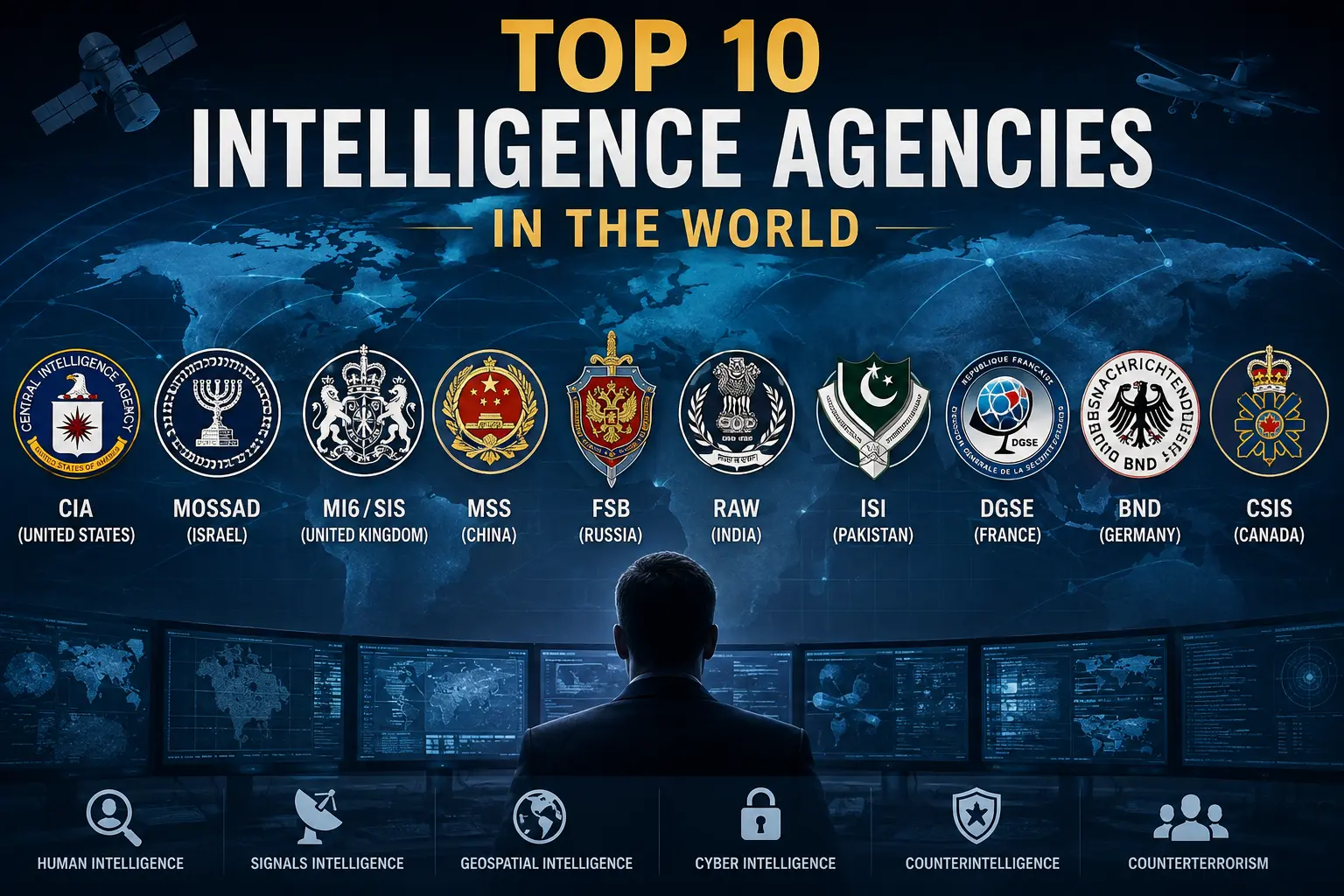
# Top 10 Intelligence Agencies in the World (2027 Ranking)
**Last Updated: January 2027**
Intelligence agencies operate largely outside public view, so no government or international body publishes an official global ranking of them. Based on publicly documented factors — global reach, collection capability, technological resources, operational history, international partnerships, and strategic influence — this list of the **top 10 intelligence agencies in the world** identifies the ten organizations widely regarded as the most significant in 2027. Because core capabilities remain classified, this is an editorial and analytical assessment, not an official league table.
—
## Top 10 Intelligence Agencies in the World: Quick Answer Table
| Rank | Intelligence Agency | Country | Primary Role | Key Strength |
|——|———————|———|—————|—————-|
| 1 | Central Intelligence Agency (CIA) | United States | Foreign intelligence | Global reach, technology, resources |
| 2 | Mossad | Israel | External intelligence | Covert operations, Middle East expertise |
| 3 | MI6 / Secret Intelligence Service (SIS) | United Kingdom | Foreign intelligence | Global HUMINT network, Five Eyes partnership |
| 4 | Ministry of State Security (MSS) | China | State security & foreign intelligence | Cyber and economic intelligence, scale |
| 5 | Federal Security Service (FSB) | Russia | Domestic security & counterintelligence | Internal security, counterintelligence |
| 6 | Research and Analysis Wing (RAW) | India | External intelligence | Regional expertise, South Asia focus |
| 7 | Inter-Services Intelligence (ISI) | Pakistan | Military & external intelligence | Regional network, military integration |
| 8 | Directorate-General for External Security (DGSE) | France | Foreign intelligence | HUMINT, African and Middle East operations |
| 9 | Federal Intelligence Service (BND) | Germany | Foreign intelligence | SIGINT, European coordination |
| 10 | Canadian Security Intelligence Service (CSIS) | Canada | Domestic & foreign-facing security intelligence | Five Eyes cooperation, counterterrorism |
—
## What Is an Intelligence Agency?
An intelligence agency is a government body responsible for collecting, analyzing, and delivering information that supports national security, foreign policy, and military decision-making. Intelligence agencies exist because governments need reliable, timely information about threats, adversaries, and global developments that is not available through normal diplomatic or public channels.
Intelligence organizations are generally divided into two broad categories:
– **Foreign (external) intelligence agencies** — collect information outside their own country, such as the CIA, MI6, RAW, Mossad, and DGSE.
– **Domestic (internal) intelligence agencies** — focus on internal security, counterintelligence, and threats within national borders, such as the FSB and, in a hybrid role, CSIS.
Modern intelligence work is built on several disciplines:
– **HUMINT (Human Intelligence):** Information gathered through human sources, informants, and diplomatic contacts.
– **SIGINT (Signals Intelligence):** Interception of communications, electronic signals, and data transmissions.
– **GEOINT (Geospatial Intelligence):** Analysis of satellite imagery, mapping, and geographic data.
– **OSINT (Open-Source Intelligence):** Information gathered from publicly available sources such as media, academic publications, and the internet.
– **Cyber Intelligence:** Monitoring and countering digital threats, including state-sponsored hacking and cyberespionage.
– **Counterintelligence:** Detecting and neutralizing foreign intelligence activities within one’s own country.
– **Counterterrorism:** Identifying and disrupting terrorist networks and planned attacks.
Most major intelligence agencies combine several of these disciplines, though their legal mandates and areas of focus differ significantly by country.
—
## How We Ranked the Top 10 Intelligence Agencies in the World
Because intelligence budgets, personnel numbers, and operational successes are rarely disclosed, no ranking of intelligence agencies can be fully objective. This list uses a qualitative methodology based on publicly available information, drawing on government disclosures, parliamentary oversight reports, academic research, and established journalism. No numerical intelligence “score” is claimed for any agency, since such figures cannot be verified.
The assessment weighs the following factors:
– **Global reach (20%)** — Geographic scope of operations and stated areas of interest.
– **Intelligence collection capabilities (20%)** — Documented HUMINT and technical collection programs.
– **Technology and cyber capabilities (15%)** — Publicly known investment in signals intelligence, cyber operations, and surveillance technology.
– **Operational capability (15%)** — Historical operations and events that are publicly documented or officially acknowledged.
– **Intelligence analysis (10%)** — Role in producing assessments used by national leadership.
– **International partnerships (10%)** — Participation in intelligence-sharing arrangements such as Five Eyes.
– **Strategic influence (10%)** — Documented role in shaping foreign policy and national security decisions.
Agencies with different legal mandates — for example, a foreign intelligence service compared with a domestic security agency — are not directly interchangeable. Where relevant, this distinction is explained rather than flattened into a single score.
—
## Top 10 Intelligence Agencies in the World
### 1. Central Intelligence Agency (CIA) — United States
**Overview**
The Central Intelligence Agency is the United States’ primary civilian foreign intelligence service, established in 1947 under the National Security Act. It reports to the Director of National Intelligence and is headquartered at the George Bush Center for Intelligence in Langley, Virginia. The CIA’s mission is foreign intelligence collection and analysis rather than domestic law enforcement, which falls to the FBI.
**Key responsibilities**
– Collecting foreign intelligence through human and technical sources
– Producing all-source intelligence analysis for the U.S. President and policymakers
– Conducting covert action authorized by the President
– Counterintelligence and counterterrorism operations abroad
– Coordinating with other members of the U.S. Intelligence Community
**Major capabilities**
The CIA is publicly known for extensive HUMINT operations, a global station network within U.S. embassies, and significant investment in cyber and technical collection, often in coordination with the National Security Agency (NSA).
**Why it ranks highly**
The CIA’s combination of global reach, resourcing, technological capability, and documented historical operations places it consistently at the top of independent assessments, alongside its central role in the Five Eyes intelligence-sharing alliance.
**Global role**
The CIA maintains liaison relationships with allied intelligence services worldwide and plays a central role in U.S. foreign policy, counterterrorism, and crisis response.
**Key facts**
– Established: 1947
– Headquarters: Langley, Virginia
– Parent structure: U.S. Intelligence Community, overseen by the Director of National Intelligence
– Primary focus: Foreign intelligence and covert action
– Founding legislation: National Security Act of 1947
—
### 2. Mossad — Israel
**Overview**
Mossad, officially the Institute for Intelligence and Special Operations, is Israel’s external intelligence agency, established in 1949. It reports directly to the Prime Minister’s Office and operates independently of Israel’s domestic security service, Shin Bet.
**Key responsibilities**
– Foreign intelligence collection, particularly across the Middle East
– Counterterrorism operations abroad
– Covert action authorized by the Israeli government
– Preventing the proliferation of weapons technology to hostile states
**Major capabilities**
Mossad is publicly associated with a strong HUMINT tradition and a long operational history in hostile and denied-access environments, reflecting Israel’s security priorities in a contested regional environment.
**Why it ranks highly**
Mossad’s documented operational history, particularly its counterterrorism and counter-proliferation record, and its central role in Israeli national security place it among the world’s most closely studied intelligence services.
**Global role**
Mossad works with allied services on shared counterterrorism priorities and is frequently referenced in academic and journalistic analysis of intelligence tradecraft.
**Key facts**
– Established: 1949
– Reports to: Prime Minister of Israel
– Primary focus: External intelligence and counterterrorism
– Distinct from: Shin Bet (domestic security) and Aman (military intelligence)
—
### 3. MI6 / Secret Intelligence Service (SIS) — United Kingdom
**Overview**
The Secret Intelligence Service, commonly known as MI6, is the United Kingdom’s foreign intelligence service, with roots dating to the Secret Service Bureau established in 1909. It operates under the Foreign, Commonwealth and Development Office and is distinct from MI5, the UK’s domestic security service.
**Key responsibilities**
– Foreign intelligence collection to support UK national security and foreign policy
– Counterterrorism and counter-proliferation work overseas
– Supporting UK diplomatic and defence objectives with intelligence assessments
– Liaison with allied intelligence services
**Major capabilities**
MI6 is publicly known for a long-standing global HUMINT network and close technical cooperation with GCHQ, the UK’s signals intelligence agency.
**Why it ranks highly**
MI6’s century-long institutional history, global station presence, and central role in the Five Eyes alliance support its consistent ranking among the world’s leading foreign intelligence services.
**Global role**
MI6 works closely with the CIA and other Five Eyes partners and plays a significant role in Western intelligence-sharing arrangements.
**Key facts**
– Founded: 1909 (as the Secret Service Bureau’s foreign section)
– Oversight: Foreign, Commonwealth and Development Office
– Primary focus: Foreign intelligence
– Distinct from: MI5 (domestic security) and GCHQ (signals intelligence)
—
### 4. Ministry of State Security (MSS) — China
**Overview**
The Ministry of State Security is China’s principal civilian intelligence and security agency, established in 1983 by merging elements of internal security and foreign intelligence functions. It combines domestic counterintelligence with foreign intelligence collection.
**Key responsibilities**
– Foreign intelligence collection supporting China’s political, economic, and security interests
– Domestic counterintelligence and political security
– Economic and industrial intelligence gathering
– Cyber intelligence operations
**Major capabilities**
The MSS is publicly documented as operating one of the largest state intelligence apparatuses in the world, with significant reported investment in cyber capabilities and economic intelligence gathering, according to Western government assessments and academic research.
**Why it ranks highly**
The scale of China’s intelligence apparatus, its documented cyber and economic intelligence activity, and its integration with state and Communist Party priorities support a high ranking, even though operational details remain far less transparent than those of Western agencies.
**Global role**
The MSS is central to China’s global economic and strategic engagement and is frequently referenced in Western government reports on cyber and economic espionage.
**Key facts**
– Established: 1983
– Structure: Ministry-level agency of the People’s Republic of China
– Primary focus: Combined foreign intelligence and domestic security
– Notable feature: Broader mandate than most Western agencies, spanning both external and internal intelligence
—
### 5. Federal Security Service (FSB) — Russia
**Overview**
The Federal Security Service is Russia’s principal domestic security and counterintelligence agency, established in 1995 as a successor to parts of the Soviet-era KGB. The FSB’s primary role is internal security, counterintelligence, and counterterrorism within Russia and neighboring regions.
**Key responsibilities**
– Domestic counterintelligence and counterespionage
– Counterterrorism within Russia
– Border security oversight
– Protection of state secrets and critical infrastructure
**FSB vs. SVR**
It is important to distinguish the FSB from Russia’s Foreign Intelligence Service (SVR). The **FSB is primarily a domestic security and counterintelligence agency**, while the **SVR is Russia’s dedicated foreign intelligence service**, responsible for espionage abroad. The FSB is also reported to conduct some intelligence activity beyond Russia’s borders, particularly in neighboring states, but its core legal mandate is domestic.
**Why it ranks highly**
The FSB’s extensive domestic reach, resources, and documented role in Russian state security place it among the most influential security services globally, despite its primarily internal mandate.
**Global role**
The FSB is frequently referenced in Western government and academic assessments of Russian state security and counterintelligence activity.
**Key facts**
– Established: 1995
– Predecessor: KGB (Soviet Committee for State Security)
– Primary focus: Domestic security and counterintelligence
– Distinct from: SVR (foreign intelligence) and GRU (military intelligence)
—
### 6. Research and Analysis Wing (RAW / R&AW) — India
**Overview**
The Research and Analysis Wing, commonly known as RAW, is India’s primary external intelligence agency, established in 1968 following the 1962 and 1965 conflicts exposed gaps in India’s foreign intelligence capacity. RAW reports directly to the Prime Minister’s Office and operates independently of India’s domestic Intelligence Bureau.
**Key responsibilities**
– Foreign intelligence collection relevant to India’s national security
– Monitoring developments in neighboring countries and the broader region
– Counterterrorism intelligence with an external focus
– Supporting India’s foreign policy and defence planning
**Major capabilities**
RAW is publicly known for its regional expertise, particularly regarding South Asia, and its role in supporting India’s strategic assessments on neighboring states.
**Why it ranks highly**
RAW’s dedicated external mandate, decades of institutional experience, and central role in India’s national security architecture support its inclusion among the world’s significant intelligence agencies, particularly given the complex regional security environment it operates in.
**Global role**
RAW coordinates with allied and regional partners on shared security concerns and plays a central role in India’s assessments of its immediate neighborhood.
**Key facts**
– Established: 1968
– Reports to: Prime Minister’s Office, Government of India
– Primary focus: External (foreign) intelligence
– Distinct from: Intelligence Bureau (domestic intelligence)
—
### 7. Inter-Services Intelligence (ISI) — Pakistan
**Overview**
The Inter-Services Intelligence directorate is Pakistan’s primary intelligence agency, established in 1948. Unlike most agencies on this list, the ISI is a military-led organization, headed by a serving lieutenant general and staffed substantially by personnel from Pakistan’s armed forces, alongside civilian and paramilitary components.
**Key responsibilities**
– Military and external intelligence collection
– Counterterrorism and internal security coordination
– Coordination between Pakistan’s civilian government and military establishment on security matters
– Border and regional security assessments
**Major capabilities**
The ISI is publicly documented as maintaining a substantial regional intelligence network and playing an integrated role in Pakistan’s military and foreign policy establishment.
**Why it ranks highly**
The ISI’s deep integration with Pakistan’s military structure, its regional network, and its documented historical role in South Asian security dynamics support its inclusion among globally significant intelligence organizations.
**Relationship to the military**
The ISI’s director-general is a serving military officer, and the organization is closely tied to Pakistan’s Ministry of Defence, distinguishing it structurally from most civilian-led agencies on this list.
**Key facts**
– Established: 1948
– Leadership: Headed by a serving lieutenant general
– Primary focus: Military and external intelligence
– Structure: Integrated with Pakistan’s armed forces
—
### 8. Directorate-General for External Security (DGSE) — France
**Overview**
The Directorate-General for External Security is France’s principal foreign intelligence service, established in its current form in 1982 as successor to earlier French intelligence bodies. It operates under the French Ministry of the Armed Forces.
**Key responsibilities**
– Foreign intelligence collection supporting French national security and foreign policy
– Counterterrorism operations abroad, particularly in Africa and the Middle East
– Economic intelligence supporting French strategic interests
– Paramilitary and special operations support
**Major capabilities**
The DGSE is publicly known for a strong HUMINT tradition and an extensive operational history in Francophone Africa, reflecting France’s historical ties to the region.
**Why it ranks highly**
The DGSE’s documented operational reach, particularly across Africa and the Middle East, and its integration with French defence and foreign policy establish it as one of Europe’s most capable foreign intelligence services.
**Global role**
The DGSE cooperates with European and NATO partners while maintaining a distinctive independent operational tradition compared to Anglo-American services.
**Key facts**
– Established: 1982 (in current form)
– Oversight: French Ministry of the Armed Forces
– Primary focus: Foreign intelligence
– Notable regional focus: Africa and the Middle East
—
### 9. Federal Intelligence Service (BND) — Germany
**Overview**
The Bundesnachrichtendienst, or BND, is Germany’s foreign intelligence service, established in 1956. It reports directly to the German Chancellor’s Office and is legally restricted from domestic law enforcement activity.
**Key responsibilities**
– Foreign intelligence collection supporting German national security
– Signals intelligence and technical collection
– Supporting German and European security assessments
– Counterterrorism intelligence with a foreign focus
**Major capabilities**
The BND is publicly known for significant signals intelligence capabilities and close cooperation with European intelligence partners.
**Why it ranks highly**
The BND’s technical capabilities, its position within the European security architecture, and Germany’s role in NATO and EU security cooperation support its inclusion among globally significant agencies.
**Global role**
The BND plays a coordinating role among European intelligence services and maintains liaison relationships with NATO partners.
**Key facts**
– Established: 1956
– Reports to: German Chancellor’s Office (Bundeskanzleramt)
– Primary focus: Foreign intelligence, particularly SIGINT
– Distinct from: BfV (domestic intelligence)
—
### 10. Canadian Security Intelligence Service (CSIS) — Canada
**Overview**
The Canadian Security Intelligence Service was established in 1984, separating intelligence functions from the Royal Canadian Mounted Police. CSIS has a hybrid mandate that includes both domestic security intelligence and a foreign-facing role in counterterrorism and threat assessment.
**Key responsibilities**
– Domestic security intelligence and counterintelligence
– Threat assessments related to terrorism, espionage, and foreign interference
– Limited foreign intelligence collection in support of Canadian security interests
– Screening and advisory functions for Canadian government security clearances
**Major capabilities**
CSIS is publicly known for its role in counterterrorism and its cooperation with Five Eyes partners on shared threat assessments, particularly regarding foreign interference.
**Why it ranks highly**
CSIS’s integration into the Five Eyes alliance, its documented role in counterterrorism, and Canada’s broader security cooperation with allied nations support its inclusion in this list, despite operating on a smaller scale than several other agencies here.
**Global role**
CSIS shares threat assessments with Five Eyes partners and plays an active role in identifying foreign interference activities in Canada.
**Key facts**
– Established: 1984
– Predecessor: RCMP Security Service
– Primary focus: Domestic security intelligence with foreign-facing counterterrorism role
– Alliance: Member of the Five Eyes intelligence-sharing partnership
—
## CIA vs Mossad vs MI6 vs RAW
| Feature | CIA | Mossad | MI6 | RAW |
|———|—–|——–|—–|—–|
| Country | United States | Israel | United Kingdom | India |
| Primary role | Foreign intelligence | External intelligence | Foreign intelligence | External intelligence |
| Established | 1947 | 1949 | 1909 | 1968 |
| Main intelligence focus | Global HUMINT, technical collection, covert action | Regional HUMINT, counterterrorism, counter-proliferation | Global HUMINT, liaison with allies | Regional HUMINT, South Asia focus |
| International role | Central to Five Eyes and global liaison networks | Close counterterrorism cooperation with allied services | Core member of Five Eyes | Regional cooperation, bilateral partnerships |
| Publicly known strengths | Scale, technology, global station network | Operational history in denied-access environments | Institutional longevity, allied integration | Regional expertise, neighborhood focus |
These four agencies illustrate how “top” intelligence agencies differ fundamentally in scale and mission rather than existing on a single comparable scale. The **CIA** operates with the largest resource base and broadest global footprint of the four, reflecting the scale of the United States’ foreign policy interests and its position within the Five Eyes alliance alongside the UK, Canada, Australia, and New Zealand. **MI6** shares a similar foreign-intelligence mandate and Five Eyes membership but operates with a smaller resource base, relying heavily on close liaison relationships, particularly with the CIA and European partners.
**Mossad’s** mandate is narrower in geography but historically intensive in operational tempo, reflecting Israel’s security environment and its long-documented focus on counterterrorism and counter-proliferation across the Middle East. Unlike the CIA and MI6, Mossad does not participate in the Five Eyes framework, though it maintains close bilateral intelligence-sharing relationships with Western partners on shared threats.
**RAW**, like the CIA and MI6, is a dedicated external intelligence service reporting to the head of government, but its operational focus is concentrated on South Asia and India’s immediate neighborhood rather than global reach. RAW’s comparatively younger institutional history (established in 1968, decades after MI6 and the CIA) and its regional mandate mean direct capability comparisons with global agencies like the CIA are inherently limited — RAW’s stated priorities center on regional stability and border security rather than worldwide power projection.
What unites all four is their status as **dedicated foreign/external intelligence agencies** — distinguishing them from domestic security services such as the FSB or the FBI’s intelligence functions, which operate under different legal mandates focused primarily within national borders.
—
## RAW vs ISI — What’s the Difference?
RAW and ISI are often compared because of their roles in South Asian security dynamics, but they differ structurally in important ways.
| Factor | RAW (India) | ISI (Pakistan) |
|——–|————-|—————–|
| Country | India | Pakistan |
| Organization type | Civilian agency reporting to the Prime Minister’s Office | Military-led directorate reporting through the armed forces command structure |
| Primary mission | External (foreign) intelligence | Combined military and external intelligence |
| Leadership | Civilian officer, typically drawn from the Indian Police Service or Indian civil services | Serving lieutenant general of the Pakistan Army |
| Established | 1968 | 1948 |
| Regional focus | India’s neighborhood and broader strategic environment | Regional security, with a historically significant role in Afghanistan-related affairs |
The core structural difference is that **RAW is a civilian intelligence organization** reporting directly to India’s political leadership, while the **ISI is embedded within Pakistan’s military command structure**, headed by a serving general officer. This reflects broader differences in how the two countries have institutionalized civilian versus military control over intelligence functions since independence in 1947.
Both agencies have been the subject of extensive academic, journalistic, and government commentary regarding regional security dynamics in South Asia, and both are considered central to their respective countries’ national security establishments. This comparison focuses on publicly documented organizational structure and mandate rather than unverified claims about specific operations.
It is worth noting that RAW is distinct from India’s **National Investigation Agency (NIA)**, established under the NIA Act, 2008. The NIA is a federal law-enforcement and counter-terrorism investigation body that probes terrorism-related offenses within India, whereas RAW’s mandate is external intelligence collection outside India’s borders. The two agencies operate under different legal frameworks and serve different functions within India’s broader security architecture.
—
## Foreign Intelligence Agencies vs Domestic Intelligence Agencies
Intelligence agencies generally fall into two categories, though some have hybrid mandates.
**Foreign (external) intelligence agencies** focus on collecting information outside national borders to support foreign policy, defence planning, and national security decision-making. Examples include:
– CIA (United States)
– MI6 (United Kingdom)
– RAW (India)
– Mossad (Israel)
– DGSE (France)
**Domestic (internal) security intelligence agencies** focus primarily on counterintelligence, counterterrorism, and threats within national borders. Examples include:
– FSB (Russia) — domestic security and counterintelligence
– The FBI’s National Security Branch (United States) — domestic intelligence and counterintelligence functions, distinct from the CIA’s foreign mandate
– CSIS (Canada) — primarily domestic, with a foreign-facing counterterrorism component
Some organizations, such as China’s MSS, combine both foreign and domestic mandates within a single agency, which is a notable structural difference from countries that maintain separate foreign and domestic services. This distinction matters because an agency’s legal mandate directly shapes what kind of intelligence work it is authorized to conduct, and confusing foreign and domestic agencies is one of the most common factual errors in casual reporting on intelligence topics.
—
## Which Intelligence Agency Is the Most Powerful?
There is no universally accepted way to identify the world’s single most powerful intelligence agency, because critical factors such as budgets, personnel numbers, and operational success rates remain classified in every country. Any claim of a definitive “most powerful” agency should be treated as an informed assessment rather than a verified fact.
That said, the **CIA is frequently regarded as one of the world’s most influential intelligence agencies** based on publicly available evidence, including its global operational footprint, substantial resourcing, central role in the Five Eyes alliance, and extensive documented history of foreign intelligence and covert operations spanning more than seven decades. Its position at the center of the U.S. Intelligence Community also gives it access to fused intelligence from the NSA, DIA, and other agencies.
However, different methodologies can produce different conclusions. An assessment weighted toward domestic security scale might favor Russia’s FSB or China’s MSS; one weighted toward operational history in denied environments might favor Mossad; and one weighted toward European technical cooperation might favor the BND or DGSE. Readers should treat any “most powerful” claim, including this one, as an analytical judgment rather than an objective ranking.
—
## Which Intelligence Agency Is India’s?
India’s primary external intelligence organization is the **Research and Analysis Wing (R&AW)**, commonly known as RAW. Established in 1968 and reporting directly to the Prime Minister’s Office, RAW is responsible for foreign intelligence collection and analysis relevant to India’s national security, with a particular focus on the country’s immediate neighborhood and broader strategic environment. India’s domestic intelligence functions are handled separately by the **Intelligence Bureau (IB)**, which is India’s oldest intelligence agency, dating to the colonial era.
—
## How Do Intelligence Agencies Work?
Most intelligence agencies operate using a structured process known as the **intelligence cycle**, which typically includes the following stages:
1. **Requirement** — Policymakers and national leadership identify the information they need to make decisions.
2. **Collection** — Analysts and field officers gather relevant information using HUMINT, SIGINT, GEOINT, OSINT, and other collection methods.
3. **Processing** — Raw data is converted into a usable format, such as translating intercepted communications or organizing imagery.
4. **Analysis** — Analysts evaluate the processed information, identify patterns, and assess its reliability and significance.
5. **Dissemination** — Finished intelligence products are delivered to policymakers, military leaders, and other authorized recipients.
6. **Feedback** — Recipients provide feedback that refines future intelligence requirements, restarting the cycle.
This cycle is a general framework used across most national intelligence communities, though specific procedures and terminology vary by country.
—
## Why Intelligence Agencies Are Important for National Security
Intelligence agencies play a central role in a country’s overall security architecture by supporting:
– **Counterterrorism** — Identifying and disrupting planned attacks before they occur
– **Counterintelligence** — Detecting and neutralizing foreign espionage activities
– **Military planning** — Providing assessments of adversary capabilities and intentions
– **Foreign policy** — Informing diplomatic strategy with timely, accurate information
– **Cybersecurity** — Identifying and countering state-sponsored cyber threats
– **Counter-proliferation** — Monitoring the spread of weapons of mass destruction and related technology
– **Strategic warning** — Providing early indications of emerging crises or conflicts
– **Protection against foreign interference** — Identifying attempts by foreign actors to influence domestic politics or institutions
Without functioning intelligence agencies, governments would have significantly reduced visibility into threats that develop outside official diplomatic channels, making national security planning far more reactive and less informed.
—
## Frequently Asked Questions About the Top 10 Intelligence Agencies in the World
### 1. What are the top 10 intelligence agencies in the world?
Based on publicly available information, the **top 10 intelligence agencies in the world** frequently cited among the most significant include the CIA, Mossad, MI6, MSS, FSB, RAW, ISI, DGSE, BND, and CSIS. No official global ranking exists, so this list reflects an editorial assessment based on documented capabilities and influence.
### 2. Which is the most powerful intelligence agency in the world?
There is no verified way to confirm a single “most powerful” agency, since budgets and operational details remain classified. The CIA is frequently cited as one of the most influential based on its scale, resources, and global reach, but this remains an analytical judgment rather than an official fact.
### 3. Which intelligence agency is India’s?
India’s primary external intelligence organization is the Research and Analysis Wing (RAW), established in 1968 and reporting to the Prime Minister’s Office. India’s domestic intelligence agency is the Intelligence Bureau (IB), and terrorism-related investigations fall under the National Investigation Agency (NIA).
### 4. Is RAW one of the world’s top intelligence agencies?
RAW is widely regarded as a significant regional intelligence agency due to its dedicated external mandate and decades of institutional experience, particularly regarding South Asian security dynamics, though its global footprint is smaller than agencies like the CIA or MI6.
### 5. Is CIA the most powerful intelligence agency?
The CIA is frequently regarded as one of the most influential agencies based on public evidence of its resources, global reach, and historical role, but “most powerful” cannot be objectively confirmed due to classified information across all countries.
### 6. What is the difference between CIA and FBI?
The CIA is the United States’ foreign intelligence agency, focused on collecting intelligence outside U.S. borders. The FBI is a domestic law enforcement and internal security agency, with the FBI’s National Security Branch handling domestic counterintelligence and counterterrorism.
### 7. What is the difference between CIA and MI6?
Both are foreign intelligence agencies for their respective countries — the CIA for the United States and MI6 for the United Kingdom. They differ mainly in scale, resources, and institutional history, with the CIA generally operating a larger global footprint.
### 8. What is the difference between RAW and ISI?
RAW is a civilian agency under India’s Prime Minister’s Office focused on external intelligence, while ISI is a military-led directorate under Pakistan’s armed forces with a combined military and external intelligence mandate.
### 9. Which country has the largest intelligence network?
The United States is widely regarded as operating one of the largest and most well-resourced intelligence networks globally, spanning multiple agencies including the CIA, NSA, and DIA, though exact comparisons with China and Russia are limited by classification.
### 10. What does an intelligence agency do?
An intelligence agency collects, processes, and analyzes information to support national security, foreign policy, and military decision-making, using methods such as HUMINT, SIGINT, and OSINT.
### 11. What is HUMINT?
HUMINT, or Human Intelligence, refers to information gathered through human sources, including informants, diplomatic contacts, and field officers, rather than through technical or electronic means.
### 12. What is SIGINT?
SIGINT, or Signals Intelligence, refers to intelligence gathered by intercepting communications, electronic signals, and data transmissions, often conducted by specialized agencies like the NSA or GCHQ.
### 13. Which intelligence agencies are part of Five Eyes?
The Five Eyes alliance includes intelligence agencies from the United States, United Kingdom, Canada, Australia, and New Zealand, including the CIA, NSA, MI6, GCHQ, CSIS, and their Australian and New Zealand counterparts.
### 14. What is the difference between foreign and domestic intelligence?
Foreign intelligence agencies collect information outside national borders to support foreign policy and defence, while domestic intelligence agencies focus on internal security, counterintelligence, and threats within national borders.
### 15. Are intelligence-agency rankings officially recognized?
No. No government or international organization publishes an official ranking of intelligence agencies. Any such ranking, including this list of the top 10 intelligence agencies in the world, is an analytical assessment based on publicly available information.
—
## Sources and Further Reading
– [Central Intelligence Agency](https://www.cia.gov/) — official website
– UK Secret Intelligence Service — official website (sis.gov.uk)
– Government of Israel — Prime Minister’s Office (gov.il)
– French Ministry of the Armed Forces — official resources (defense.gouv.fr)
– Federal Intelligence Service (BND), Germany — official resources (bnd.bund.de)
– Canadian Security Intelligence Service — official website (canada.ca/csis)
– [National Investigation Agency (NIA), Government of India](https://nia.gov.in/) — official website, for India’s federal counter-terrorism investigation body
– [Research & Analysis Wing (R&AW) — Wikipedia](https://en.wikipedia.org/wiki/Research_%26_Analysis_Wing) — background reference on organizational structure and history
– National Security Act of 1947, United States
– U.S. Office of the Director of National Intelligence — publications
– Parliamentary and government oversight reports on national intelligence structures
—
## About Young Star Defence Academy
Young Star Defence Academy (YSDA) is a defence education platform dedicated to helping NDA, CDS, AFCAT, and SSB aspirants build strong general knowledge and current affairs foundations. This article is part of YSDA’s ongoing coverage of **defence current affairs** and **military GK**, designed to support students preparing for competitive defence examinations and the **SSB interview** process. For structured preparation, explore YSDA’s resources on **NDA preparation**, **CDS preparation**, and **Indian defence forces** current affairs.